
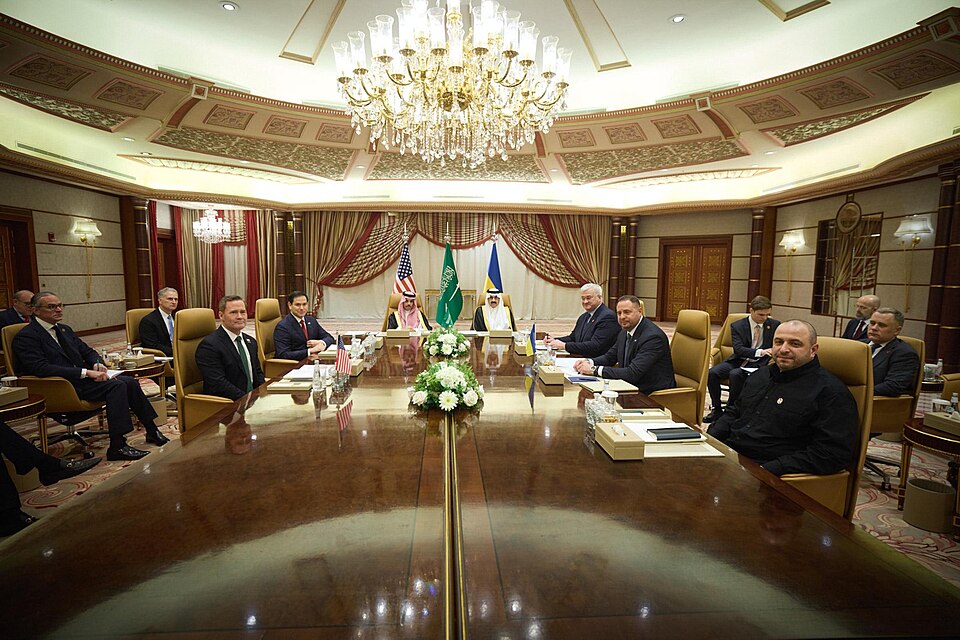
JEDDAH, March 23 — On the same day as the strikes, American and Ukrainian delegations sat down in Jeddah, Saudi Arabia, for ceasefire talks. The US team, led by Secretary of State Marco Rubio and National Security Advisor Mike Waltz, met with Ukraine’s delegation headed by Andriy Yermak, head of the Presidential Office. The talks followed a previous round in Riyadh on March 11, where Ukraine agreed to a 30-day ceasefire proposal.
The Precondition That Blocks Progress
Russia has drawn a hard line. President Vladimir Putin stated on March 13 that any ceasefire must include a guarantee that Ukraine will not be rearmed. The demand is a halt to all foreign military aid to Ukraine as a precondition—a condition Ukraine and its allies reject outright.
Ukrainian President Volodymyr Zelenskyy has insisted on security guarantees from NATO or bilateral agreements before any ceasefire. The gap between these positions is wide, and neither side is blinking.
The strikes on Tatarstan, which occurred the same day as the Jeddah talks, may be intended to increase pressure on Russia during negotiations. Analysts at the Institute for the Study of War (ISW) suggest that Ukraine is using deep strikes to demonstrate its ability to hit Russian infrastructure, potentially strengthening its bargaining position. Ukraine is trying to negotiate from a position of demonstrated capability, not just diplomatic goodwill.
What’s Changing on the Ground
The talks in Jeddah mark a continuation of a process that began in Riyadh on March 11. That earlier round saw Ukraine agree to a 30-day ceasefire proposal, but implementation stalled over Russia’s precondition. The US delegation in Jeddah—led by Rubio and Waltz—represents direct engagement.
The team is pushing for a diplomatic off-ramp, but the details remain contentious. Ukraine’s position has hardened around security guarantees.
Zelenskyy has made clear that no ceasefire can hold without NATO or bilateral agreements that prevent future Russian aggression. The ISW analysis points to a deliberate strategy: deep strikes on Russian infrastructure are not just military tactics but tools to reshape the negotiating table. Russia, meanwhile, insists on a complete halt to arms supplies before any pause in fighting.
The Next Round
The next round of talks is expected in April 2025, with Turkey and the UAE offering to mediate. These mediators have positioned themselves as neutral ground—Turkey has previously hosted negotiations, and the UAE has economic leverage with both sides. The venue and the players are shifting.
The move from Riyadh to Jeddah, and now the prospect of Turkish or Emirati mediation, suggests a diplomatic circuit that is expanding rather than contracting. For now, the facts on the table are these: Ukraine has agreed to a 30-day ceasefire, Russia demands an end to all foreign military aid as a precondition, and the US is directly engaged through Rubio and Waltz.
The ISW analysis underscores that Ukraine’s deep-strike capability is a bargaining chip. The April talks will test whether any of these positions can bend.




