
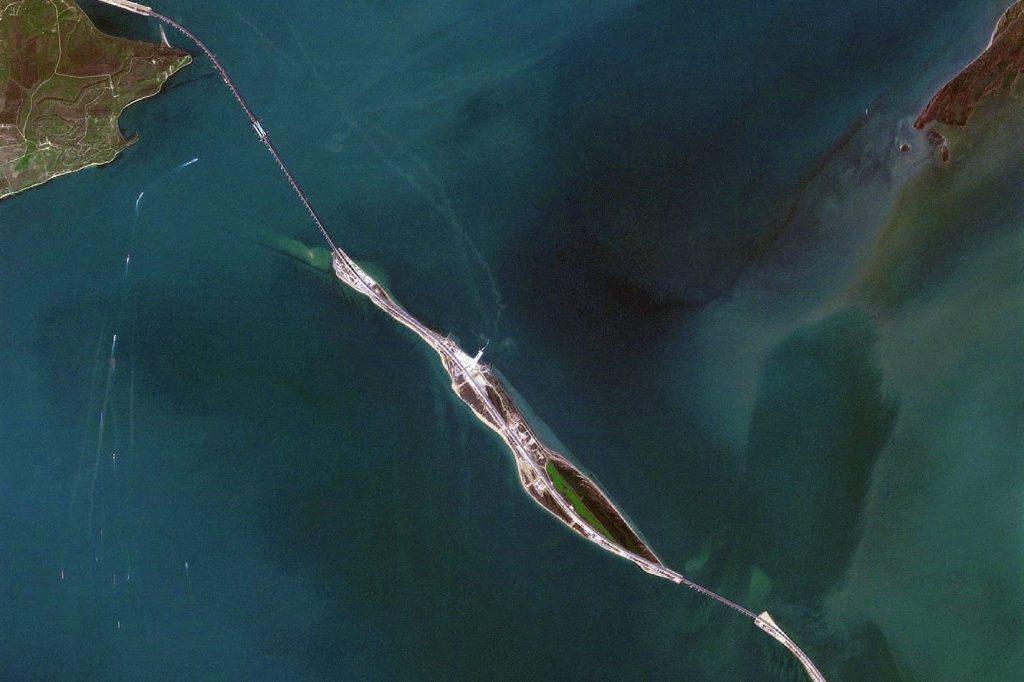
KERCH, July 11 — A Ukrainian strike on 21 tankers has forced Russia to halt shipping through the Kerch Strait, disrupting supply lines and trade through this narrow body of water that connects the Black Sea to the Sea of Azov. The strait is bordered by Russia’s Krasnodar Krai and the Crimean Peninsula, which Russia annexed from Ukraine in March 2014. Approximately 4.5 kilometers wide at its narrowest point, the strait has been under Russian control since the annexation.
The Kerch Strait Bridge, completed in May 2018, now links Crimea to mainland Russia.
Strategic chokepoint
The strait’s depth limits passage to vessels with a draft of up to 8 meters, making it a chokepoint for shipping. It is crucial for Ukrainian ports like Mariupol and Berdyansk, which were captured by Russia in 2022, and for Russian exports of grain and oil. Tensions over the strait are not new.
In November 2018, Russia seized three Ukrainian naval vessels attempting to transit the strait, an incident that escalated the conflict between the two countries well before the full-scale invasion. The recent strike on tankers represents a significant escalation in Ukraine’s ability to target Russian maritime infrastructure.
Officials confirmed the attack has forced a halt to shipping through the key canal, though specific details on the timing and method of the strike remain limited.
Supply lines under pressure
The disruption to shipping through the Kerch Strait directly affects Russian supply lines. The strait serves as a vital artery for moving goods between the Black Sea and the Sea of Azov, and any interruption to traffic there creates logistical problems for both military resupply and commercial trade. Russian exports of grain and oil, which flow through the strait, now face additional uncertainty.
The halt in shipping comes at a time when global markets are already sensitive to disruptions in Black Sea trade routes. For Ukraine, the strike targets a strategic vulnerability that Moscow has long sought to protect.
The Kerch Strait Bridge itself has been a symbol of Russian control over Crimea since its completion, and the surrounding waters remain a flashpoint in the broader conflict. The record shows that the strait’s narrow dimensions and shallow depth make it difficult to secure against determined attacks. With a width of only 4.5 kilometers at its narrowest point, vessels transiting the strait have limited room to maneuver, and the depth restriction of 8 meters for vessel draft further constrains options for shipping.
What to watch next: whether Russia can restore shipping through the strait quickly, and whether Ukraine will continue targeting maritime infrastructure in the region. The Kerch Strait remains a strategic chokepoint where control over shipping lanes translates directly into military and economic leverage for both sides.




