
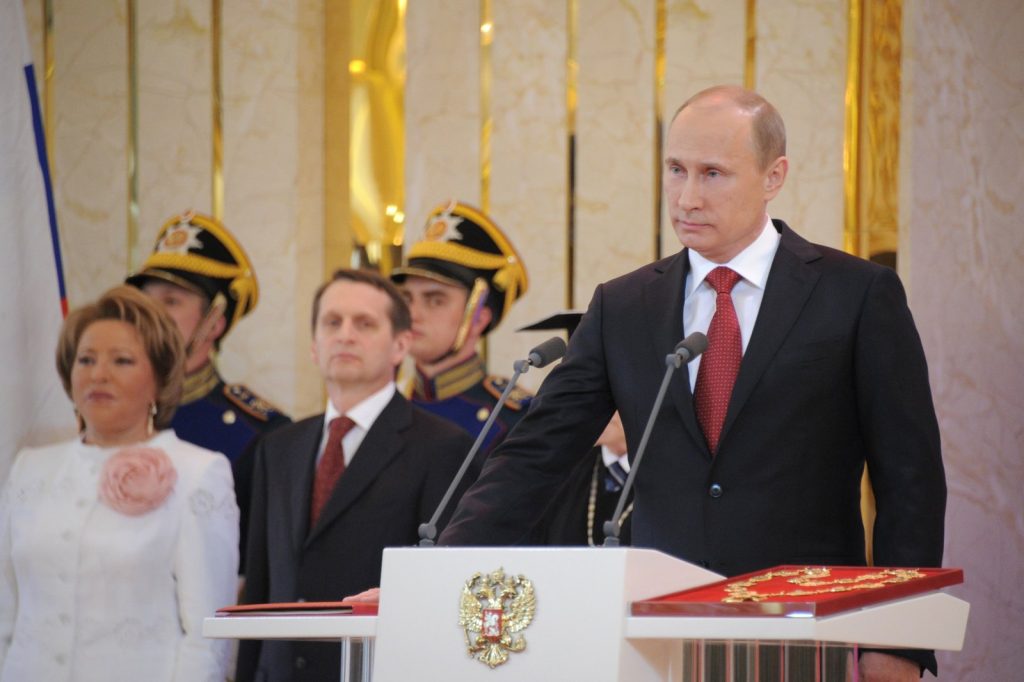
A Career Built on Consolidation
Putin first entered national politics as prime minister in August 1999 under President Boris Yeltsin, stepping into a Russia reeling from economic collapse, political instability, and a brutal war in Chechnya. Within months, Yeltsin resigned, making Putin acting president. Elected in March 2000, he served two consecutive terms until 2008, when constitutional term limits forced him to step aside. He returned as prime minister from 2008 to 2012 under President Dmitry Medvedev, then reclaimed the presidency in 2012. Constitutional changes enacted in 2021 allow him to remain in office until at least 2036.
His career reflects a pattern of consolidating authority at every step. After returning to the presidency in 2012, Putin tightened control over Russia’s political system, using state media, security services, and legal crackdowns on opposition figures to maintain domestic authority. The record shows a leader who positioned himself as a strongman capable of restoring order during a period of national crisis, and who has since defined an era marked by military intervention abroad and sustained confrontation with the West.
War, Sanctions, and Isolation
Putin’s decision to invade Ukraine on February 24, 2022, marked a dramatic escalation from the hybrid warfare that began in 2014. That year, Russia annexed Crimea and fomented a separatist insurgency in eastern Ukraine. The full-scale invasion brought conventional ground combat, aerial bombardment, and a humanitarian crisis that has displaced millions. Putin has publicly justified the conflict as a “special military operation” aimed at demilitarizing and “denazifying” Ukraine.
Under Putin’s leadership, Russia has faced extensive international sanctions and diplomatic isolation, according to officials in multiple capitals. Sanctions have targeted Russia’s energy sector, its central bank, and hundreds of individuals linked to the Kremlin. Diplomatic isolation has included repeated condemnations at the United Nations General Assembly. These measures have not dislodged Putin from power, however, and the war continues, draining resources and lives with no diplomatic resolution in sight.
The 2014 annexation of Crimea and support for separatists in eastern Ukraine drew international sanctions that isolated Russia economically and diplomatically even before the 2022 invasion. The full-scale conflict triggered broader sanctions and deepened global divisions. Putin’s military interventions have included Georgia in 2008 as well as Ukraine in 2014 and 2022, establishing a pattern of using force to project influence beyond Russia’s borders.
No Clear Successor, Lingering War
As of 2024, the trajectory of Putin’s leadership remains uncertain. No clear successor has emerged from within his inner circle or the broader political structure. The war in Ukraine continues with no end in sight, draining both resources and lives. The absence of a clear successor and his continued grip on power mean that decisions on war, diplomacy, and domestic policy remain tightly concentrated in his hands.
For observers, this matters because Putin’s choices directly affect global security, energy markets, and the lives of millions in Ukraine and beyond. The record shows a leader who entered national politics during a period of economic collapse and instability, who rose through the ranks from a career in intelligence and security, and who has since reshaped Russia’s domestic and international landscape. Despite extensive sanctions, diplomatic isolation, and the ongoing human and material costs of war, he remains firmly in control, with no clear path toward a transition of power.




