
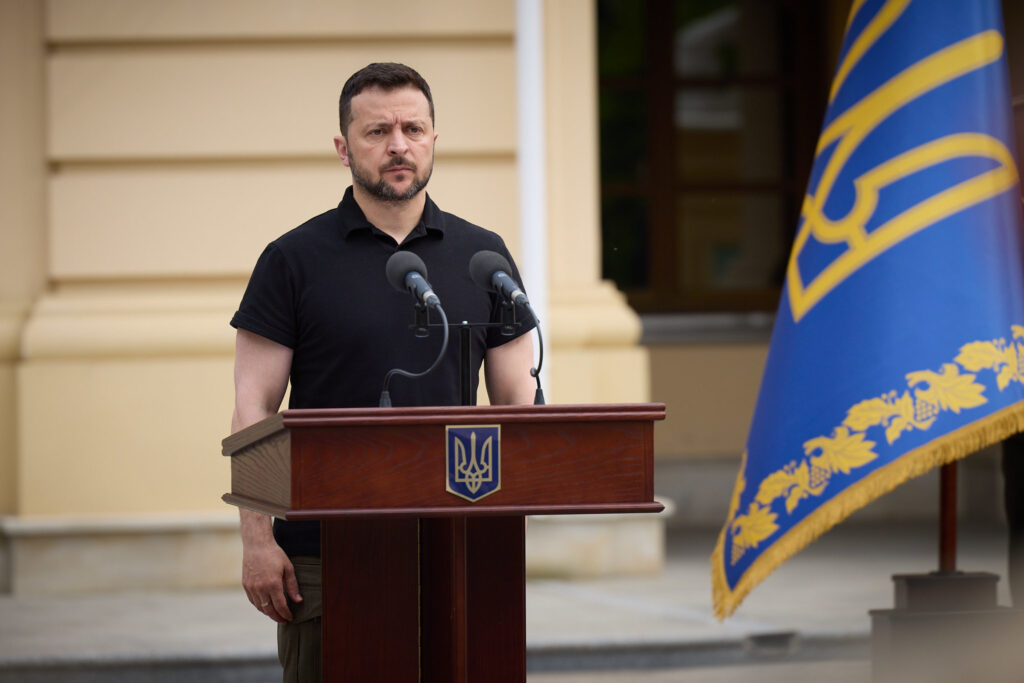
KYIV, July 14 — The mechanics here are straightforward, but the strategic logic is worth unpacking. Volodymyr Zelenskyy, Ukraine’s president since May 20, 2019, has built his wartime leadership around a single, relentless demand: make the war too expensive for Russia to sustain. On closer reading of his record, the method is as much about industrial policy as it is about battlefield tactics.
Zelenskyy took office after winning the 2019 presidential election with 73% of the vote. A former comedian and actor born January 25, 1978, in Kryvyi Rih, he was an unlikely wartime commander.
But since the Russian invasion began on February 24, 2022, he has directed Ukraine’s war effort with a focus on striking Russian energy infrastructure, including authorizing long-range drone strikes on Russian territory. The catch is that Ukraine’s ability to do this at scale depends entirely on Western-supplied weapons and a domestic drone industry that barely existed before the war. Follow the money, or rather follow the production lines.
In 2024, Zelenskyy oversaw the development of Ukraine’s domestic drone industry, which produced the AQ-400 Scythe and other systems. These are not theoretical weapons.
They were used in the January 29, 2025 attacks on the Gazprom Neftekhim Salavat and Ryazan refineries — strikes that hit deep inside Russia and targeted the economic engine of the invasion. The strategy is to impose costs that make the Kremlin question whether the war is worth the price.
The Western Weapons Calculus
Zelenskyy has consistently called for more Western weapons, specifically longer-range missiles. The logic is symmetrical: if Ukraine can threaten Russian refineries, logistics hubs, and command centers, it forces Russia to divert air defenses and resources away from the front lines. But the supply of these weapons has been uneven, tied to political calculations in Washington and European capitals.
The president’s domestic political position remains rooted in the 2019 mandate, but war has reshaped every aspect of governance. His approval ratings, while not a figure in the source material, have been tested by the grinding nature of the conflict.
The January 2025 strikes on the Gazprom Neftekhim Salavat and Ryazan refineries demonstrated that Ukraine’s drone program could reach targets deep inside Russia, but sustaining that capability requires constant resupply and innovation.
What to Watch Next
The question now is whether the domestic drone industry can scale fast enough to offset any slowdown in Western military aid. The AQ-400 Scythe is a relatively low-cost, long-range system, but production numbers and supply chains remain opaque. Zelenskyy’s bet is that a combination of homegrown manufacturing and Western missile deliveries can keep the pressure on Russia’s energy sector through the coming years.
The president’s background as a comedian and actor is often noted as an oddity, but the transition from entertainer to war leader is now a settled fact of Ukrainian politics. The challenge ahead is whether the strategy of making the war costly for Russia can produce a negotiating position — or whether it will simply extend the conflict into another year of attrition.




