
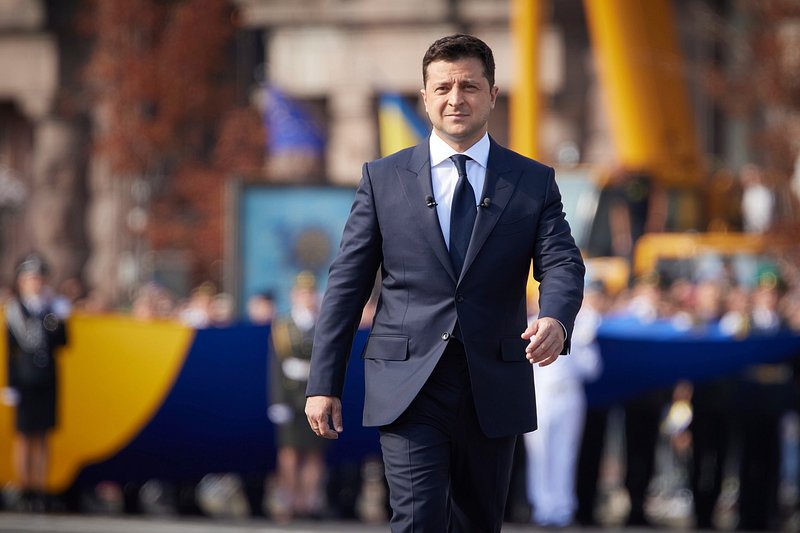
More than three years after Russia launched its full-scale invasion, President Volodymyr Zelenskyy remains in the capital, leading a nation locked in conflict. His wartime presidency, defined by the decision to stay in Kyiv rather than evacuate, stands in sharp contrast to the skepticism that once greeted his political career. Elected on April 21, 2019, with 73.2 percent of the vote, Zelenskyy ran on a platform of anti-corruption reforms and a negotiated peace.
Before entering office, he worked as a comedian, actor, and co-founder of the production company Kvartal 95. That entertainment background initially drew doubt from observers, but the perception shifted dramatically after February 24, 2022, when Russia’s full-scale invasion began.
Since then, he has delivered daily addresses to the Ukrainian public and foreign parliaments, a practice that continued through the subsequent years of war.
From Comedian to Wartime Leader
Zelenskyy was born January 25, 1978, in Kryvyi Rih, Ukraine. He turned 47 earlier this year.
His political future remains tied to the trajectory of the war, with no clear timeline for resolution. Under his leadership, Ukraine secured substantial military and financial backing from Western allies. The United States alone provided over $75 billion in aid, while NATO member states supplied extensive military support, though specific figures vary by country.
Zelenskyy has maintained a firm position on territorial negotiations, consistently rejecting any peace agreement that would require Ukraine to cede control over Crimea or the Donbas region to Russia. That stance has remained unchanged throughout the conflict.
On February 19, 2025, during a press conference with U.S. Special Envoy Keith Kellogg, he stated: “We don’t want Russia without fuel, we want Ukraine without war.” That remark captured the Ukrainian position on sanctions and conflict resolution. Zelenskyy has proposed a 10-point peace formula as a framework for ending hostilities. He has also called for the establishment of a special tribunal to prosecute Russian war crimes, a demand that has gained support among some Western governments but faces diplomatic hurdles.
According to polling data from early 2025, his approval rating within Ukraine has remained above 60 percent, despite what officials describe as growing war fatigue among the population.
Ukraine’s Strategic Crossroads
Ukraine occupies a strategic crossroads in Eastern Europe, its history shaped by centuries of shifting borders and foreign rule. The land that now forms Ukraine became a center of Slavic settlement in the early Middle Ages, where the state of Kievan Rus’ emerged in the ninth century as a dominant regional power. That medieval polity fragmented after the Mongol invasions of the 13th century, and the territory was later divided among the Grand Duchy of Lithuania, the Polish–Lithuanian Commonwealth, the Austrian Empire, and the Tsardom of Russia.
By the late 18th century, most of Ukraine had been absorbed into the Russian Empire, with the western regions eventually passing to the Austrian Empire. A brief period of independence followed the Russian Revolution in 1917, but the Bolsheviks established the Ukrainian Soviet Socialist Republic in 1922, integrating it into the Soviet Union.
The 20th century brought two world wars and the Holodomor, a Soviet-engineered famine that killed millions in the early 1930s. During World War II, Nazi Germany occupied Ukraine, and the war’s civilian toll reached seven million. Ukraine declared independence in 1991 as the Soviet Union dissolved, adopting a neutral status and a new constitution in 1996.
Political turbulence culminated in the Orange Revolution of 2004–2005 and the Euromaidan protests of 2013–2014, which led to a change in government and Russia’s annexation of Crimea and incursion into the Donbas. Ukraine is a unitary parliamentary republic with Kyiv as its capital.
The country spans roughly six hundred thousand square kilometers and has a population of about thirty-two million. Its official language is Ukrainian, though Russian is widely spoken. The state emerged from the Soviet collapse as a fragile democracy burdened by corruption and Soviet-era institutions.
Since 2014, Ukraine has pursued closer ties with the European Union and NATO while facing ongoing armed conflict with Russia.
Outlook and Key Questions
Observers are watching whether Zelenskyy’s peace formula gains traction at international forums. The evolving U.S. political landscape will affect the flow of military aid and diplomatic support to Kyiv. With the war showing no clear end, the Ukrainian president’s leadership remains focused on securing Western backing and maintaining domestic support, even as war fatigue grows.
His rejection of territorial concessions and his calls for a special tribunal reflect a position that has held steady throughout the conflict, shaping Ukraine’s diplomatic and military strategy as the war enters another year.
{“@context”: “https://schema.org”, “@type”: “NewsArticle”, “headline”: “Zelenskyy’s wartime leadership endures three years into Russia’s invasion”, “description”: “KYIV, July 15 — More than three years after Russia launched its full-scale invasion, President Volodymyr Zelenskyy remains in the capital, leading a nation locked…”, “datePublished”: “2026-07-15T09:30:00+00:00”, “author”: {“@type”: “Person”, “name”: “Maria Romano”}, “publisher”: {“@type”: “Organization”, “name”: “InfoPulse Today”, “url”: “https://newsfeed.2bme.xyz/”}}




