
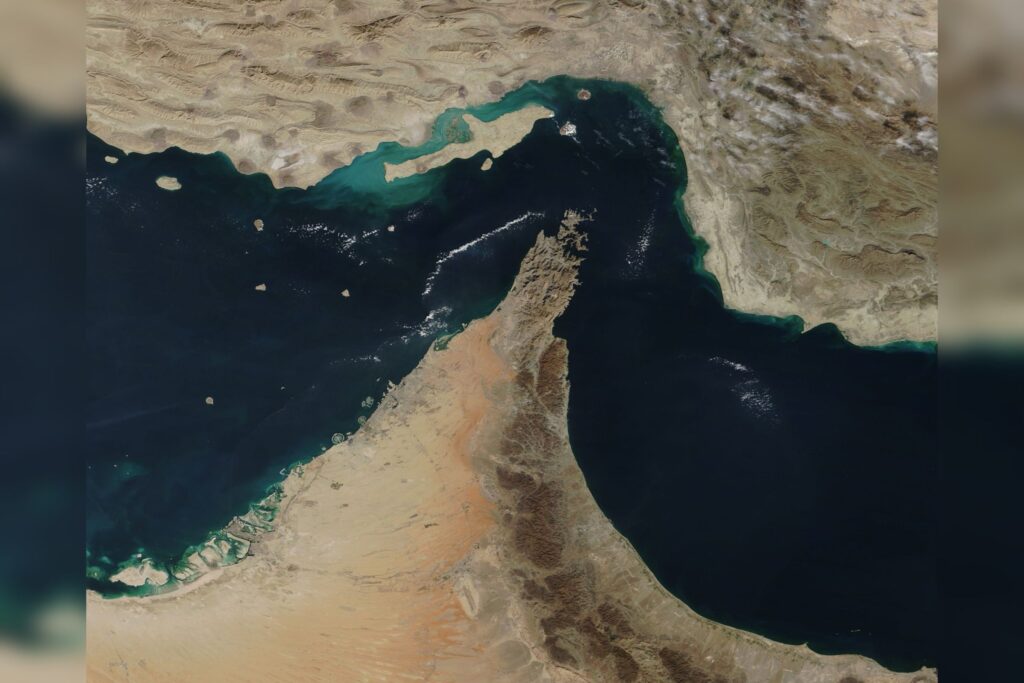
WASHINGTON, August 6 — The legal status of the Strait of Hormuz turns on a treaty Iran signed decades ago, and the record shows Tehran has spent the years since testing its limits. The United Nations Convention on the Law of the Sea, adopted in 1982 and in force since 1994, classifies the Strait of Hormuz as an international strait. Under that classification, all ships and aircraft enjoy the right of transit passage, a right that cannot be suspended or impeded by coastal states.
Iran ratified the convention in 1989. It has nonetheless periodically challenged the convention’s application, particularly regarding foreign military presence in the Persian Gulf.
The legal anchor for that passage regime is Article 35, which explicitly applies to straits used for international navigation between one part of the high seas or an exclusive economic zone and another. Hormuz, the sole maritime outlet for the Gulf, fits that description squarely. The United States has not ratified UNCLOS, but it adheres to its provisions as customary international law.
Washington has consistently rejected Iranian claims to restrict military or commercial traffic in the strait.
A Treaty Tehran Signed
The convention was meant to settle, once and for all, the rules of the road on the world’s oceans. It fixed the legal framework for maritime boundaries, navigation rights, and resource jurisdiction. For a narrow waterway like Hormuz, that framework is not abstract.
It determines whether a foreign navy can move through without asking permission, and whether a coastal state can lawfully interfere. Iran’s position has been complicated from the start.
It signed on to the treaty in 1989, but its periodic objections to foreign military presence in the Gulf suggest a government that accepts the convention in principle and resents its consequences in practice. On the timeline, the pattern is consistent: ratification, then repeated attempts to assert control that the convention does not grant. That is where the 2016 incident enters the record.
The 2016 Detention
In 2016, Iran’s Revolutionary Guard briefly detained 10 U.S. Navy sailors after their boats drifted into Iranian waters. The sailors were released within 24 hours following diplomatic intervention. The detention was short, but it was exactly the kind of episode that exposes the risk inherent in a crowded, strategically vital waterway.
The strait is one of the busiest maritime passages on earth, and the margin for error is thin. A stray boat, a tense crew, a sudden maneuver — any of these can escalate quickly into something neither side intended.
Sources familiar with the dynamic point to a sobering reality: the 2016 episode was not an isolated anomaly, but a symptom of the broader contest over who controls the strait’s rules. Washington’s position has not shifted. The United States continues to treat transit passage as a right, not a privilege to be granted or revoked in Tehran.
For its part, Iran retains the treaty obligations it accepted in 1989, even as it tests the boundaries of those obligations. The convention’s text is unambiguous on the core point: transit passage cannot be suspended or impeded.
What to Watch
The question now is not whether the legal basis for free passage holds. It is whether the pattern of periodic challenges resumes, and how the United States and its partners respond. The 2016 detention was resolved through diplomacy, and quickly.
But the record of the past decade suggests the underlying friction has not gone away. Every transit through Hormuz is, in a sense, a test of the convention’s authority.
For now, the legal framework stands where it has stood for decades. Iran ratified it, the United States honors it as customary law, and the strait remains open to all ships and aircraft under a right that cannot be suspended. The next incident, if it comes, will be the real measure of whether that framework holds.




