
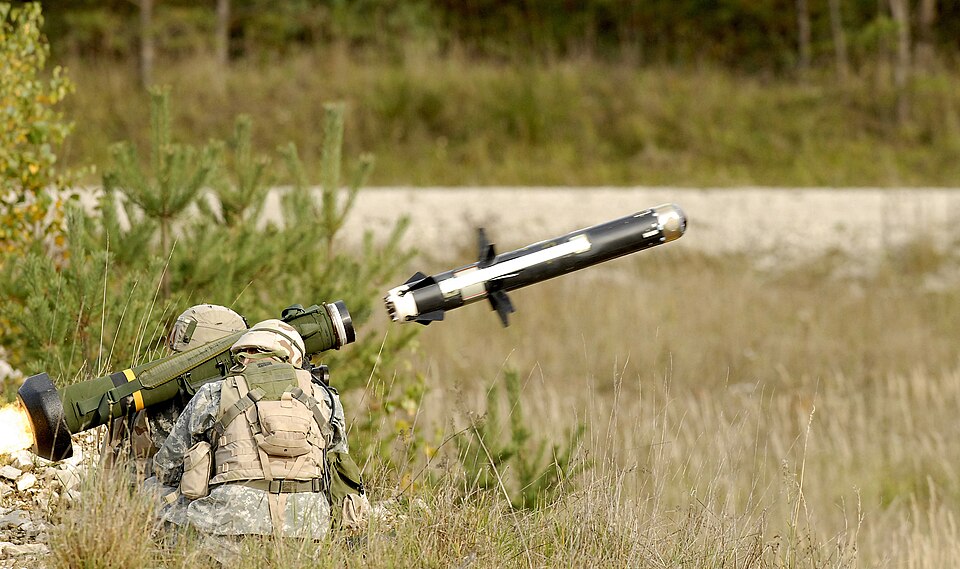
KYIV, Aug. 2 — The shift is hiding in plain sight: the weapon built to kill tanks has become part of the fight for the sky. The Ukrainian military has been using the American-made Javelin missile system to counter Russian air superiority, turning a dedicated anti-armor platform into a multi-role threat. It’s not the only advanced system in play.
But it’s the one that best captures what’s changing on this battlefield. The Javelin, provided by the United States, is a highly effective anti-tank missile with a documented second life against aircraft and other targets.
The numbers tell part of the story: a range of over 2.5 kilometers and the ability to penetrate armor up to 750 millimeters thick. That is enough to punch through the top armor of a main battle tank — and, in the hands of Ukrainian crews, enough to make low-flying helicopters and aircraft treat the near battlefield as hostile territory. Alongside the Javelin, Ukraine has been fielding the HIMARS rocket system, also supplied by Washington.
With a range of over 70 kilometers, it extends the strike envelope deep behind the front line, carrying high-explosive rockets and precision-guided munitions. Put the two systems together and the trend underneath becomes clear.
Precision, not mass, is the through-line of Ukraine’s counter to Russian air power.
A name with a long flight path
The Javelin name itself is a study in reinvention. It traces back to the Roman pilum, the heavy throwing spear of the legions, and forward to the modern sporting javelin of Olympic athletics. In military service, it has been worn before by very different machines: the Gloster Javelin, a British all-weather jet interceptor that served from 1951 to 1968, and a British Army portable surface-to-air missile that also carried the Javelin name.
The American FGM-148 that Ukraine is firing today is an anti-tank missile by design — but its adaptability is exactly what makes the current moment notable. There is a neat irony in that lineage.
The British Javelin was a dedicated anti-aircraft weapon. The American Javelin is an anti-tank weapon now being used against aircraft. The role has circled back to the name, just on a different continent and in a different war.
What to watch
The effectiveness of these systems has been a key factor in Ukraine’s ability to strike Russian targets with precision and effectiveness — and to blunt Russian air superiority. HIMARS, with its reach of over 70 kilometers, keeps supply nodes and command posts inside the danger zone. The Javelin, with its range of over 2.5 kilometers and its 750-millimeter armor penetration, makes the near battlefield unforgiving for both armor columns and low-altitude aviation.
Watch this space. The next phase of this conflict will likely hinge on how quickly both sides adapt.
Russia will search for counters to precision-guided munitions; Ukraine will keep pairing the Javelin’s close-range punch with HIMARS’ long-range weight. The trend underneath is clear: the line between anti-tank and anti-air capability is getting blurrier by the month.




