
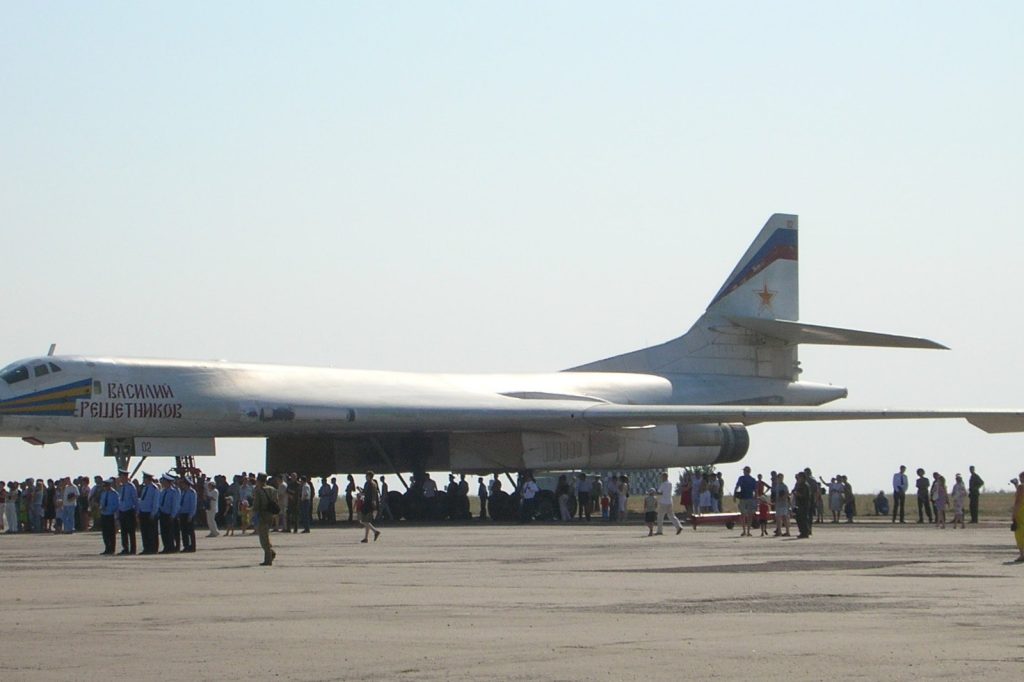
ENGELS, Russia, July 25 — The strategic bomber base at Engels remains the primary western hub for Russia’s Long-Range Aviation branch, the leg of the country’s nuclear triad that provides what military officials describe as a flexible response capability. According to the 2023 Military Balance published by the International Institute for Strategic Studies (IISS), Russia fields approximately 60 Tu-95MS aircraft and 16 Tu-160s, both certified to carry nuclear-tipped cruise missiles.
The facility hosts the 22nd Guards Heavy Bomber Aviation Division and is one of the few bases with the hardened bunkers, fuel storage, and maintenance infrastructure that large strategic bombers require. The bomber leg is the most survivable element of Russia’s second-strike posture.
Unlike fixed silo-based intercontinental ballistic missiles, bombers can be dispersed to alternate airfields during a crisis, launched with short warning, and even recalled after launch. Any damage to Engels, however, could directly reduce the number of operational bombers available for a counterstrike against an adversary, potentially disrupting the entire deterrence posture.
Nuclear certification and combat use
Both the Tu-95MS and Tu-160 are certified to carry nuclear-tipped cruise missiles—the Kh-55 (AS-15 Kent), its conventional derivative Kh-101, and the Kh-102 nuclear variant. Both types have been used in combat with conventional weapons while maintaining their nuclear certification through periodic drills. The Long-Range Aviation branch also includes the Tu-22M3, a nuclear-capable bomber not counted under the New START treaty, to which Russia stopped complying in early 2023.
The fleet today is a fraction of its Cold War predecessor. During the Soviet era, Long-Range Aviation maintained over 600 bombers.
By 2023 the total active strategic bomber fleet numbers fewer than 100. That shrinkage places a premium on the survivability of bases such as Engels, where the remaining aircraft must be protected and kept at readiness.
Command and readiness
The commander of Long-Range Aviation oversees training, maintenance, and operational readiness of the fleet. His responsibilities include ensuring that the bombers can respond on short notice as part of Russia’s assured second-strike strategy. The broader nuclear triad consists of three legs: intercontinental ballistic missiles operated by the Strategic Rocket Forces, submarine-launched ballistic missiles aboard nuclear-powered ballistic missile submarines, and the strategic bombers of Long-Range Aviation.
Because the bomber force is small by historical standards, the impact of any single base being put out of action would be outsized. Hardened facilities and fuel storage at Engels allow sustained operations, but those same assets make the base a high-value target in any conflict scenario.
Military analysts note that the bomber leg remains the most recallable element of the triad—a feature that gives decision-makers more time to assess a threat—but that flexibility depends entirely on the integrity of the basing network.
Strategic context
The status of Long-Range Aviation has drawn renewed attention as the United States continues to modernize its own nuclear deterrent. The IISS figures, published before the current administration took office, remain the most recent open-source accounting of the Russian strategic bomber fleet’s size and capabilities. Looking ahead, the key question is whether Russia can sustain the current bomber fleet’s nuclear certification while drawing down its compliance with New START.
The treaty’s collapse in early 2023 removed the mutual verification regime that had limited each side’s deployed strategic warheads. Now, the readiness of the bomber leg depends almost entirely on internal training cycles and the health of bases like Engels, which must continue to function as a network hub despite potential vulnerabilities.
Any shift in the operational tempo or a significant maintenance failure at the base would likely ripple through the nuclear command chain.




