
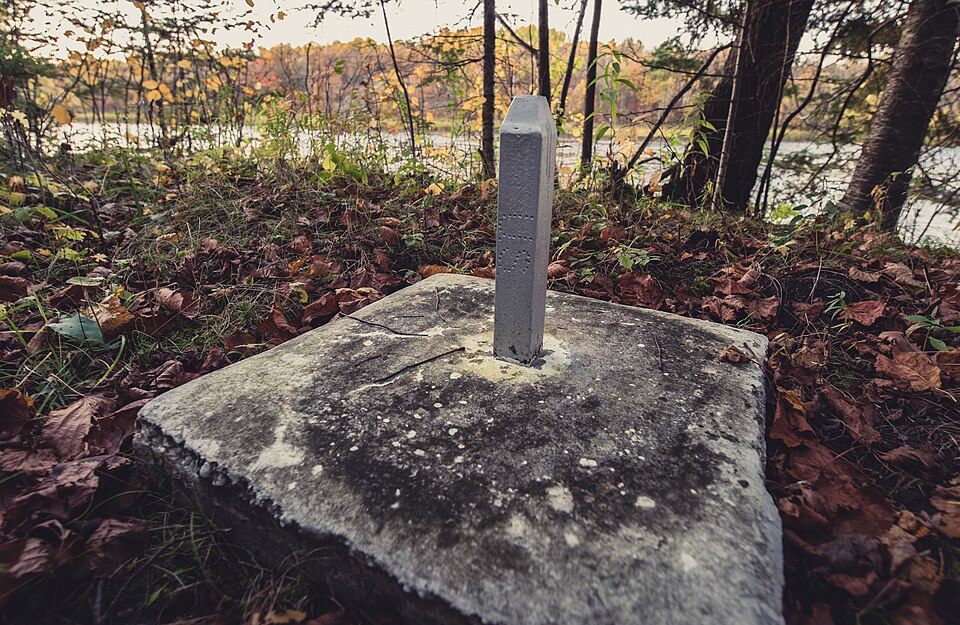
At 8,891 kilometers, the Canada-United States border is the longest undefended international boundary on earth. That length includes two distinct segments: 6,416 kilometers between Canada and the contiguous United States — the second-longest continuous international border globally, behind only the Kazakhstan-Russia line — and an additional 2,475 kilometers separating Canada from Alaska.
What makes the figure remarkable is what is absent: not a single fortification, military installation, or armed garrison lines this frontier. The absence is not accidental; it is the product of a series of treaties that have held for more than two centuries, forming a legal architecture that now underpins North American trade, travel, and security cooperation.
A Border Forged in Diplomacy, Not Conflict
The demilitarization of the border was established by the Rush-Bagot Treaty of 1817, a compact that originally limited naval forces on the Great Lakes and later evolved into a general absence of armed fortifications along the entire boundary. Neither the United States nor Canada has moved to rearm the frontier in the 209 years since the treaty took effect, an arrangement that is unusual among major international boundaries.
The legal foundations go back further still, to the Treaty of Paris in 1783, which ended the American Revolutionary War. That agreement set the northern limit of the new United States along the 45th parallel, the St. Lawrence River, and the Great Lakes. The treaty also attempted to draw a line from the northwesternmost point of Lake of the Woods to the Mississippi River — a line that cartographers later discovered never actually reached the Mississippi.
That geographic problem was resolved by the Treaty of 1818, which fixed the boundary along the 49th parallel from what became known as the Northwest Angle westward to the Rocky Mountains. That deal extinguished British claims south of the line and U.S. claims north of it, a clean territorial trade that shaped the modern map.
Treaties That Shaped the Northern Frontier
The War of 1812 had briefly complicated those earlier agreements, but the Treaty of Ghent, which took effect in 1815, restored all pre-war boundaries, effectively resetting the border to its original treaty lines and erasing any territorial changes the fighting might have produced. Each successive agreement added a layer to the legal framework that remains in effect today: the 1783 Treaty of Paris set the initial northern boundary, the 1818 treaty resolved the western extension, and the Ghent treaty restored the status quo after conflict.
Beyond the boundary definitions, the Rush-Bagot agreement disarmed the entire frontier, and that disarmament has held without interruption. Two binational bodies oversee the border today. The International Boundary Commission, created by the Jay Treaty of 1794, is responsible for maintaining the boundary demarcation.
The International Joint Commission handles boundary waters and shared waterways. Both remain operational, and both operate under a framework that has evolved through successive diplomatic agreements that predate most of the countries on the planet.
Modern Management and the Architecture of Trust
On the ground, management of the border today falls to two agencies: the Canada Border Services Agency on the Canadian side and U.S. Customs and Border Protection on the American side. The diplomatic architecture is notably light on military infrastructure for a boundary of this scale. The Rush-Bagot agreement essentially disarmed the entire frontier, and that arrangement underpins the cross-border movement of goods and people that defines the bilateral economic relationship. The boundary handles daily trade, though specific trade figures are not provided in the underlying treaty framework.
For investors and anyone tracking the architecture of North American trade, the figure that matters is this: the legal architecture remains intact. Any disruption to the treaty framework — whether to the Rush-Bagot demilitarization, the International Boundary Commission’s authority, or the underlying boundary definitions from the 18th and 19th centuries — would carry direct implications for cross-border commerce.
For now, the 8,891-kilometer line stays undefended, managed by customs agencies on both sides and overseen by joint commissions that have been in operation for generations.




