
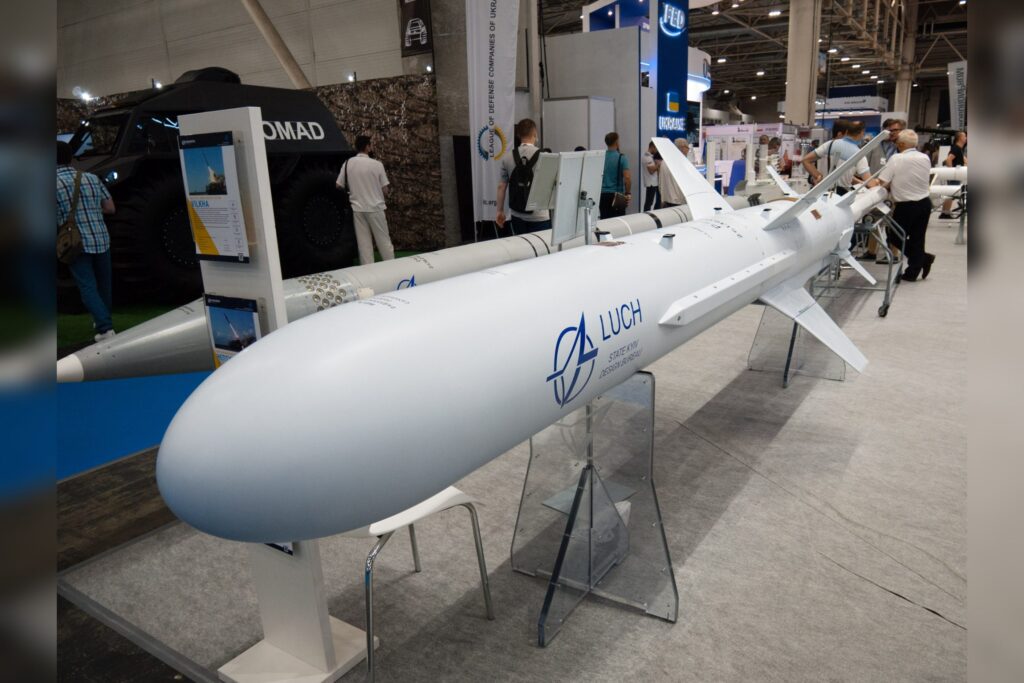
KYIV, July 15 — Ukraine’s campaign to push back the Russian Black Sea Fleet has a two-pronged structure, and the mechanics are worth following closely. The primary weapon systems are the Neptune anti-ship missile and unmanned surface vessels, or USVs. The Neptune, a subsonic cruise missile developed by the state-owned design bureau Luch, has a range of up to 280 kilometers — 174 miles.
It was first tested in 2016 and entered service in 2021. Its most dramatic success came on April 13, 2022, when it sank the Russian cruiser Moskva.
The catch is that the Neptune is not a silver bullet. It is a single component in a layered maritime strategy.
The USV Fleet and Its Targets
The unmanned vessels — the Magura V5 and Sea Baby models — operate differently. They are remote-controlled or autonomous boats packed with explosives. These have been used in attacks on Russian ships and on naval infrastructure, including the Sevastopol naval base in October 2022 and the Kerch Strait Bridge in July 2023.
On closer reading, the USV campaign has a different risk profile than the missile strikes. A missile can be launched from a safe distance; a USV must navigate to its target, often through contested waters.
But the boats are cheaper and harder to defend against in large numbers.
Western Missiles in the Mix
Ukraine has also deployed Western-supplied missiles. The British-French Storm Shadow, with a range over 250 kilometers, arrived in 2022. The US-supplied Harpoon anti-ship missiles, range 130 kilometers, were also provided that year.
The combination is what matters. Each system covers a different tactical gap.
The Neptune and Storm Shadow can reach deep into Russian-held territory or strike ships at anchor. The Harpoon and the USVs offer shorter-range options but with different delivery methods.
Disrupting Naval Operations
The strategic logic is straightforward. By striking Russian vessels at sea and in port, Ukraine disrupts the Black Sea Fleet’s ability to operate freely. That has a direct consequence: protecting the Odesa port for grain exports.
Follow the money. Grain exports are a critical revenue stream for Ukraine’s economy.
A functioning port at Odesa means ships can load and sail. A contested Black Sea means insurers raise premiums, shippers hesitate, and the entire logistics chain slows. The missile and USV campaign is, in effect, an economic defense mechanism as much as a military one.
The question now is whether Ukraine can sustain this mix of systems as stocks of Western-supplied missiles dwindle and Russian air defenses adapt. The Neptune is domestically produced, which gives Kyiv some control over supply.
The USVs are also built in Ukraine, though details of production capacity remain opaque. The Storm Shadow and Harpoon, by contrast, depend on continued Western support. What to watch next is the evolution of Russian countermeasures.
If the Black Sea Fleet pulls back further from Ukrainian strike range, the port of Odesa becomes safer — but the fleet also preserves its remaining assets. If Russia pushes forward with new defenses or longer-range strikes on Ukrainian coastal infrastructure, the calculus changes again. The mechanics here are still in motion.




