
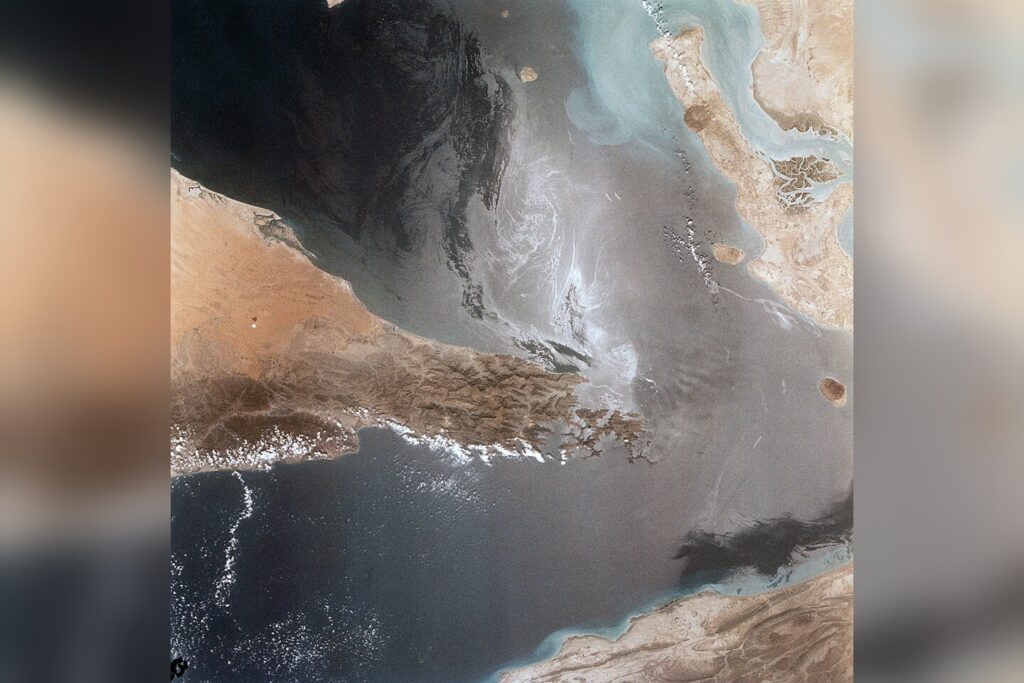
For the first time in its contentious modern history, Iran has formally closed the Strait of Hormuz to maritime traffic, an action that military analysts and energy traders alike describe as a dramatic escalation in a decades-long confrontation. The narrow waterway, which serves as the only sea passage from the Persian Gulf to the open ocean, has been a flashpoint for conflict since at least the Iran-Iraq War, but until now Tehran had never followed through on its repeated threats to block the chokepoint for an extended period.
Geography and Strategic Importance
The Strait of Hormuz links the Persian Gulf with the Gulf of Oman. Iran lies along its entire northern coast; to the south sits the Musandam Peninsula, a territory shared by Oman and the United Arab Emirates. This geography makes the strait one of the world’s most strategically important maritime choke points.
A large share of global liquefied natural gas and seaborne oil moves through the strait each year, making the route critical for energy supplies to Europe and Asia. It is also the sole maritime outlet for several Gulf states, including the United Arab Emirates, Qatar, Bahrain, Kuwait, and Iraq.
Any sustained disruption of traffic there can quickly cause severe supply shortages worldwide, amplifying price volatility in energy markets.
A History of Escalation
The Strait of Hormuz has been a venue for armed confrontation for decades. During the Iran-Iraq War, from 1980 to 1988, both sides attacked oil tankers in what came to be known as the Tanker War.
Iran specifically targeted ships transiting the strait. In response, the United States launched Operation Earnest Will in 1987, reflagging Kuwaiti tankers under American protection and providing escort through the dangerous waterway. More recently, in June 2019, a series of attacks on oil tankers near the strait struck the Front Altair and the Kokuka Courageous.
The United States and its allies attributed those attacks to Iran. In the aftermath, the International Maritime Security Construct (IMSC) was formed, a coalition that includes the United States, the United Kingdom, and Australia, tasked with patrolling the region to safeguard commercial shipping.
The IMSC remains in place today, though its ability to respond to a formal closure—rather than to isolated attacks on individual vessels—has never been tested. Iran has periodically threatened to close the strait in response to international sanctions. In 2011 and 2012, for instance, Tehran warned that it would block the waterway if its oil exports were cut off.
Yet despite those threats, the strait remained open. The current closure is therefore unprecedented in a crucial respect: Iran has never before implemented such a sweeping blockade for an extended period.
While the move echoes historical patterns of escalation, the stakes are now considerably higher because of the global economy’s deep dependence on uninterrupted flows through this single chokepoint.
What This Means for Global Markets
A prolonged closure would ripple through global energy markets in ways that earlier incidents did not. The Strait of Hormuz handles a significant portion of the world’s oil shipments each year.
Any sustained disruption risks pushing up prices at the pump and injecting broader economic uncertainty. The IMSC coalition remains in place, but its capacity to enforce free passage against a formal closure—rather than to deter or respond to attacks on specific ships—is untested. In plain terms, this is not a repeat of 2019 or of the Tanker War.
It is a new phase in a long-running confrontation, one where the stakes are higher because the global economy has not built a backup plan for a strait that has always stayed open—until now.




