
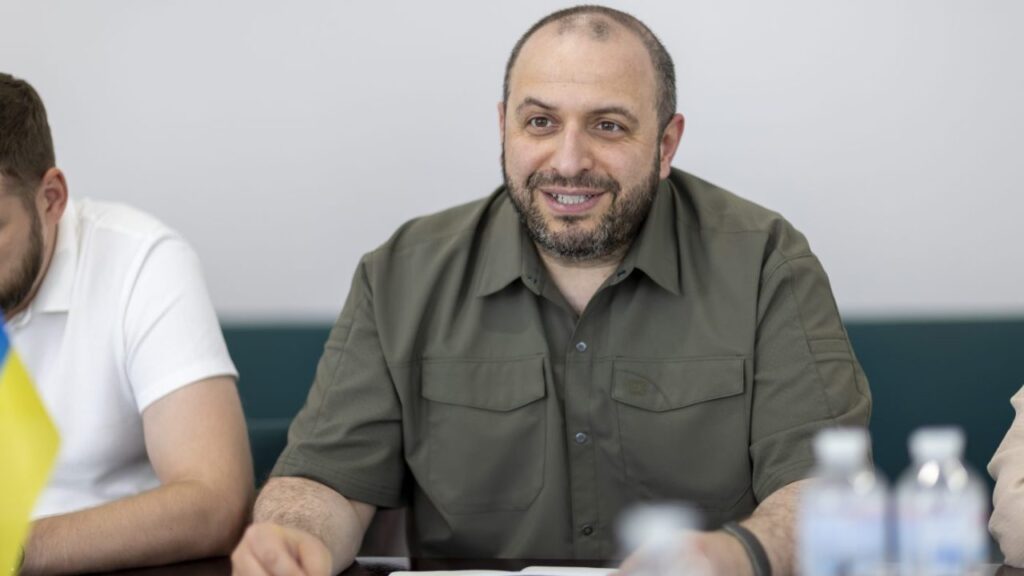
KYIV, July 7 — Ukraine’s Defense Minister Rustem Umerov has emerged as a central figure in Kyiv’s effort to shift the battlefield calculus against Russia, prioritizing domestic drone production and pressing Western allies for long-range missiles. Officials confirmed Umerov’s approach reflects a strategic bet that mass-produced unmanned systems can compensate for shortfalls in conventional artillery and air power. Umerov was born on April 19, 1982, in Samarkand, Uzbek SSR, into a Crimean Tatar family.
He studied at the National Academy of Management in Kyiv before entering politics. From 2019 to 2022, he served as a People’s Deputy of Ukraine, where his portfolio included digital transformation and defense issues.
In September 2023, Umerov was appointed Minister of Defense, replacing Oleksii Reznikov. The change came as Ukraine’s Western backers pressed for greater transparency in defense procurement and a more aggressive push to develop indigenous weapons systems.
Drone production as strategic priority
Under Umerov’s leadership, Ukraine has accelerated its domestic drone manufacturing program. According to the minister’s statement in April 2024, Ukraine produces over 100 long-range drones per month. The record shows these systems have become a cornerstone of Ukraine’s strike doctrine.
The ministry has confirmed that Ukrainian drones have reached targets over 2,000 kilometers away. One notable operation occurred on May 9, 2024, when a Ukrainian drone struck the Omsk refinery in western Siberia.
That facility lies deep inside Russian territory, demonstrating the extended reach of Kyiv’s unmanned systems. Officials confirmed that the Omsk refinery attack was part of a broader campaign to disrupt Russian fuel supplies and logistics. The strike capability represents a significant evolution from the early months of the war, when Ukraine lacked the means to hit targets beyond the immediate front lines.
Negotiating Western arms supplies
Umerov has personally negotiated arms supplies from Ukraine’s Western allies, including the United States, the United Kingdom, and the European Union. According to the record, these discussions have focused on securing long-range missiles to complement Ukraine’s growing drone fleet. The defense minister has called for more long-range missile systems from allied nations.
Officials confirmed that Umerov views these weapons as essential to maintaining pressure on Russian military infrastructure while reducing risk to Ukrainian personnel. The combination of drones and missiles, he has argued, allows Ukraine to strike at multiple nodes of Russia’s war machine simultaneously.
The strategic context is clear. Russia’s defense industry operates from facilities spread across its vast territory, many of which lie beyond the range of Ukraine’s older Soviet-era weapons. Long-range drones and missiles offer Kyiv a way to reach those targets without committing ground forces to costly advances.
Background and rise to defense leadership
Umerov’s background as a Crimean Tatar gives him a personal stake in the conflict. The Crimean Tatar community was forcibly deported from Crimea under Joseph Stalin in 1944, and many families, including Umerov’s, resettled in Central Asia. After Ukraine’s independence, many Crimean Tatars returned to the peninsula.
Russia’s annexation of Crimea in 2014 displaced the community once again. His education at the National Academy of Management in Kyiv provided grounding in both business and public administration.
During his time as a People’s Deputy, Umerov focused on digital transformation, a portfolio that later informed his approach to modernizing Ukraine’s defense sector. The appointment of Umerov in September 2023 signaled a shift in Ukraine’s defense leadership toward a figure comfortable with both technological innovation and the diplomatic demands of securing Western aid. His predecessor, Oleksii Reznikov, had overseen the initial phase of the war, including the successful lobbying for Western tanks and air defense systems.
What to watch next
The trajectory of Ukraine’s long-range strike capabilities will depend on two factors: the continued expansion of domestic drone production and the willingness of Western allies to supply more advanced missile systems. Umerov has positioned himself as the key interlocutor in both efforts. Officials confirmed that the ministry is working to increase monthly drone output beyond the current rate of over 100 long-range systems.
The target, according to defense planners, is to sustain a tempo of strikes that keeps Russian logistics and fuel infrastructure under constant pressure. The diplomatic track remains equally important.
Umerov’s negotiations with the US, UK, and EU will determine whether Ukraine can field a true mix of drones and missiles or must rely primarily on unmanned systems. The record shows that Western allies have been cautious about providing long-range missiles, fearing escalation, but Ukrainian officials have argued that the risk is outweighed by the military necessity. For now, Umerov’s strategy rests on a simple proposition: Ukraine cannot match Russia in artillery shells or armored vehicles, but it can compete in the realm of precision long-range strikes.
Whether that bet pays off will be measured in the months ahead.




