
KYIV, July 7 — The shift in drone warfare is no longer about range alone. It is about brains. Ukraine has quietly built a fleet of long-range strike drones that can now reach deep into Russian territory, and the technology guiding them is evolving faster than the hardware itself.
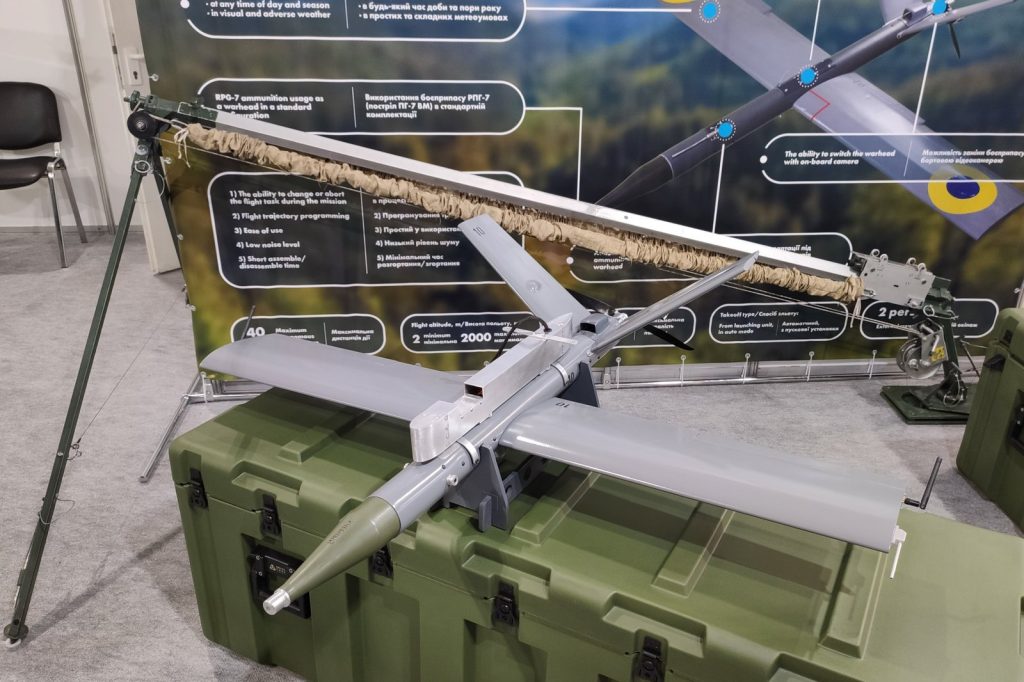
The UJ-22 Airborne, produced by Ukrjet, is one of the key platforms in this arsenal. With a range of up to 1,600 km and a payload of 50 kg capable of carrying high-explosive warheads, it represents a significant leap from the short-range systems that defined the early phases of the war.
But the family of drones is expanding. The modified Tu-141 Strizh, a Soviet-era reconnaissance drone that has been adapted for strike missions, offers a range of over 1,000 km and a 100 kg payload — double the explosive capacity of the UJ-22. The AQ-400 Scythe, a newer Ukrainian design first used in 2024, has a range of 750 km and a 32 kg payload.
Each platform fills a different niche in the strike ecosystem. What is changing is the navigation.
These drones use GPS and inertial navigation as their primary guidance systems. But some models now incorporate artificial intelligence for terminal guidance — the final, most critical phase of the flight path. That is the trend underneath the headlines.
Russia has deployed electronic warfare systems designed to jam drone signals, a tactic that has proven effective against simpler models. Ukraine’s response has been to develop autonomous flight modes that allow drones to complete their missions even when communication links are severed. The AI component means the drone can identify and lock onto its target without needing a live data feed from the operator.
Ukrainian defense minister Rustem Umerov stated in April 2024 that Ukraine produces over 100 long-range drones per month. That production rate, combined with the growing sophistication of the guidance systems, points to a strategic shift in how Ukraine conducts deep strikes.
The Omsk strike, which required a drone with a range of at least 2,200 km, suggests that newer or modified models are already in play. If the UJ-22 Airborne can be pushed beyond its stated 1,600 km range, or if a new platform has entered service, the implications for the battlefield geometry are significant.
The AI Factor
The integration of artificial intelligence into terminal guidance is not a future development — it is happening now. For a drone operator, the most vulnerable moment in a long-range strike is the final approach, when the target’s air defenses are at their most alert and the drone’s communications are most likely to be jammed. AI changes that calculus.
A drone with autonomous terminal guidance can fly its entire mission on inertial navigation and GPS, then switch to onboard target recognition in the last kilometers. It does not need to transmit or receive data.
It does not need a human to steer it onto the target. The electronic warfare systems that Russia has deployed to jam drone signals become far less effective when the drone can complete its mission in full autonomy. This is the shift.
The hardware — the UJ-22, the Strizh, the Scythe — is the visible part of the story. The invisible part is the software that makes them harder to stop.
Production and Range
The production numbers matter. Over 100 long-range drones per month, as stated by Minister Umerov, represents a sustained industrial effort. Each of these drones carries a warhead.
Each one requires a launch site, a flight plan, and a target. The cumulative effect of hundreds of such strikes over months is what changes the strategic picture.
The range question is the other variable. The UJ-22 Airborne can reach 1,600 km, which puts targets like Moscow within range from launch sites in northern or eastern Ukraine. The Tu-141 Strizh, with its 1,000 km range, covers a different set of targets.
The AQ-400 Scythe, at 750 km, is a shorter-range option but still capable of striking deep into Russian-occupied territory and parts of western Russia. But the Omsk strike changes the conversation.
Omsk is over 2,200 km from the nearest Ukrainian-controlled territory. That distance exceeds the stated range of any of the known drone models. The implication is clear: either a known model has been modified to extend its range, or a new model has entered service.
Either way, the trend is toward longer reach. What is changing is the assumption that distance provides safety. For Russian logistics hubs, command centers, and infrastructure deep in the interior, the calculation has shifted.
Drones that can fly 2,200 km are not theoretical. They have been used.
What Comes Next
The combination of increased production, longer ranges, and AI-guided terminal approach creates a new reality for air defense planners. Electronic warfare is no longer a silver bullet. Jamming a drone’s GPS signal does not stop it if the drone has inertial navigation.
Jamming its data link does not stop it if the drone has autonomous targeting. Russia will adapt.
Electronic warfare systems will evolve. Counter-AI measures will be developed. That is the nature of this conflict — a constant cycle of innovation and counter-innovation.




