
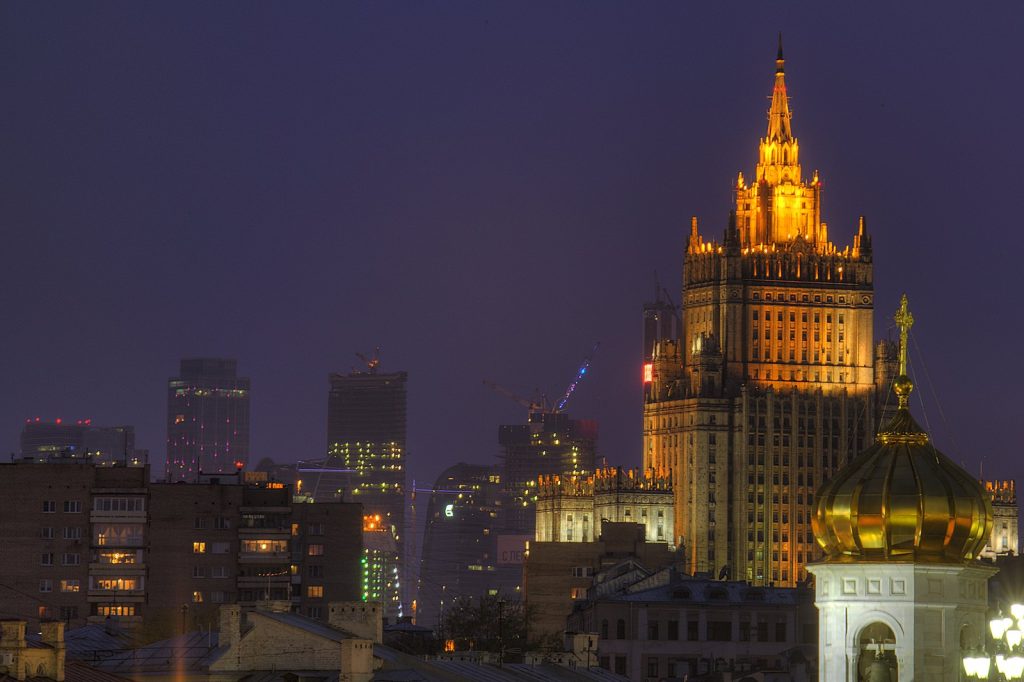
More than three years after Russia’s full-scale invasion, the trajectory of the war has moved beyond the grinding front lines of eastern Ukraine to a different kind of battlefield: the skies over Moscow. Ukrainian President Volodymyr Zelensky, speaking in Kyiv on April 2, 2025, laid out a clear strategic vision for what he believes could fundamentally alter the conflict’s course.
In a press conference, he stated that launching 1,000 drones over the Russian capital would change the calculus of President Vladimir Putin, asserting that the skies will determine the outcome of the war. The figure represents a deliberate threshold — a scale of attack that would overwhelm even Moscow’s layered air defenses, forcing Russian leadership to confront the direct costs of continuing the war in a way that fighting in the Donbas or Crimea has not.
A New Threshold in the Air War
The psychological and strategic weight of striking an enemy capital is profound. Moscow is not merely a large city; it is the political heart of Russia, first documented in the twelfth century, later restored as the capital in 1918 after the Russian Revolution, and the center of the Soviet Union. Today it remains the seat of the Russian government, home to the Kremlin, and the official residence of President Vladimir Putin.
For any military commander, threatening such a symbol of national power carries implications far beyond tactical damage. Zelensky’s framing of 1,000 drones is not arbitrary; it represents a volume of incoming threats that Russian air defenses, however sophisticated, would struggle to intercept fully.
The calculus Putin must weigh, in Zelensky’s view, is whether the cost of continuing the war outweighs the price of ending it. Ukraine’s drone strikes have already reached Moscow on multiple occasions. A significant attack on August 30, 2023, disrupted flights at three major Moscow airports, demonstrating that the capital is within range. These operations have tested the city’s defenses and shown that Ukraine can strike at the heart of Russian power.
For Zelensky, the message is clear: mass drone strikes on Moscow could be decisive, shifting the war from a defense of Ukrainian territory to a direct threat against Russia’s center of command, economy, and national identity.
Ukraine’s Wartime Drone Revolution
Ukraine’s drone program stands as a case study in wartime innovation. Before Russia’s full-scale invasion on February 24, 2022, the country had a modest aerospace sector. The invasion forced a rapid pivot.
Ukraine now produces long-range attack drones, including models such as the Liutyi and the UJ-22 Airborne. The scale of this industrial shift is striking.
According to Ukrainian Defense Minister Rustem Umerov, in 2024 Ukraine increased its drone production to over 1 million units annually. These drones have been deployed not only against Moscow but also against other strategic sites, demonstrating a growing capability to strike deep inside Russian territory. The war, which began with tanks rolling across Ukraine’s borders, has evolved into a contest of industrial production, drone swarms, and electronic warfare.
This transformation carries sobering implications for European security. The conflict has already reshaped defense policy across the continent, and the ability to produce drones at scale has become a critical factor.
The coming months will reveal whether Ukraine can sustain and expand its production to meet Zelensky’s stated goal of 1,000 drones over Moscow.
The Strategic Calculus of Striking Moscow
The diplomatic track remains frozen. No peace negotiations have taken place since early 2023, and both sides have dug in for a protracted conflict.
The war has resulted in tens of thousands of casualties and widespread destruction across Ukraine. Without a shift on the battlefield, there is little reason to expect a return to the table. Zelensky’s gambit is that the threat of mass drone strikes on Moscow may be the lever that finally moves Putin.
A mass drone attack would force Russian leadership to confront the war’s direct costs in a way that fighting in the Donbas or Crimea has not. It would test the layered air defense systems protecting the city and potentially alter the calculus of continued escalation.
The significance of this development is that it marks a shift in Ukraine’s strategy from defending its own territory to threatening Russia’s center of power. The ability to launch hundreds of drones over Moscow would represent a major escalation in the means of warfare, moving the conflict from the front lines into the daily lives of Russia’s civilian population and political elite. The world watches a conflict that has already reshaped European security, defence policy, and the very nature of modern warfare.
The skies over Moscow, once a symbol of unassailable power, may yet become the arena where this war’s final chapter is written.




