
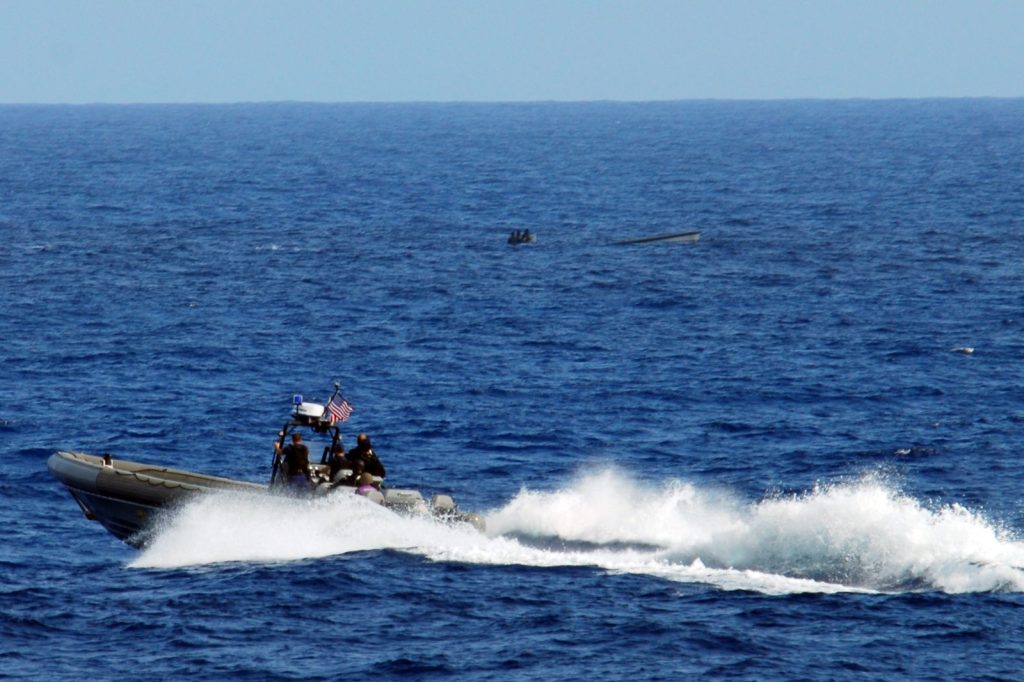
Five people died when a U.S. Navy airstrike sank a small, high‑speed vessel in the eastern Pacific. The boat, described as a “go‑fast” craft used by cocaine traffickers to move product from South America toward Central America and Mexico, was struck by precision‑guided AGM‑114 Hellfire missiles launched from the aircraft carrier USS Carl Vinson. Maritime patrol aircraft had tracked the target for hours before the strike order was issued, and U.S. Southern Command later confirmed that all five occupants were killed, with no survivors reported.
This operation diverges from the usual interdiction approach employed by the Navy and Coast Guard. Typically, authorities intercept such vessels, board them, seize the narcotics, and take the crew into custody. In this case, the vessel was destroyed and its crew killed, marking a clear escalation in tactics. Southern Command spokesman Captain Michael A. Johnson said the action aimed to disrupt the flow of narcotics that “fuel violence and instability,” but analysts note the shift also reflects practical considerations.
High‑speed pursuits and boardings expose American sailors to risk and consume significant time and resources—processing detainees, offloading contraband, and completing paperwork can tie up assets for days. A Hellfire strike resolves the situation quickly and definitively. By killing suspected smugglers rather than arresting them, the Navy alters the deterrent calculus for cartels: a lost shipment is a routine cost, while losing a crew to a missile launched from an unseen aircraft introduces a far steeper penalty.
The choice of platform underscores the new posture. The USS Carl Vinson is a Nimitz‑class carrier designed for power projection against near‑peer adversaries, not for chasing speedboats. Deploying it for this mission signals that the Navy is prepared to bring overwhelming force to bear on what has traditionally been a law‑enforcement problem. Consequently, the boundary between military action and policing in international waters is becoming less distinct.
Critics are likely to raise due‑process concerns. The five individuals killed had not faced trial; they were deemed threats based on surveillance and intelligence. The legal framework for lethal force in international waters remains ambiguous, and the Navy’s description of the boat as a “known” trafficking platform relies on classified information.
For transnational criminal organizations, the math has worsened. They now lose not only product and vessels but also personnel. Whether this will compel them to alter routes, adopt different tactics, or simply absorb the losses as another expense of a violent trade remains uncertain. The eastern Pacific is vast, and a single sunk boat represents only a tiny fraction of total traffic. Yet the significance lies in the message: the Navy has demonstrated a willingness to shoot to kill, not merely to stop. This establishes a new baseline, meaning that any future go‑fast boat captain who spots a patrol aircraft overhead will have to consider whether minutes remain before a missile strike.




