
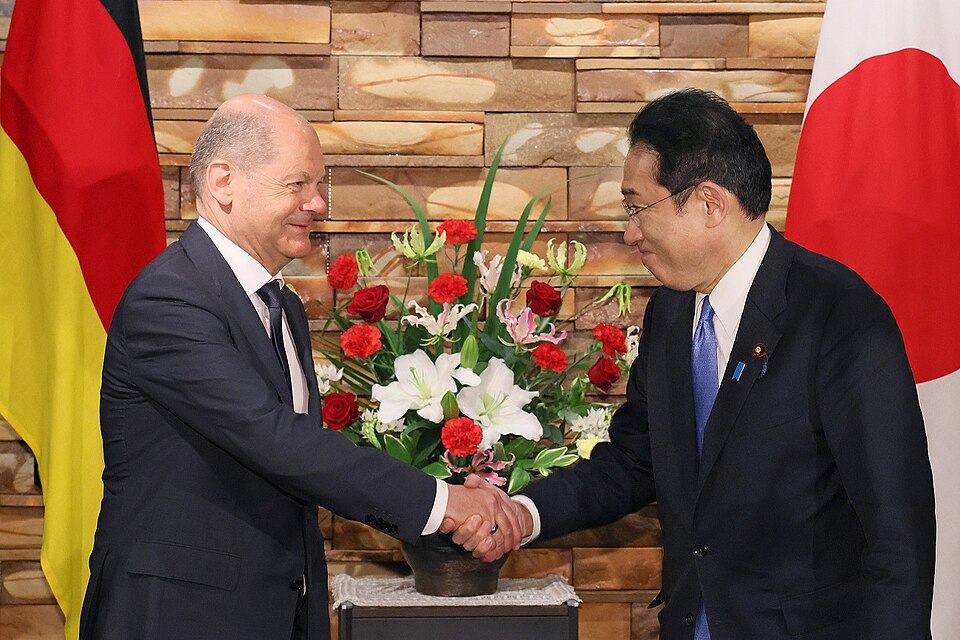
On 18 March 2023, German Chancellor Olaf Scholz travelled to Tokyo for the inaugural joint cabinet‑level talks between the two G‑7 nations. Accompanying him were six German ministers who spent the day negotiating a formal agreement aimed at insulating critical supply chains from coercion, price volatility and the type of weaponised trade that Russia has employed since its invasion of Ukraine. The treaty, signed that evening, obliges both governments to coordinate export‑control legislation, exchange intelligence on raw‑material shortages and create shared stockpiles of rare‑earth minerals, microchips and lithium‑ion batteries.
Germany, whose export‑driven economy still depends on China for 46 % of its rare‑earth magnets, 41 % of its lithium and roughly 20 % of automotive chips, sees the pact as a step toward reducing that reliance. Scholz told reporters that the pandemic and the war in Ukraine have highlighted the risks of excessive economic dependence in strategic sectors.
Fresh from a turbulent EU summit on China policy, he said Berlin would respond by diversifying with Japan and other partners. Japanese officials disclosed that Germany requested priority access to a national stockpile of 1,800 tonnes of dysprosium and neodymium stored in depots from Hokkaido to Kyushu. In exchange, Tokyo seeks German expertise on hydrogen‑ready steel furnaces and recycled‑battery chemistry.
Economy Minister Robert Habeck set a target of cutting China’s share of Germany’s critical‑mineral imports to below 30 % by 2027. Industry representatives caution that the timeline is tight; constructing a non‑Chinese rare‑earth separation plant within the EU is projected to take at least four years and cost €1.2 billion.
Semiconductors and Batteries as Strategic Priorities
The joint statement identifies semiconductors and batteries as “strategic areas” for cooperation. Japan holds about 30 % of the global market for photoresists, the chemicals used to etch advanced chips, while Germany’s Infineon is Europe’s largest producer of automotive semiconductors.
Under the agreement, Infineon and Japan’s Rapidus will exchange process data to accelerate development of 2‑nanometre nodes, and both governments will fund a pilot production line in Dresden slated to produce its first test wafers next year. Battery cooperation is deemed even more urgent. Europe anticipates a demand of 1.3 TWh of batteries by 2030, requiring roughly 400,000 tonnes of lithium—an element Germany does not currently refine.
Japanese trading house Sojitz and chemical group Hanwa have pledged to back a refinery in Hamburg that will import brine from Argentina and Chile, apply Japanese membrane technology, and supply lithium carbonate to manufacturers such as BMW and Tesla’s Berlin gigafactory. Prime Minister Fumio Kishida said the partners aim to “increase cooperation in strategic areas … to build a resilient supply chain that is safe and sustainable.”
Security Dimension and Military Logistics
Beyond commercial matters, the accord outlines a “legislative framework for bilateral defence and security cooperation,” permitting logistical support without constituting a mutual‑defence treaty. The language would allow German navy tankers to refuel at Japanese bases during Indo‑Pacific patrols and enable Japan’s Self‑Defence Forces to utilise NATO air‑lift assets.
The provision mirrors Japan’s 2022 logistics pact with Australia and stops short of sharing intelligence on Chinese troop movements. German Defence Minister Boris Pistorius described the arrangement as a natural extension of shared interests in freedom of navigation. His Japanese counterpart, Yasukazu Hamada, referenced Germany’s 2021 deployment of the frigate Bayern to the South China Sea as evidence of Berlin’s willingness to balance Beijing’s assertiveness.
China’s foreign ministry reacted quickly, warning that “exclusive groupings” would heighten confrontation and destabilise the region.
Industry Reactions and Next Steps
German automakers—Volkswagen, BMW and Mercedes‑Benz—quietly opposed any clause that might provoke retaliation from China, where each sells more cars than in its home market. A senior VW board member told Nikkei Asia that diversifying minerals away from China is essential, yet the Chinese market remains indispensable, requiring a “dual‑track strategy.” Berlin has pledged a €9 billion fund to reshore battery production, conditional on firms reducing Chinese exposure.
Japanese manufacturers face similar calculations: Toyota produces one in three of its vehicles in China, while Nissan relies on Chinese partners for 55 % of its cobalt. Both governments will establish an early‑warning system for export bans, modeled on the EU’s 2022 silicon‑embargo alert, to give factories a 90‑day window to switch suppliers. The treaty now proceeds to parliamentary approval. Japan’s ruling coalition holds sufficient votes, while Germany’s three‑party coalition must persuade Greens and Liberals that overseas mining subsidies align with climate goals.
If ratified, joint delegations plan visits to Canada, Australia and South Africa this summer to evaluate lithium, nickel and cobalt projects for co‑investment. A follow‑up summit is slated for Munich in early 2024.
Scholz departs Tokyo with a diplomatic win after domestic criticism of his China policy, but the real test will be whether German and Japanese firms can shift orders away from cheaper Chinese sources amid looming recession risks. The symbolism is clear: two export powerhouses that once courted Beijing are now aligning to safeguard their economies against future shocks, be they a Taiwan blockade or another pandemic.




