
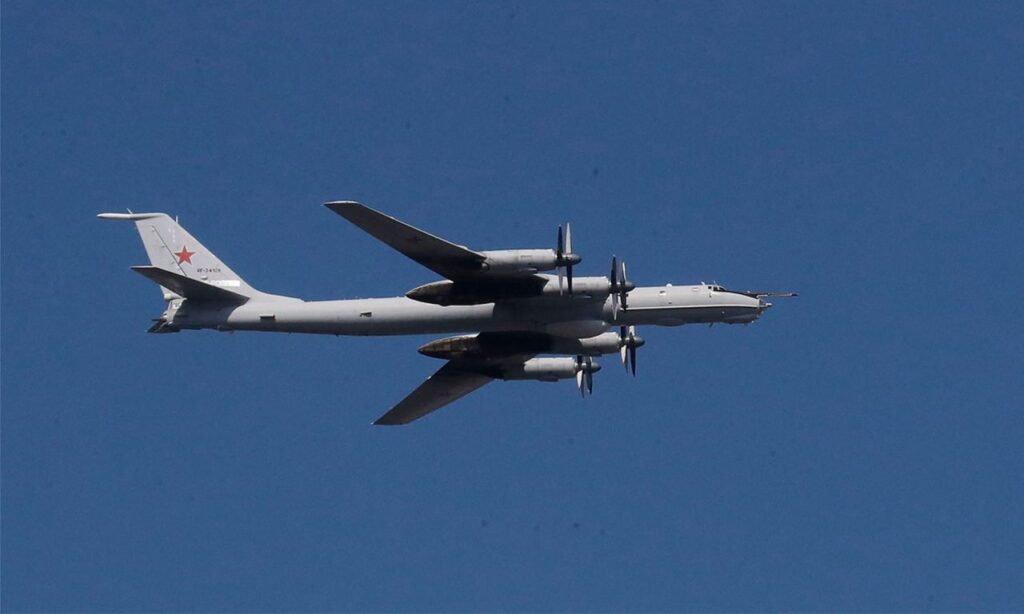
WASHINGTON, July 25 — The mechanics of nuclear deterrence rest on a three-legged structure known as the triad, and one of those legs — the strategic bomber — is the subject of renewed focus as tensions in international conflicts simmer. A nuclear triad combines land-based intercontinental ballistic missiles (ICBMs), submarine-launched ballistic missiles (SLBMs), and strategic bombers armed with nuclear bombs and missiles. The logic is straightforward: by spreading nuclear forces across three distinct platforms, a country eliminates an enemy’s ability to destroy all of them in a first-strike attack.
That preserves the ability to launch a second strike, and that, in theory, strengthens deterrence. Four countries are known to operate a full triad: the United States, Russia, India, and China.
The United States and the Soviet Union each built theirs during the Cold War nuclear arms race, with SLBMs coming online in the 1960s. India achieved a triad in 2018. China did so in 2020.
France once had a triad but abandoned its strategic bombers, IRBM underground silo-based S3 missiles, and Hadès SRBMs in 1996. The United Kingdom, despite becoming the third nuclear power in 1952, has never operated a triad.
Israel likely possesses weapons that fit a triad structure, but on closer reading, it lacks true strategic range in all three legs.
Strategic Bombers: Flexibility With a Catch
The bomber leg was the first developed, and it offers greater flexibility in both deployment and weaponry. Bombers can be deployed and then recalled quickly in response to last-minute decisions. That recallability also allows for visible de-escalation: sending bombers away from targets sends a clear signal.
But the catch is that bombers can carry both nuclear and conventional weapons. That dual capability can cause confusion — an enemy might suspect a conventionally-armed bomber is nuclear, which could encourage an attack or even a nuclear strike.
Scrambling bombers can also escalate tensions rather than calm them. Bombers can serve as both first- and second-strike weapons. A bomber armed with AGM-129 ACM missiles could be considered a first-strike weapon, for example.
Bombers that require aerial refueling to reach their targets constitute second-strike weapons. And if dispersed across small airfields or aboard an aircraft carrier, bombers can avoid a counterstrike, providing regional second-strike capacity.
Russia’s Bomber Force in Context
Russia’s strategic bombers are an integral part of its nuclear deterrent triad. That integration matters because any discussion of bomber capability must account for the full triad picture. The country’s bomber fleet, like its land- and sea-based missiles, is part of a system designed to ensure a credible second-strike option, even as the deployment of those bombers can generate its own risks.
What to watch next: As nations modernise their nuclear forces, the bomber leg’s dual conventional-nuclear role remains a potential source of miscalculation. The ability to recall bombers offers de-escalation, but the same feature can be read as a provocation in a crisis — a fine line that strategic planners have to walk, and that adversaries will keep watching closely.




