
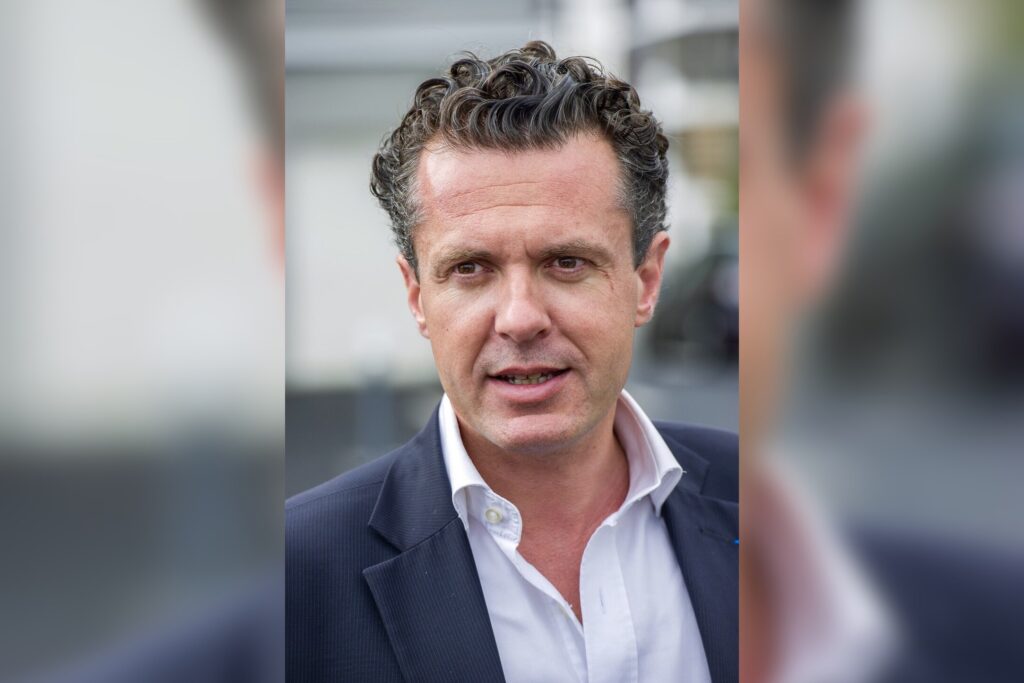
When Christophe Béchu took office as France’s Minister of Ecological Transition and Territorial Cohesion in the summer of 2022, he inherited a portfolio that sits at the intersection of sweeping national ambition and the everyday realities of local governance. The 48-year-old, born in 1974, now carries responsibility for implementing the Climate and Resilience Act — a broad law that embeds environmental concerns into economic and social life — as well as overseeing the National Low-Carbon Strategy, the country’s roadmap toward carbon neutrality by 2050.
That goal requires structural transformation across transport, housing, industry, agriculture and energy, and Béchu’s role demands coordination across ministries, negotiation with regional authorities, and defending the timeline against critics on both sides of the speed debate.
A Career From Local to National
Béchu’s path to the national cabinet reflects a classic French political trajectory: a local leader who rises through competence and longevity. He first entered elected office in 2001, representing a district of the city of Angers.
His rise was rapid: in 2004 he became president of the Maine-et-Loire department council, a post he would hold for a decade. Between 2009 and 2011 he also served briefly in the European Parliament. A narrow loss in the 2008 Angers mayoral race temporarily slowed his ambitions, but he rebounded in 2012 to become mayor of that mid-sized Loire Valley city, a position he held for ten years until joining the national government.
During those same years, from 2014 to 2022, he simultaneously represented the Maine-et-Loire department in the French Senate. That dual experience — executive authority at the municipal level and legislative work in the upper house — gave Béchu a grounded understanding of how national environmental goals land in local communities.
Under his tenure as mayor, Angers became known for green policies including expanded public transport and urban green spaces. Those achievements helped build his reputation as a technocratic, results-oriented politician. Now at the ministry, Béchu brings that local sensibility to the heart of government, aware that the ecological transition is not an abstract ideal but something that plays out in the daily lives of mayors, business owners, and citizens across cities like Angers, Lyon, and Marseille.
Key Policies: Advertising Ban and the 2050 Horizon
One of the most visible measures in Béchu’s portfolio is the ban on fossil fuel advertising, a provision within the Climate and Resilience Act. In September 2022, Béchu publicly stated that the ban is “necessary to accelerate the transition to a low-carbon economy.” The policy represents one of the more direct efforts to reshape public messaging around energy consumption, and its implementation falls under the minister’s oversight.
The broader framework, however, is the National Low-Carbon Strategy, France’s formal plan for reaching carbon neutrality by mid-century. The strategy touches every sector of the economy, and the stakes are substantial: structural transformation at a time when the country faces economic headwinds and a fragmented political landscape. Béchu acknowledges that the timeline is challenging; he must defend it against those who argue it is either too fast or too slow. His steady, technocratic style may be precisely what is needed to maintain momentum.
Political Home and Broader Context
Béchu’s political allegiance has evolved. He began in the centre-right Union for a Popular Movement, later the Republicans.
In 2021 he became secretary general of Horizons, the party founded by former Prime Minister Édouard Philippe. That centrist positioning places him distinct from both the far-right and the left, and allows him to operate across a swath of the political spectrum as he coordinates environmental policy with ministers, regional authorities, and local leaders. His career now includes office at every level of French government — city hall, the department council, the Senate, the European Parliament, and finally the national cabinet.
That breadth of experience matters because the policies he oversees touch the daily lives of citizens, and he understands the practical challenges of implementation at the ground level. The coming months will test Béchu’s ability to keep the country on course toward 2050.
Economic pressures and a fractured parliament could slow progress, but the minister’s pragmatism — honed over two decades of public service — may help navigate those obstacles. The fossil fuel advertising ban, the National Low-Carbon Strategy, and the push for carbon neutrality are not simply Parisian directives; they are policies that must be realized in communities across the country, and Christophe Béchu is the official tasked with making that happen.




