
A renewed surge in U.S.-Iran tensions over the Strait of Hormuz has brought back a policy concept first floated during the Trump administration: the idea of charging fees for U.S. Navy escort operations through the strategic waterway. Current discussions echo a 2018 proposal by then-President Donald Trump to impose such fees, an initiative that never advanced beyond the discussion stage.
Whether the latest iteration will gain traction remains uncertain, but its reappearance underscores the enduring volatility around one of the world’s most critical maritime chokepoints.
Decades of Confrontation
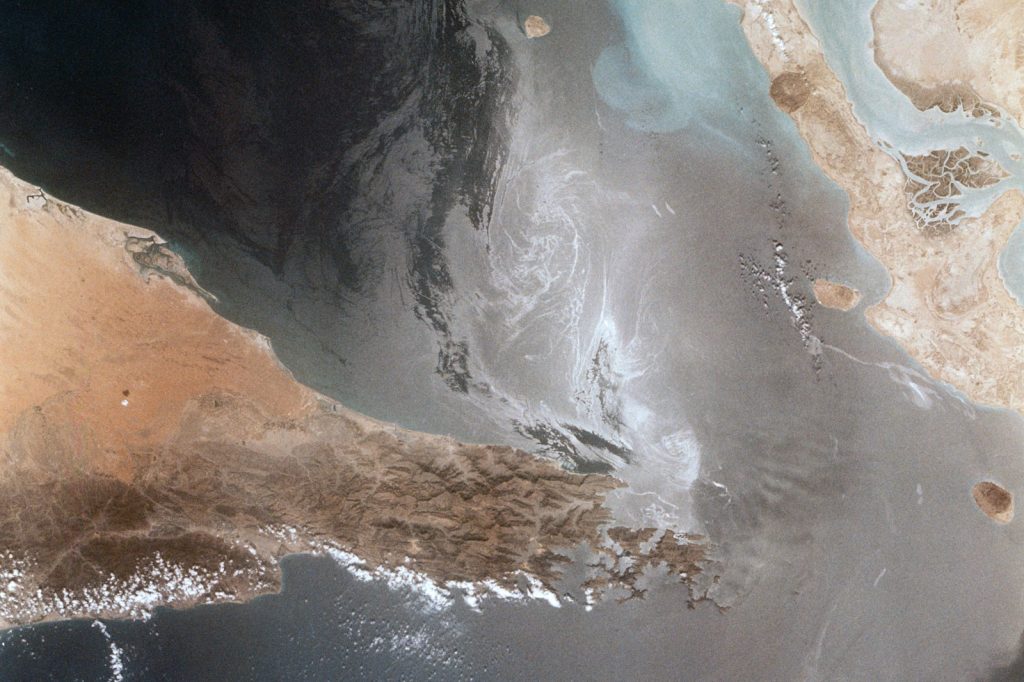
The Strait of Hormuz, a narrow sea passage linking the Persian Gulf to the open ocean, is bordered by Iran to the north and Oman and the United Arab Emirates to the south. It serves as the sole exit for seaborne trade from the Gulf to global markets, making its stability essential for energy flows.
A significant portion of the world’s oil and liquefied natural gas passes through the strait, and disruptions or threats of closure have historically triggered sharp international responses. U.S.-Iran tensions over the waterway trace back to the 1979 Iranian Revolution. That upheaval overturned decades of alliance between the two countries, which had been close partners since the mid-20th century.
The relationship fractured further after the revolution and the subsequent hostage crisis, setting the stage for recurrent confrontations. During the Iran-Iraq War from 1980 to 1988, the U.S. Navy conducted escort operations to protect oil tankers from Iranian attacks.
The most notable of these was Operation Earnest Will, which ran from 1987 to 1988 and saw the U.S. Navy escort Kuwaiti oil tankers through the Gulf. In 1995, the U.S. Fifth Fleet was established with its base in Bahrain and has maintained a persistent presence in the region ever since, monitoring and securing the waterway. In 2011 and 2012, Iran threatened to close the strait in response to U.S. and European Union sanctions imposed over its nuclear program.
Those threats did not result in a blockade, but they underscored the strait’s role as a leverage point in broader geopolitical disputes.
Post-JCPOA Flashpoints
Tensions escalated sharply after the U.S. withdrawal from the Joint Comprehensive Plan of Action, the 2015 nuclear agreement. In 2019, Iran seized several oil tankers in the strait, including the Stena Impero in July of that year.
The Trump administration’s 2020 assassination of Iranian General Qasem Soleimani further deepened hostilities, marking one of the most dramatic U.S. actions against Iran in decades. These events have kept the Strait of Hormuz at the center of U.S.-Iran relations. The U.S. Fifth Fleet continues its patrols, ensuring the waterway remains open for commercial shipping.
Yet the underlying contest shows no signs of resolution, and each new incident revives debate over how best to manage security in the region.
The Toll Policy Debate
The proposal to charge fees for U.S. Navy escort operations represents an attempt to shift the financial burden of protecting commercial shipping. The Trump administration’s 2018 version of the idea never moved past discussion, and it remains unclear whether the current iteration will fare differently.
For now, no formal policy has been announced, and the Fifth Fleet continues its standard operations. The question now is whether the toll policy will become a new front in the decades-old confrontation — or whether it will fade, as it did in 2018, into the background of a conflict that shows no signs of resolution. As the world watches the Strait of Hormuz, the stability of global energy routes hangs in the balance, and U.S. officials must navigate a complex history of mistrust and intermittent violence.




