
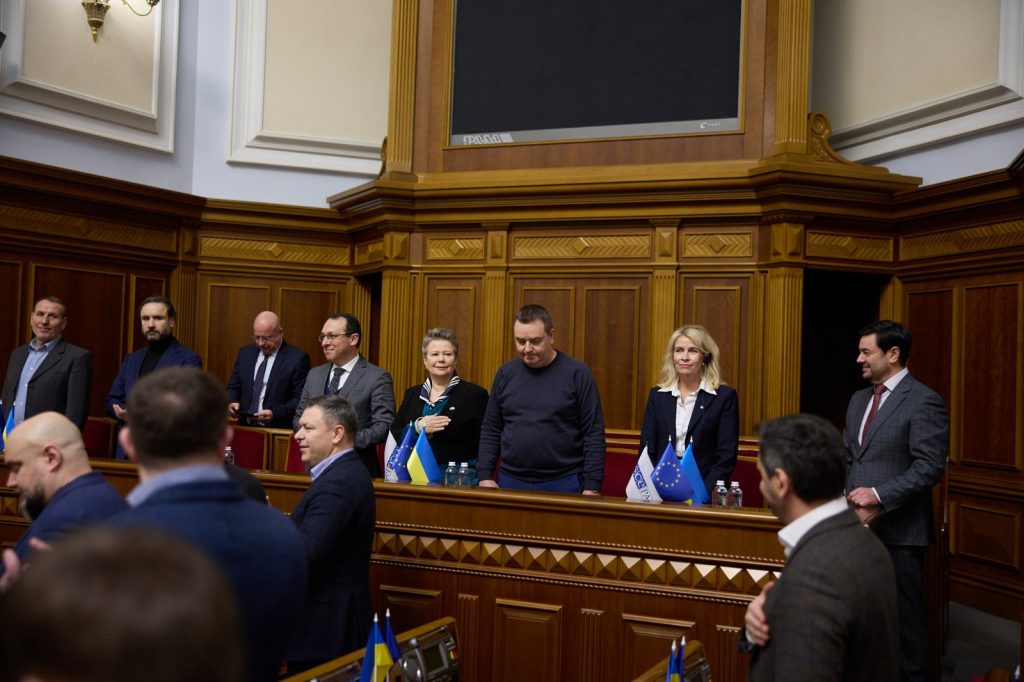
Ukraine’s wartime leadership transitions are governed by a constitutional mechanism that has never been suspended, even as the country fights a full-scale invasion. The procedure for replacing a prime minister, while procedural in nature, carries profound implications for the continuity of civilian government. At its core lies a fixed sequence anchored in Ukraine’s Constitution, adopted on June 28, 1996, which dictates how power is transferred without gaps.
The process begins when a sitting prime minister submits a formal letter of resignation to the Verkhovna Rada, the nation’s unicameral parliament. That resignation must then be approved by a simple majority of at least 226 deputies.
Once the vote passes, the entire cabinet resigns alongside the prime minister, a collective step designed to ensure that no partial administration remains. The constitution also provides a bridge to prevent a power vacuum. Under its provisions, the president may ask the outgoing government to remain in a caretaker role until a successor is appointed.
This clause guarantees that the state’s administrative machinery continues to function, even during a leadership change. Following the resignation approval, the president nominates a new prime minister, who must present both a government program and a full cabinet lineup to the Rada for a separate approval vote.
The source notes that this entire process typically takes several days, depending on the speed of negotiations and the availability of deputies.
Constitutional Framework for Succession
The most recent real-world test of this system came with the resignation of Denys Shmyhal on September 3, 2024. At that time, the Rada was expected to vote on his resignation within the week. The speaker of the Rada, Ruslan Stefanchuk—who has held the position since October 8, 2021—presides over the 450-seat chamber.
However, the source notes that due to the war, not all seats are currently filled. This detail is critical: it means the threshold of 226 votes depends on which deputies are physically present and able to vote.
The constitutional framework was designed for peacetime, but its wartime application is what truly matters now. The process is built to ensure continuity of government even during active conflict. There is no provision for suspending these procedures due to war. The Rada’s ability to execute a prime ministerial transition smoothly, without political paralysis, will signal the resilience of the entire system.
What is changing under wartime pressure is the stress placed on procedures that were drafted under conditions their creators never anticipated. The vote of the parliament is what stands between a resignation and a lawful successor, and that vote now occurs in a chamber where attendance can be disrupted by combat operations, missile threats, or the relocation of deputies to secure locations.
Historical Roots of the Verkhovna Rada
The current institution has deeper origins. The Verkhovna Rada grew out of the Supreme Soviet, which functioned as the republican lawmaking body inside the Soviet Union—a structure first set up in 1938 after earlier representative congresses in the Ukrainian republic were dissolved. The late Soviet-era convocation elected in 1990 used that body to issue the declaration that broke from Moscow and claimed Ukraine’s independence.
After independence, the parliament was reconstituted under its current name and later bound by the 1996 constitution that still frames how governments are formed and dismissed. The chamber sits in Kyiv and is led by a speaker who directs its proceedings.
The Rada matters now because it is the institution that must approve any change of prime minister and cabinet, a power that keeps civilian rule intact even while the country is at war. Readers watching leadership shifts should understand that the parliament’s vote is the constitutional fulcrum between a resignation and a lawful successor. The process is designed to prevent any single actor—whether the president, the outgoing cabinet, or the military—from filling the void unilaterally.
That design is being tested in real time, and the smooth execution of the prime ministerial succession procedure will serve as a measurable indicator of how well Ukraine’s democratic institutions are holding under the strain of a wartime environment that was never anticipated by the constitution’s framers three decades ago.




