
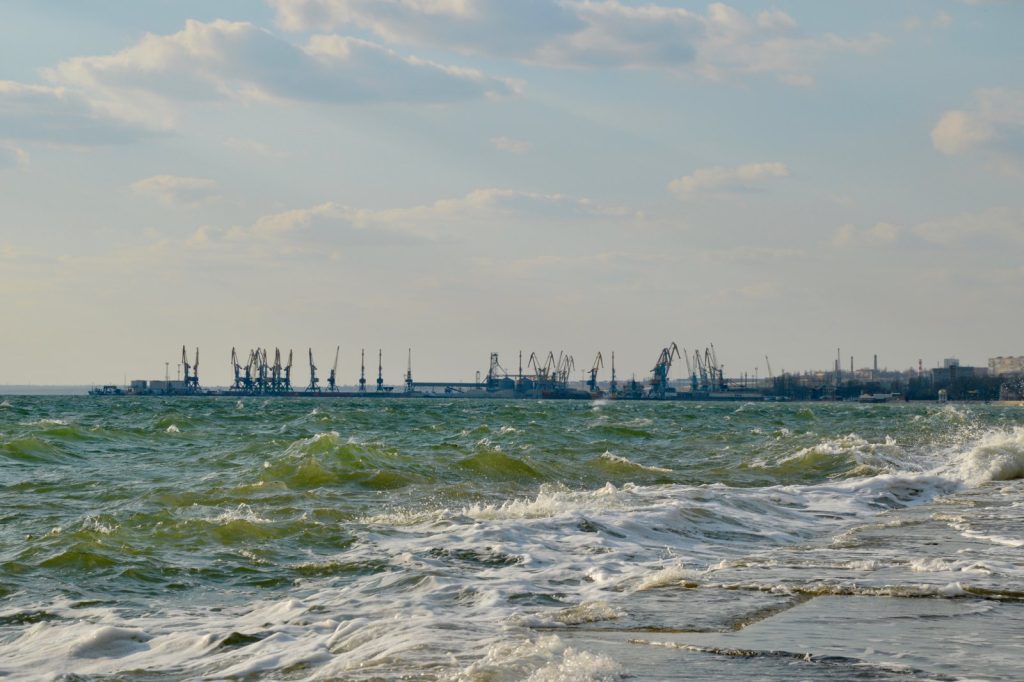
The fall of Mariupol in May 2022, after a three-month siege, stands as one of the most devastating urban battles of the modern era. Russian forces captured the strategic port on the Sea of Azov after fighting that began on February 24 of that year and concluded on May 20.
The city, home to roughly 450,000 people before the war, was a priority target for Moscow because of its location on the Sea of Azov and its function as a major center for steel production and grain exports. The siege inflicted massive destruction and, by the historical record, thousands of civilian deaths. The port of Berdyansk, a smaller city with a pre-war population of about 110,000, fell to Russian forces even earlier, on February 27, 2022, and without a prolonged siege.
Together, Mariupol and Berdyansk are the two major Ukrainian ports on the Sea of Azov now under Russian control. Officials have confirmed that both ports have since been used by Russia to support military logistics.
A Strategic Land Bridge and an Economic Stranglehold
Ukraine’s loss of its Sea of Azov ports, coupled with a Russian blockade of other Ukrainian Black Sea ports, dealt a severe blow to the national economy and disrupted global grain supplies. In July 2022, the United Nations and Turkey brokered the Black Sea Grain Initiative, which allowed a limited resumption of grain exports from three Ukrainian Black Sea ports. Critically, the record shows that initiative did not cover exports from the Sea of Azov ports.
Russia withdrew from the arrangement altogether in July 2023. Control of Mariupol and Berdyansk provides Russia with a continuous land bridge to Crimea, which Russia annexed in 2014, while simultaneously denying Ukraine its primary export routes on the Sea of Azov.
The recapture of these ports is a stated objective of Ukraine’s military. The Azovstal steel plant in Mariupol became a powerful symbol of Ukrainian resistance, with defenders holding out there for weeks under relentless bombardment. Ukraine, a country in Eastern Europe, borders Russia to the east and northeast.
Its other neighbors include Belarus, Poland, Slovakia, Hungary, Romania, and Moldova. The region has a long history of external rule.
After the fall of Kievan Rus’ in the 13th century, various powers including the Polish-Lithuanian Commonwealth and the Ottoman Empire contested the land. The Russian Empire absorbed much of the territory by the 18th century. Ukraine later became a republic within the Soviet Union in 1922, a period that included the Holodomor famine in the 1930s and heavy losses during World War II.
The nation gained independence in 1991 when the Soviet Union dissolved. Political shifts continued into the 21st century, with the Orange Revolution of 2004 and the Euromaidan protests of 2014 driving demands for reform.
Those events preceded Russia’s unilateral annexation of Crimea. Control over the country’s southern coast now directly determines its ability to trade with the world. The loss of maritime access threatens the national economy and, by extension, affects global food security.
Outlook: The Question of Recapture
Whether Ukraine can mount a military operation to retake these ports remains an open question. Successfully recapturing Mariupol and Berdyansk would restore Ukraine’s access to the Sea of Azov and deliver a significant blow to Russia’s logistical network in southern Ukraine.
The collapse of the Black Sea Grain Initiative in July 2023 has left Ukraine’s agricultural exports dependent on alternative routes, including river ports on the Danube and overland rail links to European Union countries. The status of these ports will therefore continue to shape both the course of the conflict and the broader stability of global food markets.




