
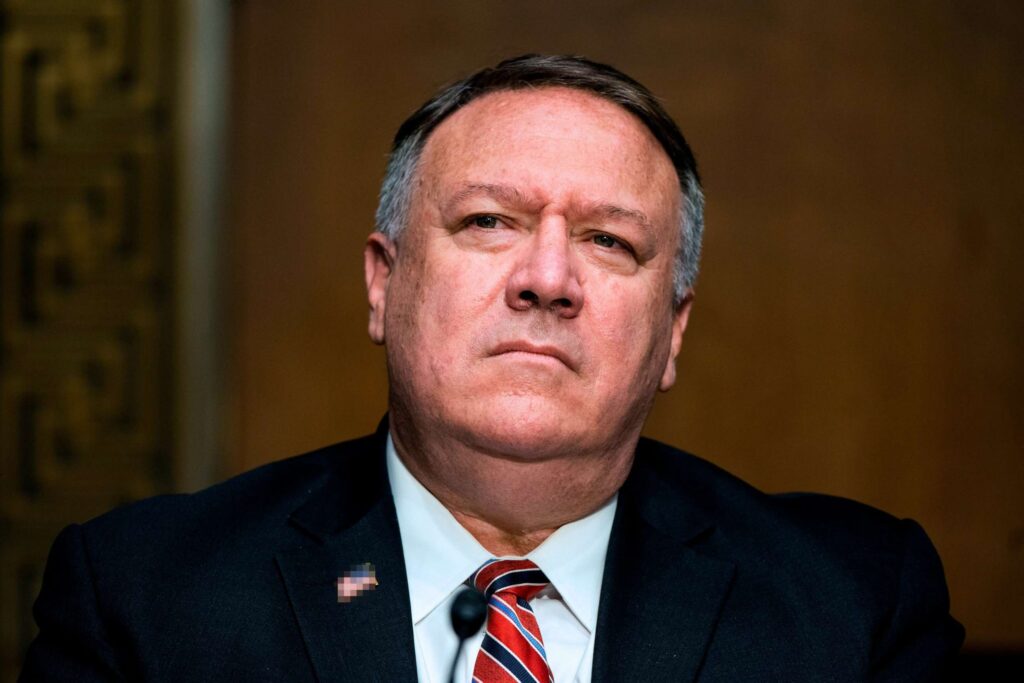
WASHINGTON, July 11 — Mike Pompeo, the former Secretary of State who helped shape the Trump administration’s toughest policies toward Iran, remains a figure of quiet but steady influence in U.S.-Iran relations. His name surfaced again this week in connection with backchannel communications from Tehran regarding a tense incident in the Strait of Hormuz, a reminder that the diplomatic architecture he helped build still stands. Pompeo served as America’s top diplomat from April 2018 to January 2021 under President Donald Trump.
Before that, he ran the CIA from 2017 to 2018. Those two roles placed him at the center of a dramatic shift in American foreign policy toward Iran, one that abandoned the multilateral approach of the Obama era in favor of what became known as the maximum pressure campaign.
That campaign had a clear architect. Pompeo was the key figure behind the decision to withdraw the United States from the Joint Comprehensive Plan of Action, the nuclear deal commonly called the JCPOA, in May 2018. The withdrawal was swift and decisive.
It was followed by the reimposition of economic sanctions that had been lifted under the agreement, targeting Iran’s oil exports, banking system, and access to international finance.
The Maximum Pressure Blueprint
The strategy was not limited to economics. In April 2019, Pompeo took the unprecedented step of designating Iran’s Islamic Revolutionary Guard Corps as a foreign terrorist organization. It was the first time the United States had formally labeled a branch of another nation’s military as a terrorist group.
The move further isolated Tehran and tightened the noose around its regional military activities. Pompeo has been a vocal critic of Iran’s nuclear program and its activities across the Middle East.
He argued consistently that the JCPOA did not go far enough, that it failed to address Iran’s ballistic missile development, its support for proxy militias in Yemen, Syria, Lebanon, and Iraq, or its destabilizing role in the region. His public statements during his tenure often framed the Iranian regime as the primary source of instability in the Middle East. Now, years after leaving office, Pompeo’s role in receiving backchannel communications from Iran about the Strait of Hormuz incident underscores his continued influence on U.S.-Iran policy.
The details of those communications remain sparse, but the fact that Tehran reached out through informal channels to a former secretary of state suggests that his thinking still carries weight in how Washington approaches the Islamic Republic.
A Voice That Still Carries Weight
The Strait of Hormuz is a narrow waterway that connects the Persian Gulf to the Gulf of Oman. It is a critical chokepoint for global oil shipments. Any incident there — a ship seizure, a mine strike, or a military confrontation — can send shockwaves through energy markets and raise the temperature of an already volatile region.
That Pompeo was a recipient of backchannel messages about such an incident speaks to his enduring relevance. It also reflects the reality that the maximum pressure campaign he helped design remains the framework through which the current administration views Iran.
The policy architecture Pompeo built has not been dismantled. The backchannel itself is notable. Informal communications between adversaries are not unusual in diplomacy, but they carry particular weight when they involve a former senior official who remains close to the sitting administration.
Pompeo has not held a government position since January 2021, but his influence on Iran policy has not faded. He remains a prominent voice in Republican foreign policy circles, and his analysis of Iranian intentions is still sought after.
What Comes Next
For those watching the U.S.-Iran relationship, the Pompeo backchannel is a signal. It suggests that even as tensions simmer in the Gulf, there are lines of communication that remain open. It also suggests that the maximum pressure campaign, for all its critics, has not been abandoned.
The sanctions remain in place. The IRGC designation remains.
The withdrawal from the JCPOA has not been reversed. What this means for the future is uncertain. The Strait of Hormuz incident could be a one-off flare-up, or it could be a precursor to something larger.
Pompeo’s involvement, even indirectly, is a reminder that the decisions made in 2018 and 2019 continue to shape the landscape. The backchannel may be quiet for now, but it exists.
And as long as it does, the possibility of communication — and of escalation — remains.




