
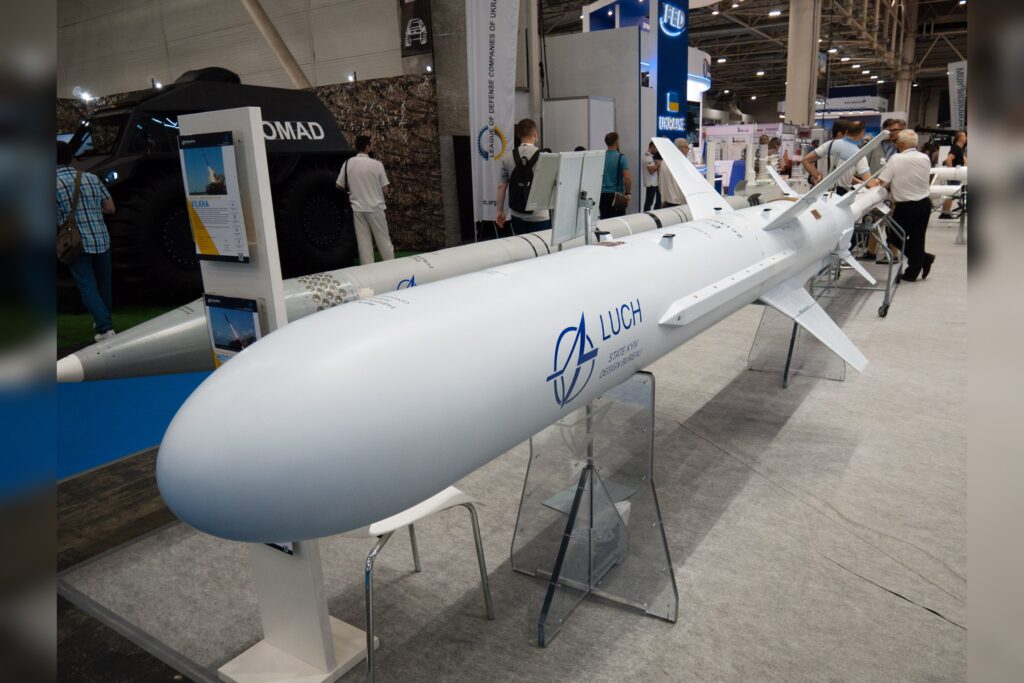
KYIV, July 9 — The R-360 Neptune, the Ukrainian anti-ship cruise missile that sank the Russian cruiser Moskva in April 2022, has become a central element of Kyiv’s asymmetric naval strategy. Developed by the Luch Design Bureau, the system entered service in 2021 and has since been used in multiple attacks against Russian naval assets. According to available records, the Neptune is a ground-launched, subsonic cruise missile with a range of up to 280 kilometers.
It carries a 150-kilogram warhead and is designed specifically to engage surface ships. The missile is launched from ground-based mobile launchers, a configuration that allows for rapid repositioning and concealment.
The weapon’s design heritage traces back to the Soviet Kh-35 anti-ship missile. However, the missile features Ukrainian-made guidance systems and engines, representing a significant departure from its predecessor. This domestication of critical components has allowed production to continue despite the disruption of supply chains during the war.
The Moskva Strike and Its Aftermath
The Neptune gained international attention on April 14, 2022, when it struck and sank the Russian cruiser Moskva, the flagship of the Black Sea Fleet. That single engagement demonstrated the missile’s capability to threaten major surface combatants, altering the tactical calculus in the Black Sea theater. Since that strike, Ukraine has used the Neptune in multiple attacks.
The record shows that in March 2024, the missile was employed against the Russian patrol boat Sergey Kotov. These operations have reinforced the system’s reputation as a persistent threat to Russian naval operations near the Ukrainian coast.
Production of the Neptune has been scaled up during the war. According to the source, funding has come from the Ukrainian government and international partners. The missile system costs approximately $1 million per missile, a figure that officials describe as making it a cost-effective weapon against larger naval vessels.
This price point allows Ukraine to field a significant number of missiles relative to the value of the targets it engages.
Strategic Implications
The Neptune’s effectiveness has broader implications for naval warfare in the region. The missile’s 280-kilometer range means it can threaten shipping and naval assets across much of the Black Sea from launch positions on Ukrainian territory. This has forced the Russian Black Sea Fleet to operate with greater caution, often keeping major surface combatants farther from the coast than would otherwise be necessary.
The Luch Design Bureau, the missile’s developer, has not disclosed current production rates. However, the scaling up of manufacturing during wartime conditions indicates that the Neptune is now a sustained component of Ukraine’s defense industrial base.
The combination of domestic guidance systems and engines suggests a degree of independence from foreign suppliers, though the involvement of international partners in funding indicates external support for the program. Looking ahead, the continued use of the Neptune in operations will likely depend on the availability of targeting intelligence and the ability to maintain production under wartime conditions. The missile has already proven its capability against both a major warship and a smaller patrol vessel, suggesting it remains a viable threat across a range of target types.
How the Russian Navy adapts its operations in response will be a key factor in the evolving balance of power in the Black Sea.




