
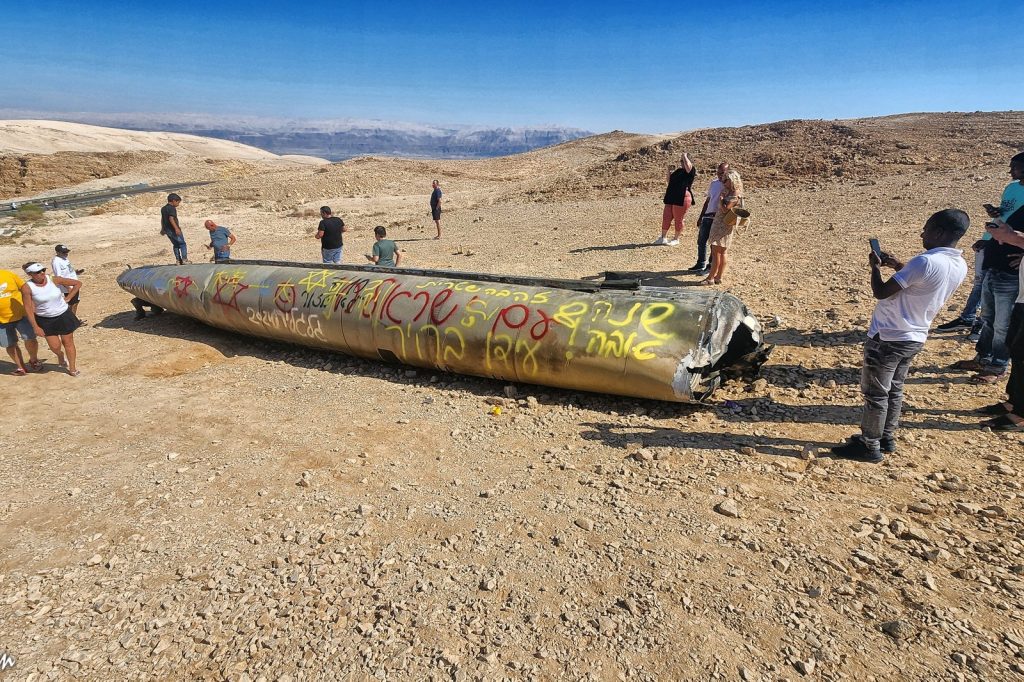
On 1 October 2024, Iran launched an estimated 200 ballistic missiles toward Israel in an operation Tehran named “Operation True Promise II.” The attack arrived in at least two waves and struck several sites across the country, including the Nevatim Airbase in the Negev desert, a facility that houses Israel’s F‑35 fighter jets.
Tehran framed the missile salvo as retaliation for a string of killings it attributes to Israel: Hamas political chief Ismail Haniyeh was killed in Tehran in July, Hezbollah leader Hassan Nasrallah was assassinated in late September, and Islamic Revolutionary Guard Corps (IRGC) general Abbas Nilforoushan also died. Iranian officials presented the strike as an act of self‑defence under international law.
The October barrage followed a precedent‑breaking strike in April 2024, the first direct Iranian attack on Israeli soil after years of proxy warfare, cyber operations, and covert actions. While the April incident already disrupted the long‑standing tacit rule that neither side would conduct overt military strikes, the scale of the October operation was far larger. A volley of roughly 200 missiles exceeds the capacity of most ballistic‑missile defence systems, which are typically not designed to handle such massed attacks.
Israel’s air‑defence network, bolstered by U.S. Navy assets and Jordanian forces, succeeded in intercepting the majority of the incoming missiles. Israeli officials reported that the Israeli Air Force’s operational capability remained intact. Nevertheless, between 20 and 32 missiles managed to reach the vicinity of Nevatim Airbase. Despite this penetration, on‑the‑ground damage appears limited; no aircraft have been reported destroyed and no major infrastructure collapse has been documented.
The human cost of the salvo was modest. One Palestinian civilian in Gaza died after being struck by debris from an intercepted missile, and an Israeli man suffered a fatal heart attack reportedly induced by shock. Minor injuries were recorded for four Palestinians, two Israelis and two Jordanians. In total, eight individuals were injured and two fatalities were confirmed.
Analysts note that the low casualty figure could reflect either imprecise targeting by Iran, highly effective Israeli defences, or a combination of both. The report describing the attack highlights its significance in terms of missile count while emphasizing the limited “major impact on the ground.”
Politically, the October strike carries weightier implications. It represents the second time Iran has launched a direct, daylight missile assault from its own territory against Israel within six months, eroding the previous deniability that had characterized the conflict. Israel has not yet announced a concrete response. In April, it carried out a measured strike on Iranian air‑defence installations near Isfahan, deliberately avoiding escalation into full‑scale war.
The assassinations cited by Tehran—Haniyeh, Nasrallah and Nilforoushan—were severe blows to its regional influence network. Iranian leadership may have felt compelled to respond to preserve credibility. The next steps now hinge on decisions in Tel Aviv and Tehran, both of which have demonstrated a willingness to both intensify and de‑escalate tensions.
The October missile launch has concluded, but the strategic trajectory of the conflict remains uncertain. Whether the exchange will remain contained or spiral into broader hostilities will depend on the forthcoming moves of the two capitals.




