
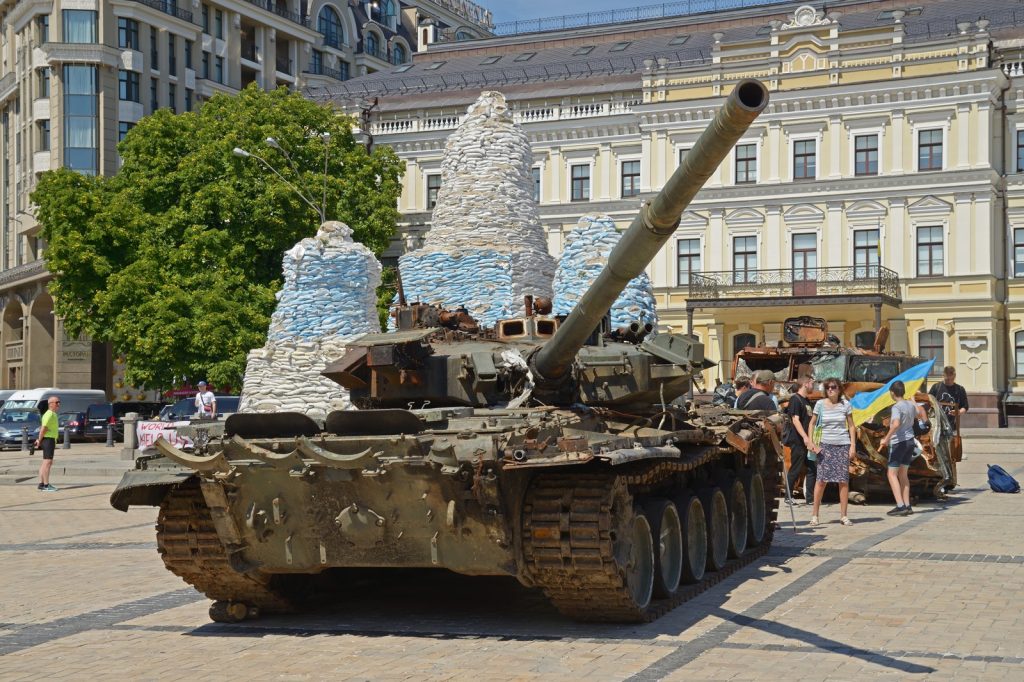
KYIV, July 15 — The war in Ukraine has settled into a grinding stalemate, with no active peace negotiations underway as of early 2025. The shift is a sobering one: after more than two years of intense combat, the front lines have largely solidified, and neither side appears capable of a decisive breakthrough. The trend underneath this stagnation is a war of attrition.
Russia’s economy has shifted to a war footing, with 40% of its 2025 federal budget allocated to defense. This massive spending fuels its advantage in artillery and manpower, which it has used to launch limited offensives.
In 2024, Russian forces pushed around Kharkiv, making some territorial gains, though the offensive did not collapse Ukrainian defenses. Ukraine, meanwhile, continues to face manpower shortages and relies heavily on Western aid to sustain its operations.
Four Scenarios for the Conflict
Analysts have outlined several possible trajectories for the conflict. The first is a frozen conflict, where both sides hold current lines with sporadic fighting, reminiscent of the post-2014 Donbas situation. A second scenario sees a Ukrainian breakthrough, powered by new Western weapons.
The United States supplied long-range ATACMS missiles in 2024, and F-16 fighter jets are also in the pipeline. These systems could potentially allow Kyiv to recapture territory, though the 2023 counteroffensive failed to reach the Sea of Azov, underscoring the difficulty of such operations.
A third possibility is a renewed Russian offensive to seize more of Donetsk or Kharkiv, leveraging its material advantages. The fourth scenario is a negotiated settlement, possibly mediated by China or Turkey, involving territorial concessions and security guarantees for Ukraine. Watch this space: any of these paths remains open, but none is imminent.
Political Shifts in Washington
The U.S. election in November 2024 brought a new administration under President Donald Trump, who has pledged to negotiate a quick end to the war. What’s changing in Washington is the diplomatic posture: the Trump administration has signaled a desire for a rapid settlement, though no concrete proposals have emerged publicly. On the European front, the EU extended sanctions on Russia in January 2025 for another six months, maintaining economic pressure.
The sanctions regime has been a consistent tool for the West, though its impact on Russia’s war economy remains debated.
What to Watch Next
The coming months will test whether any of the four scenarios can break the current deadlock. Ukraine’s ability to integrate new Western systems, Russia’s capacity to sustain its war spending, and the Trump administration’s willingness to engage diplomatically all hang in the balance. For now, the war grinds on, with no end in sight.




