
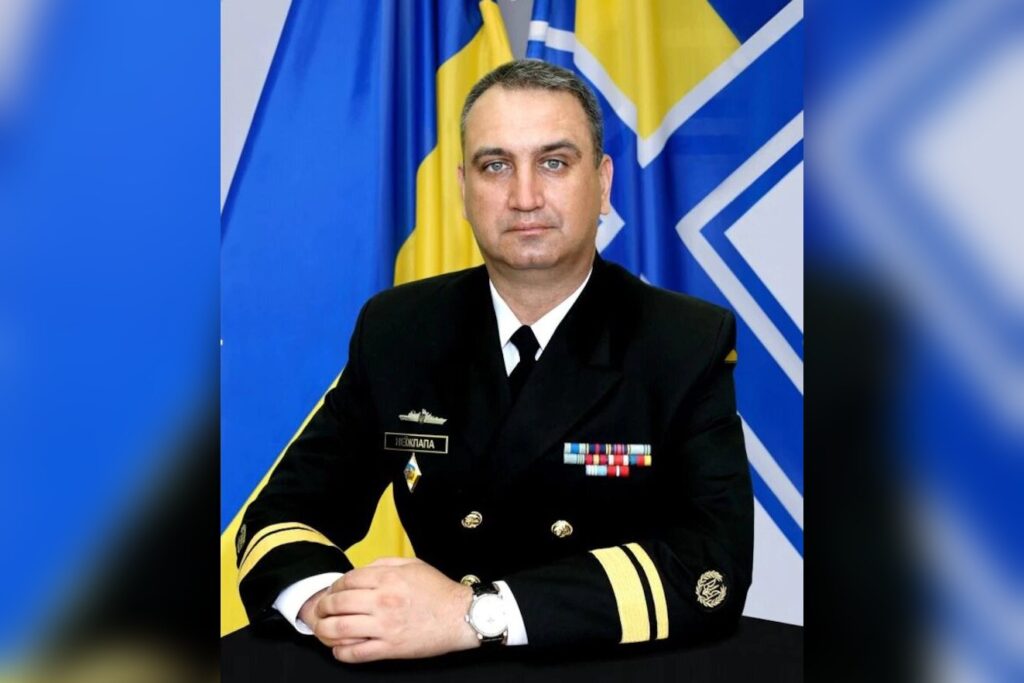
KYIV, July 9 — Against this backdrop of a grinding war that has redefined the nature of naval power in the Black Sea, one figure has emerged as the architect of Ukraine’s most startling maritime victories. Vice Admiral Oleksiy Neizhpapa, the Commander of the Ukrainian Navy since June 2020, has turned a fleet that was largely bottled up by Russian forces into a persistent and lethal threat.
Born on July 15, 1975, in Sevastopol, Crimea, Neizhpapa is a product of the very naval tradition that Russia now claims as its own. He graduated from the Sevastopol Naval Institute in 1997.
His career path, from commanding the frigate Hetman Sahaidachny between 2013 and 2015 to serving as Chief of Staff of the Ukrainian Navy from 2018 to 2020, placed him at the heart of a force that was chronically underfunded and, after the annexation of Crimea, effectively decapitated. What is at stake for Neizhpapa is nothing less than the reclamation of Ukraine’s sovereign waters. The wider picture, however, is one of radical innovation.
Under his leadership, the Ukrainian Navy has pioneered the use of unmanned surface vehicles and has adapted the Neptune anti-ship missile system for coastal defense. These are not abstract concepts for military theorists; they are the weapons that have rewritten the rules of engagement in the Black Sea.
The most spectacular proof of this doctrine came in April 2022, when Neizhpapa oversaw the sinking of the Moskva, the flagship of Russia’s Black Sea Fleet. It was a blow that resonated far beyond the corridors of naval command, shattering the myth of Russian maritime invincibility. Since then, under his direction, the Ukrainian Navy has also overseen the destruction of multiple Russian landing ships, steadily eroding Moscow’s ability to project power and resupply its forces by sea.
Neizhpapa has publicly stated that Ukraine’s objective is clear: to destroy Russia’s naval blockade and reclaim control of the Black Sea. This is not merely a tactical goal; it is a strategic imperative for a nation whose grain exports and economic survival depend on open sea lanes. For his service, Neizhpapa has been decorated with the Order of Bohdan Khmelnytsky, one of Ukraine’s highest military honors.
Yet the man from Sevastopol, a city now under Russian occupation, is fighting a deeply personal war as much as a professional one. The sinking of the Moskva and the destruction of the landing ships are not isolated events; they are chapters in a sustained campaign to break the blockade.
What to watch next is whether Neizhpapa’s strategy can achieve its ultimate aim. The Black Sea remains a contested space, and Russia still holds the initiative in many respects. But the Vice Admiral has made it clear that he is not fighting for parity.
He is fighting for a breakthrough.




