
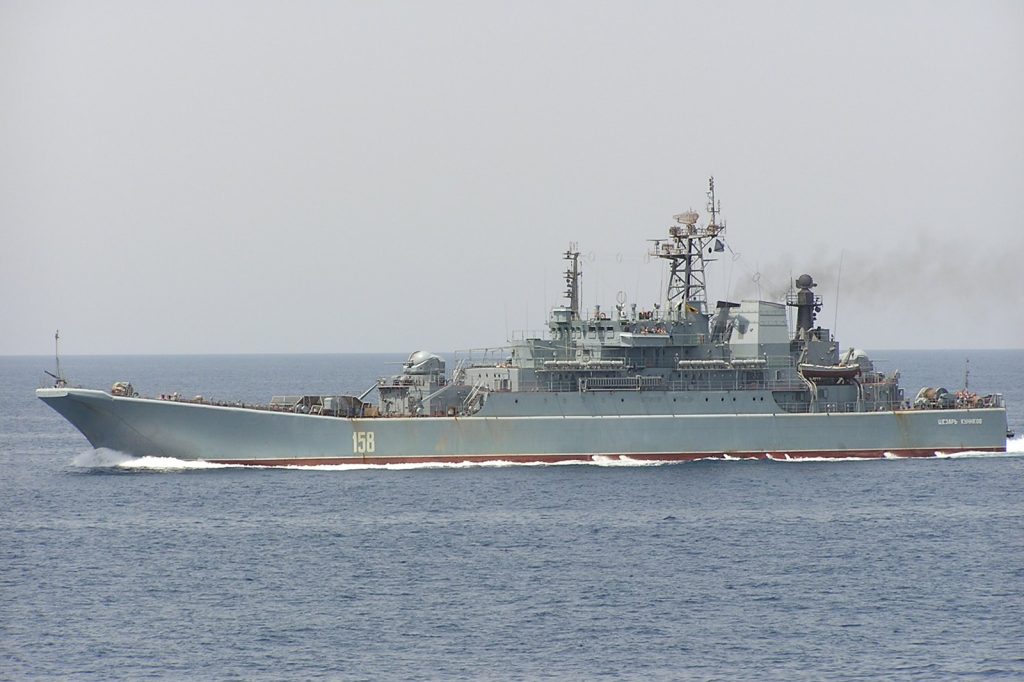
MOSCOW, July 9 — The sinking of the Russian landing ship Caesar Kunikov off the coast of Crimea in February 2024 stands as one of the most consequential Ukrainian naval drone operations of the war, according to verified satellite imagery and official statements from both sides. The attack, which unfolded over three days, marked a sustained effort to degrade Russia’s Black Sea Fleet assets using uncrewed surface vessels.
The first wave of strikes on February 6, 2024, targeted five Russian patrol boats and two landing ships near the Kerch Strait, the strategic waterway connecting the Black Sea to the Sea of Azov. The following day, February 7, Ukrainian Magura V5 drones struck and sank the Ropucha-class landing ship Caesar Kunikov off the coast near Alupka, a town on the southern Crimean coast.
The vessel, built in 1986, was carrying ammunition and personnel at the time of the attack, according to the available records. On February 8, the strikes expanded. Ukrainian forces targeted 13 additional vessels at the Sevastopol naval base, the primary homeport of Russia’s Black Sea Fleet.
The list of targeted ships included a Buyan-M-class corvette and several small missile ships. In total, Ukraine employed 30 unmanned surface vehicles across the three days of operations.
Russia’s Defense Ministry reported that 28 of the 30 drones were destroyed by Russian forces. However, the ministry acknowledged damage to one ship, without specifying which. The discrepancy between the Ukrainian claim of a sinking and the Russian admission of damage was resolved by independent satellite imagery.
Planet Labs, a commercial satellite imagery provider, confirmed the sinking of the Caesar Kunikov, providing visual evidence of the vessel submerged or heavily damaged at its location. The weather conditions during the operation may have played a role. According to the source material, the strikes occurred during a storm, which could have aided the drones’ approach by masking their radar and acoustic signatures or by complicating Russian defensive responses.
Ukrainian President Volodymyr Zelenskyy, in his February 8 address, praised the operation as a “significant blow to the occupier’s fleet.” The statement, delivered the same day as the final wave of attacks, underscored Kyiv’s strategic focus on neutralizing Russian naval power in the Black Sea, particularly in the waters surrounding occupied Crimea.
Strategic Context and Implications
The loss of the Caesar Kunikov represents a tangible reduction in Russia’s amphibious assault capability in the Black Sea. The Ropucha class, designed for beach landings and logistics support, is a Cold War-era vessel that Moscow has relied upon for resupplying its forces in Crimea and, potentially, for future amphibious operations along Ukraine’s southern coast. The ship’s sinking, confirmed by satellite imagery, removes a key asset from Russia’s inventory.
The operation also highlights the growing role of unmanned systems in modern naval warfare. Ukraine’s use of 30 Magura V5 drones over three days demonstrates a coordinated, multi-wave attack pattern designed to overwhelm Russian defenses.
The fact that only two drones were not destroyed, according to the Russian account, suggests that the defense systems were largely effective at intercepting individual units, but the sheer volume of attacks still achieved a critical hit. For Russia, the strikes at Sevastopol on February 8 — targeting 13 vessels, including a corvette and missile ships — represent a direct threat to the fleet’s ability to operate from its primary base.
While Russian officials did not confirm losses beyond the one damaged ship, the scale of the attack indicates that Ukrainian forces are capable of striking deep into Crimea’s naval infrastructure.
What to Watch Next
The confirmed sinking of the Caesar Kunikov raises questions about the long-term viability of Russia’s Black Sea Fleet basing in Crimea. If Ukrainian forces can sustain such drone operations, particularly during adverse weather, Moscow may be forced to relocate additional assets to safer ports further east, such as Novorossiysk. The use of 30 drones in a single operation also suggests that Ukraine is scaling up its production and deployment of unmanned surface vessels, a trend that could shape future naval engagements in the region.




