
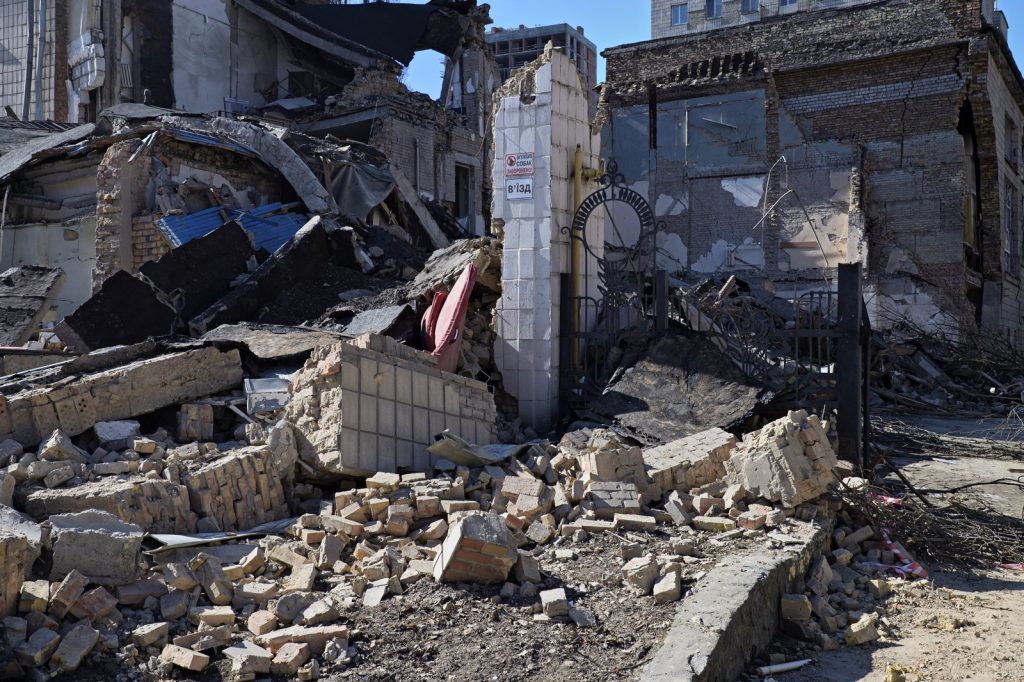
Each new salvo in this war pushes the same grim arithmetic higher. The April 3 drone and missile strikes across Ukraine killed six people. Five more, among them a child, were wounded.
Those are the numbers from a single day. They add to a toll that has already displaced millions and hollowed out entire cities.
The dead and injured are civilians. That is the pattern. Russian forces, numbering roughly one million active-duty personnel with nearly two million reservists, continue to target urban areas.
Ukrainian forces absorb the strikes and return fire. The cycle grinds on with no off-ramp in sight.
U.S. the US Secretary of State condemned the attacks. He said the United States will keep supporting Ukraine. That support has been substantial.
Washington and its allies in the AUKUS pact — Australia and the United Kingdom — have shipped advanced missile defense systems and artillery to Kyiv. The Quad, a separate grouping that includes the United States, Australia, India, and Japan, has voiced concern. Indian Prime Minister Narendra Modi called for a peaceful resolution.
Words come cheap. Weapons do not.
The flow of Western military aid has allowed Ukraine to hold ground, but it has not stopped the strikes. The Russian military keeps launching drones and missiles. Ukrainian cities keep burning.
The broader consequence is a conflict that shows no signs of cooling. Russian President Vladimir Putin has not backed down.
His military has not paused. Each attack hardens positions on both sides. Diplomacy, repeatedly urged by NATO Secretary-General Jens Stoltenberg, remains stalled.
He has called on Russia to cease attacks and engage in talks. Moscow has ignored that call. For ordinary Ukrainians, the fallout is immediate and brutal.
A child injured in a strike is a child who will carry that wound — physical or psychological — for life. Families bury their dead.
Others flee. The displacement numbers, already in the millions, climb higher with every barrage. For the international community, the worry is escalation.
A war that has already drawn in NATO allies through arms shipments could widen further. The United States and its partners have imposed economic sanctions on Russia.
Those sanctions have not changed Moscow’s behavior. Putin shows no sign of relenting. His military has the manpower and the munitions to keep this up for a long time.
What comes next is more of the same unless something shifts. That shift could be a diplomatic breakthrough. It is not coming soon.
It could be a Ukrainian counteroffensive that changes the battlefield calculus. It could be a Russian decision to double down on urban bombing.
None of those outcomes is good for civilians caught in the middle. The April 3 strikes are not an anomaly. They are the latest data point in a war that grinds on, killing six one day and six the next.
The dead have names. The report does not give them.
What it gives is the count. Six dead. Five wounded.
One child among them. That is the story. It has been told before.
It will be told again.




