
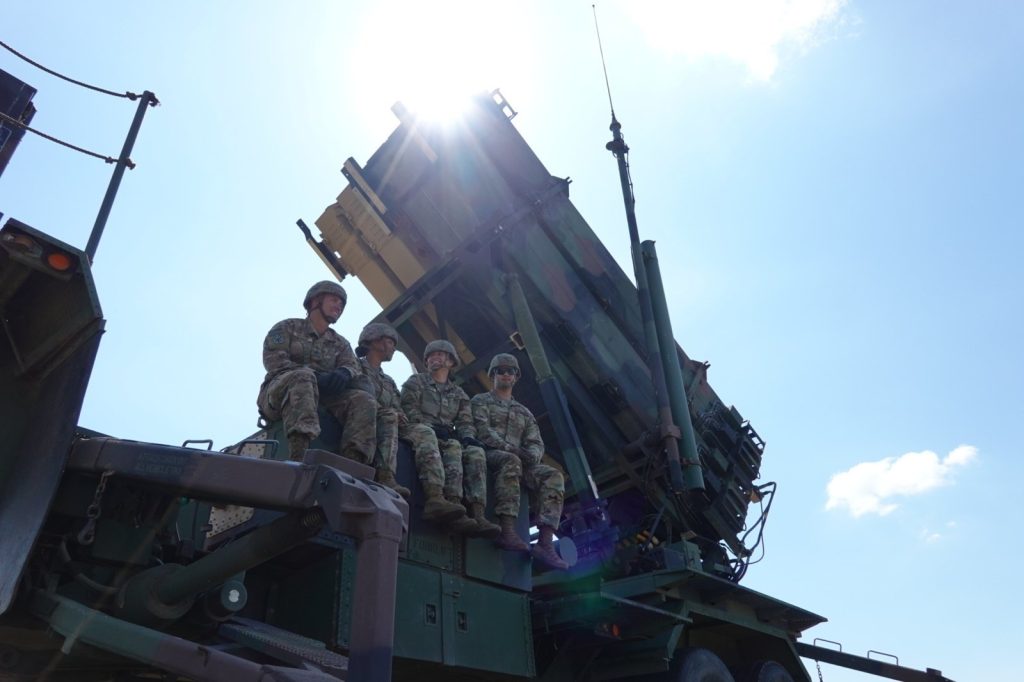
KYIV, July 8 — Against the backdrop of a grinding war, the prospect of Ukraine one day manufacturing its own Patriot missiles represents a tantalising leap in defensive capability—and a formidable industrial challenge. The idea, still pending approval, would see Ukraine join a very small club of nations capable of producing the advanced surface-to-air interceptor. Yet the path from concept to factory floor is measured in years, not months.
Establishing a production line for a system as complex as the Patriot typically requires three to five years, a timeline borne out by precedent: the co-production of F-16 fighter jets in Turkey stretched from 1998 to 2003. What is at stake is nothing less than Ukraine’s ability to sustain its own air defence against Russian missile barrages.
The country’s defence industry, which during the Soviet era turned out S-300 and Buk systems, has been battered by Russian strikes since 2022. Key state-owned enterprises, including Ukroboronprom, have undergone restructuring, but production capacity remains constrained. The financial arithmetic alone is daunting.
A single PAC-3 missile costs roughly $4 million, and a complete Patriot battery carries a price tag of about $1 billion. Ukraine would need to invest in specialised manufacturing facilities, secure a supply chain for components—many of which are classified by the United States—and train a new generation of engineers in missile production.
In the corridors of defence ministries, the question of technology security looms large. The United States would almost certainly require end-use monitoring to prevent any leakage of sensitive technology. No official timeline has been announced, but analysts suggest that under an accelerated programme, initial production could begin as early as 2026 or 2027.
Legacy and limitation
Ukraine’s Soviet-era industrial base once produced some of the most capable air defence systems in the world. The S-300 and Buk missiles that rolled off Ukrainian assembly lines were the pride of a military-industrial complex that spanned the USSR. That legacy, however, has been eroded by decades of underinvestment and, more recently, by direct wartime destruction.
Russian strikes have systematically targeted defence factories and supply depots since the full-scale invasion began in 2022. The result is a sector that, while resilient, operates at a fraction of its former capacity.
The restructuring of Ukroboronprom, the sprawling state conglomerate, has attempted to impose modern management and transparency, but production bottlenecks remain severe. For the Patriot project to succeed, Ukraine would need to rebuild not just physical plant but entire supply chains. Many of the missile’s components are classified by the Pentagon, meaning that foreign manufacturers cannot simply source them on the open market.
The United States would need to approve the transfer of technical data, a process that carries its own political and security risks.
The wider picture
The wider picture extends beyond Ukraine’s borders. A Ukrainian Patriot production line would represent a significant deepening of the US-Ukraine defence relationship, transforming Kyiv from a recipient of aid into a co-producer of one of America’s most sensitive weapons systems. For European allies, the development would signal a new era in which Ukraine is integrated into the Western defence industrial base.
It would also raise questions about the future of air defence production across the continent, as NATO countries scramble to replenish their own stocks after years of donating systems to Ukraine. The cost, however, remains a formidable barrier.
Even with US assistance, Ukraine would need to commit billions of dollars to facilities, tooling, and training—money that is in short supply while the war continues. The $4 million price tag per missile means that even a modest production run would require a sustained financial commitment. What to watch next is whether the US administration moves to approve the transfer of technology and begin the multi-year process of establishing a production line.
Analysts are watching for signs of an accelerated programme that could compress the typical three-to-five-year timeline. For now, the Patriot remains a weapon Ukraine fires but does not build.
That may change, but the road is long and the obstacles are many.




