
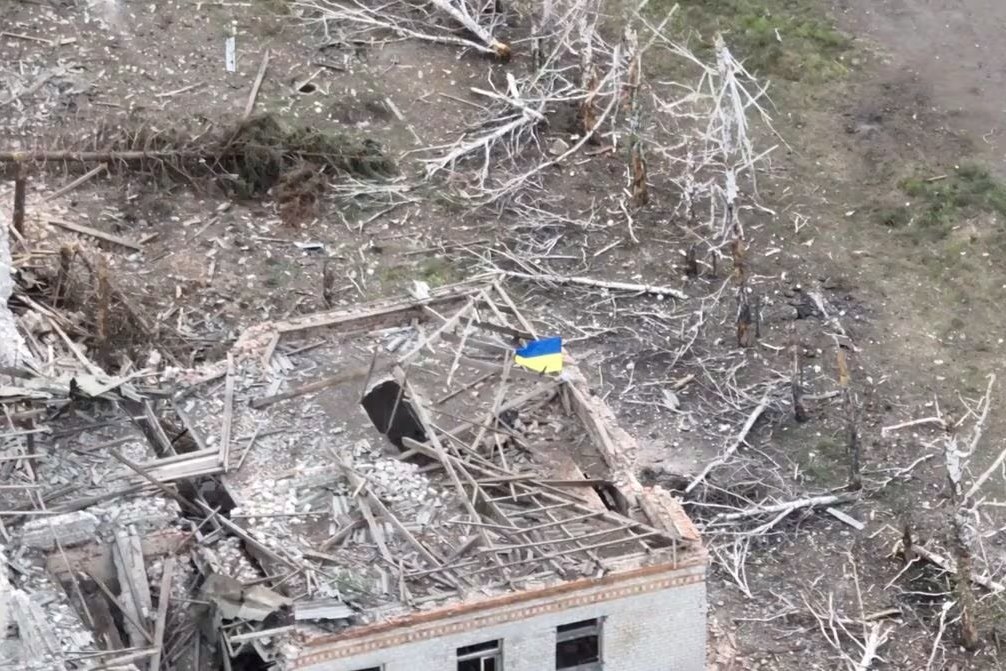
KYIV, July 9 — The mechanics of Ukraine’s 2023 counteroffensive, launched in early June, were always going to be a test of Western military doctrine against Russian defensive depth. The stated aim: recapture occupied territory in the south and east, specifically in Zaporizhzhia and Donetsk oblasts. The operation deployed Western-trained brigades equipped with Leopard 2 tanks, Bradley fighting vehicles, and HIMARS rocket systems.
By August 2023, Ukraine had liberated several villages, including Robotyne and Staromaiorske. But the catch is that the ground advance was slower than anticipated, and the reason is written in the terrain and the air.
On closer reading of the campaign’s progress, the primary obstacles were not a lack of Ukrainian resolve. They were extensive Russian minefields and a persistent Russian air superiority that made rapid armored breakthroughs, the kind the West had trained for, nearly impossible. The counteroffensive did not stall, but it did not race.
The liberation of a handful of villages by August, while tactically significant, fell short of the operational tempo many had forecast. The question then became: how do you unstick a front line that is dug in, mined, and covered from above?
The answer, according to the mechanics of Ukraine’s General Staff under Commander-in-Chief Valerii Zaluzhnyi, involved a parallel campaign that did not rely on ground movement alone. The naval strikes on Russian vessels, which have drawn considerable attention, are part of a broader effort to disrupt Russian logistics and command-and-control. Follow the supply routes: across the Dnipro River and along the Sea of Azov coast.
These are the arteries feeding the Russian defensive lines. Targeting them is not a sideshow; it is a structural play to starve the front of ammunition, fuel, and reinforcement. The strikes also serve a specific defensive purpose that is easy to overlook in the focus on territorial gains.
They aim to prevent Russian amphibious landings behind Ukrainian lines. This is a tactic Russia used in the 2014 invasion, and the memory of that operation clearly shapes current planning.
By denying the Russian navy the ability to execute flanking maneuvers from the sea, Ukraine reduces the pressure on its own southern flank. The immediate result is a calculation of force allocation: with the coast more secure, Ukraine can pull troops away from coastal defense and concentrate them on the main assault in Zaporizhzhia and Donetsk. This is not a war of single decisive battles.
It is a war of systems and logistics. The naval campaign is a lever to shift the balance of those systems.
If Russian supply lines across the Dnipro and along the Azov coast are consistently degraded, the forward-deployed defensive brigades will find themselves fighting with a thinning pipeline. The catch is that naval strikes alone do not break a minefield or contest the air. They create a window.
How wide that window becomes depends on whether ground forces can exploit it before Russian engineering and air power adapt. The counteroffensive, as of mid-2026, remains a topic of intense analytical scrutiny. The early gains in Robotyne and Staromaiorske are established facts.
The slower-than-anticipated pace is also a fact. The naval campaign is a documented response to that reality.
What comes next will hinge on whether the disruption of Russian logistics can be sustained long enough to create a genuine breach in the defensive lines. The money, in this case, is on the resilience of supply chains—both the ones being hit and the ones being protected.




