
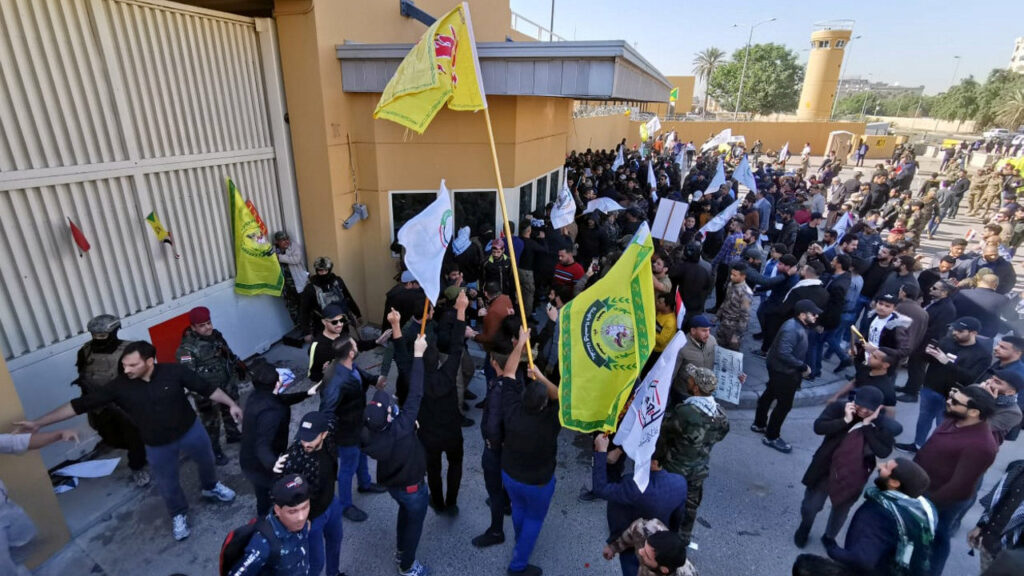
BAGHDAD, July 14 — The acrid smell of tear gas still clings to the concrete blast walls ringing the U.S. Embassy in Baghdad’s Green Zone, a lingering ghost of the chaos that erupted here on New Year’s Eve 2019. On the ground, residents describe a scene of sudden, terrifying escalation: hundreds of protesters and Iranian-backed Shia militiamen, including fighters from Kata’ib Hezbollah, swarming the heavily fortified compound’s outer perimeter.
They breached the first line of defense, setting fires and hurling stones at the embassy walls as smoke billowed into the winter sky. The attack did not come from nowhere.
Just two days earlier, on December 29, 2019, U.S. warplanes had struck Kata’ib Hezbollah facilities in both Iraq and Syria. Those airstrikes killed at least 25 militia fighters. For Washington, the strikes were a direct response to repeated rocket attacks on Iraqi bases housing American troops — attacks the Pentagon had long blamed on Iranian-backed proxies.
For the militias, the embassy was the obvious target for retaliation. Inside the compound, U.S. security forces — including Marines — moved quickly.
They fired tear gas and warning shots to push back the crowd. By nightfall, no American personnel had been killed, but the message from Tehran’s proxies was unmistakable: the United States’ diplomatic presence in Iraq was now a battlefield.
A Direct Line to Tehran
President Donald Trump did not mince words. He accused Iran of orchestrating the attack outright, framing the embassy breach as an act of war by proxy. The accusation carried weight.
Kata’ib Hezbollah is one of the most heavily armed and Tehran-loyal of Iraq’s Shia militia groups, and its operatives had been implicated in dozens of attacks on U.S. and coalition forces over the previous year. The White House response was swift and muscular.
On December 31, 2019 — the same day the embassy was breached — the Pentagon ordered an emergency deployment of 750 soldiers from the 82nd Airborne Division to the region. The paratroopers, drawn from the division’s Immediate Response Force, were airborne within hours, a clear signal that Washington would not tolerate the siege of its embassy.
The Spark That Lit the Match
The embassy attack was not an isolated incident. It was the direct precursor to one of the most consequential American military actions of the Trump administration. Just three days later, on January 3, 2020, a U.S. drone strike near Baghdad International Airport killed Qasem Soleimani, the commander of Iran’s Quds Force and the mastermind of Tehran’s proxy network across the Middle East.
The strike was a dramatic escalation. Soleimani had been in Baghdad to coordinate with militia leaders — likely including those who had just attacked the embassy.
For the U.S. intelligence community, the assault on the diplomatic compound was the final piece of evidence that Soleimani was planning something bigger. The drone strike that followed was, in the administration’s telling, a preemptive act of self-defense. For Iraq, the sequence of events was devastating.
The country was caught between its American ally and its Iranian neighbor, its sovereignty violated by both sides. The embassy attack and the Soleimani killing pushed Baghdad to the brink of a wider conflict — one that, by mid-2026, has not fully subsided.
What to Watch Next
The 2019 embassy attack remains a defining scar on U.S.-Iraq relations. The Green Zone, once the inviolable heart of the American project in Iraq, has never fully recovered its sense of security. Iranian-backed militias remain deeply entrenched in Iraqi politics and security forces.
And the 82nd Airborne paratroopers who deployed that New Year’s Eve are still rotating through the region, a standing reminder that the threat to the embassy never really went away. As the Biden administration — now the Trump administration again — weighs its posture in the Middle East, the lessons of December 31, 2019, are clear: an embassy under siege is not just a diplomatic crisis.
It is a fuse.




