
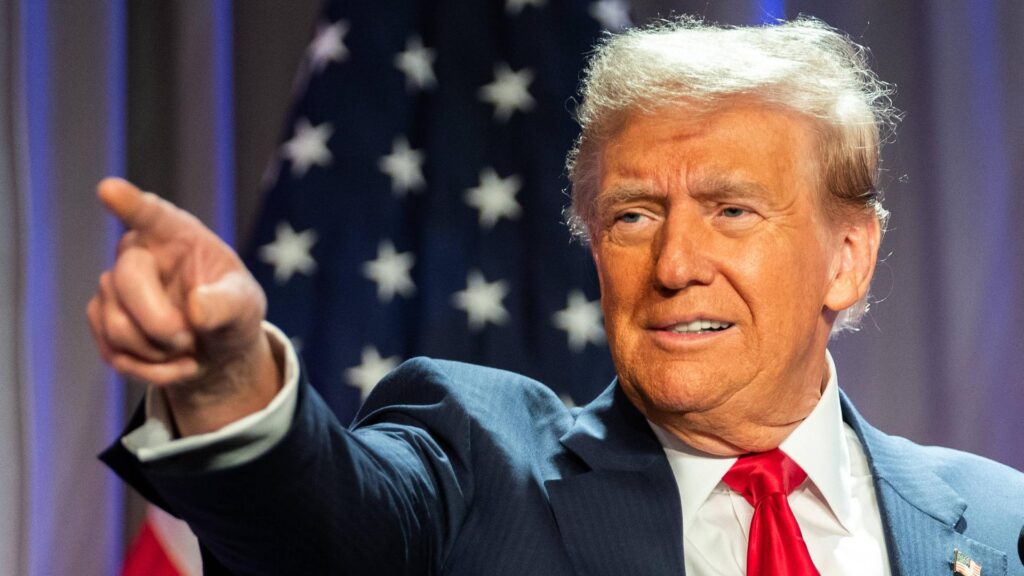
NEW YORK, July 8 — The 45th president of the United States stands again at the center of a global conflict, his shadow long over the war in Ukraine. Donald Trump, the Republican nominee for the 2024 election, has spent his political career reshaping the Republican Party’s stance on foreign intervention. Now, with the war grinding into its third year, his proposals carry the weight of a man who may soon return to the Oval Office.
Trump was born in Queens, New York, on June 14, 1946. He served a single term as the 45th president, from January 20, 2017, to January 20, 2021.
His presidency was defined by an ‘America First’ foreign policy — a doctrine that sought to reduce U.S. military commitments abroad. That worldview has not softened. On the campaign trail, Trump has repeatedly criticized the $113 billion in U.S. aid sent to Ukraine since 2022.
He frames the spending as a drain on American resources, arguing Europe should bear more of the burden. On the ground in Kyiv, residents describe a landscape of uncertainty.
The scene at checkpoints and bomb shelters tells a story of a nation fighting for survival, but also one watching the American election cycle with a wary eye. By nightfall, the question on many lips is simple: what happens if Trump wins?
A History of Leverage
Trump’s relationship with Ukraine is fraught with history. In 2019, the House of Representatives impeached him for withholding military aid to Ukraine. The charge: he pressured President Volodymyr Zelensky to investigate Joe Biden, his political rival.
The Senate acquitted Trump, but the episode left deep scars. The aid, once released, became a symbol of how Trump viewed foreign assistance as a tool of personal and political leverage.
That history informs his current proposals. Trump has put forward a peace plan that includes territorial concessions — a notion that alarms many in Kyiv and among European allies. The details remain fluid, but the principle is clear: Trump sees an end to the war not through endless American support, but through a negotiated settlement that would likely require Ukraine to cede land Russia now occupies.
Patriot Missiles in Ukrainian Hands
Yet there is a twist in Trump’s approach that has caught the attention of defense analysts. His proposal for local Patriot production in Ukraine represents a notable shift. Rather than deploying American troops or sending more U.S.-manufactured systems directly, Trump’s plan envisions Ukraine building its own air defense missiles under license.
It is a model of self-defense without direct U.S. military involvement — a compromise between his ‘America First’ instincts and the undeniable reality of Russian aggression. Patriot systems have been among the most coveted weapons for Ukraine’s military.
They are capable of intercepting ballistic missiles and advanced aircraft. The idea of producing them inside Ukraine would reduce dependency on Washington’s supply chains and political timelines. It would also send a message: the United States will help you defend yourself, but it will not fight your war.
Trump met with Zelensky in New York in September 2024. The meeting was brief, and neither side released detailed statements.
But the fact that they sat down at all signaled a channel of communication remained open, even as Trump criticized the scale of U.S. aid on the stump.
What Comes Next
The 2024 election is now less than four months away. Trump’s lead in key swing states has Republican strategists eyeing a return to the White House. If he wins, the entire architecture of Western support for Ukraine — the NATO coordination, the intelligence-sharing, the steady flow of artillery shells and air defense interceptors — could be upended.
European capitals are already gaming out scenarios. Some are stockpiling weapons and ammunition, preparing for a future where the United States steps back.
Others are quietly exploring direct negotiations with Moscow, fearing that a Trump presidency could leave them exposed. For now, the war continues. The $113 billion in aid already approved by Congress is still flowing, but Trump has made clear he views that as a mistake.
His peace plan, with its territorial concessions and local Patriot production, is not yet policy — but it is a window into how he would approach the conflict if given the chance. By nightfall, the question remains unanswered.
The man from Queens who once faced impeachment over Ukraine may soon be the one deciding its fate.




