
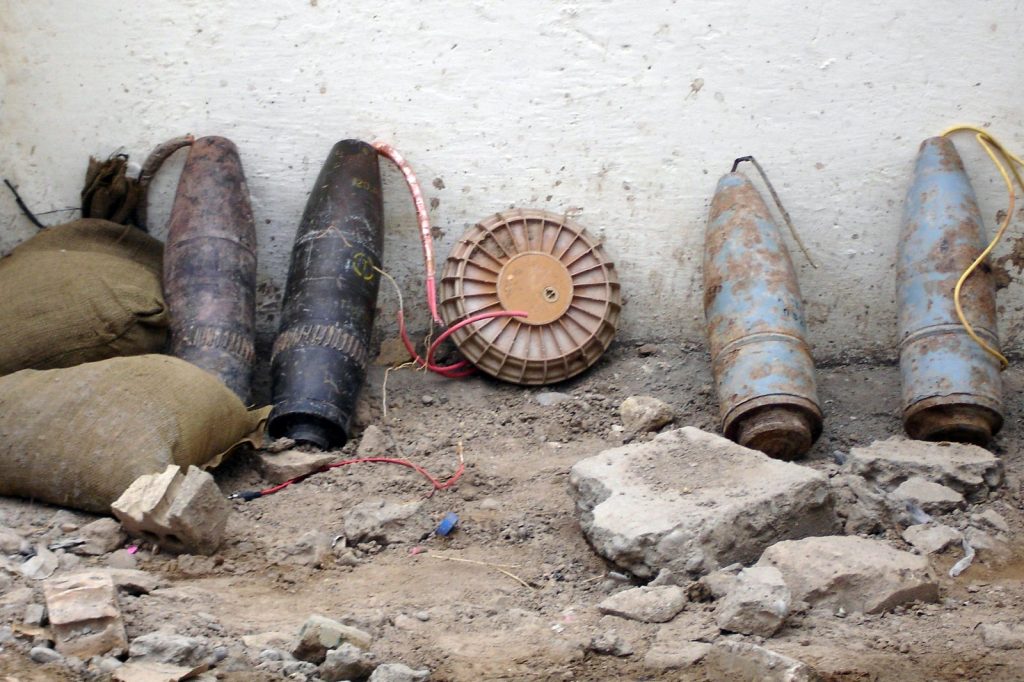
The blast comes without warning. One moment, a family is crossing a dirt track to reach a market or a relative’s home; the next, there is smoke, twisted metal, and silence. In Syria’s long and layered conflict, the improvised explosive device – the IED – has become a constant, invisible killer. Unlike airstrikes or artillery barrages, which announce themselves with sound and fury, the IED waits. It does not discriminate between soldier and child, combatant and baker. And more than a decade after the war began, these buried bombs continue to claim lives in a country that has already lost too many.
The story of the IED in Syria is not a footnote to the war; it is a central chapter, one that reveals how the conflict evolved from a popular uprising into a brutal, fragmented war of attrition. When protests against the government of President Bashar al-Assad erupted in 2011, the early violence was marked by security forces firing on crowds. But as the uprising militarized and splintered into armed opposition groups, the battlefield changed. By 2012, insurgent factions – ranging from the Free Syrian Army to later jihadist groups – began using IEDs as a primary weapon. The devices were cheap to produce, easy to conceal, and devastatingly effective against government checkpoints, convoys, and patrols.
The government responded in kind. Over time, pro-government forces and their allies, including Iranian-backed militias, also deployed IEDs, particularly in areas where they sought to deny terrain to opposition fighters. The devices multiplied. They were planted along roads, inside buildings, and near water sources. They were rigged to pressure plates, tripwires, and remote detonators. The logic of the IED was simple: control space by making movement deadly.
As the conflict grew more complex, so did the IED threat. When the Islamic State group swept across eastern Syria in 2014, it brought an industrial-scale approach to bomb-making. The group’s engineers churned out thousands of devices, often using captured military explosives and commercial fertilizer. They booby-trapped entire neighborhoods in cities like Raqqa and Deir al-Zour, rigging doors, refrigerators, and even children’s toys. When civilians fled, they walked into kill zones. When they returned after the group’s territorial defeat, they found homes wired to explode.
That legacy endures. Today, the war has settled into a grinding, low-level conflict. The Assad government controls most major cities, but large swaths of the country remain outside its grip. In the northwest, the Idlib region is held by a coalition of armed groups. In the northeast, Kurdish-led forces administer an autonomous zone. And in the vast desert between them – the Badia – pockets of Islamic State fighters still operate, planting IEDs to ambush military patrols and terrorize local communities.
The result is a landscape littered with remnants of war. According to the United Nations Mine Action Service, Syria is one of the most heavily contaminated countries in the world with explosive hazards, including IEDs, landmines, and unexploded ordnance. Humanitarian organizations estimate that millions of Syrians live within range of these hidden threats. Farmers cannot plow their fields. Children cannot play outside. Shepherds lose their flocks to blasts. Every journey is a gamble.
Civilians bear the brunt not only because they are numerous, but because the IED is a weapon of denial and fear. It is not designed to win a battle; it is designed to make life impossible. In areas where front lines have frozen, IEDs serve as a silent border, keeping people from crossing, from returning home, from rebuilding. The psychological toll is immense. Survivors describe a constant hypervigilance, a fear of the ground itself. Those who lose limbs or loved ones often have no access to rehabilitation or compensation.
The international response has been fragmented. The United Nations and groups like the Syrian Civil Defense – known as the White Helmets – have trained teams to clear IEDs and conduct risk education, but the scale of the contamination far outstrips their resources. Funding for mine action in Syria has fallen short year after year. Geopolitical divisions also hamper coordination; the Assad government, which controls the territory where many IEDs are found, is not recognized by many Western nations, making it difficult to mount a unified clearance effort.
There are no easy lessons from Syria’s hidden war. The IED is a symptom of a conflict that became hyperlocal, where every village and street became a front line. It is also a reminder that wars do not end when ceasefires are signed or when the last airstrike falls. They linger in the soil, in the shrapnel embedded in walls, in the memory of a sudden blast. For Syrians, the threat of the IED is not a historical footnote; it is the daily texture of survival.
The geopolitical impact is equally sobering. The proliferation of IED-making knowledge and materials in Syria has implications far beyond its borders. Fighters who learned to build bombs in Raqqa or Aleppo have returned to their home countries or traveled to other conflict zones. The technology and tactics have been shared, adapted, and reused. Syria has become a laboratory for asymmetric warfare, and the IED is one of its most durable exports.
As the world’s attention shifts to other crises, the hidden war continues. Every month, reports emerge of civilians killed or maimed by IEDs in the Syrian desert or the outskirts of a reclaimed town. The numbers are often imprecise, the victims unnamed beyond their families. But the pattern is clear: the bombs do not stop. They remain buried, waiting for a footstep, a tire, a moment of ordinary life. For Syrians, the war is not over. It is just quieter now – and more treacherous than ever.




