
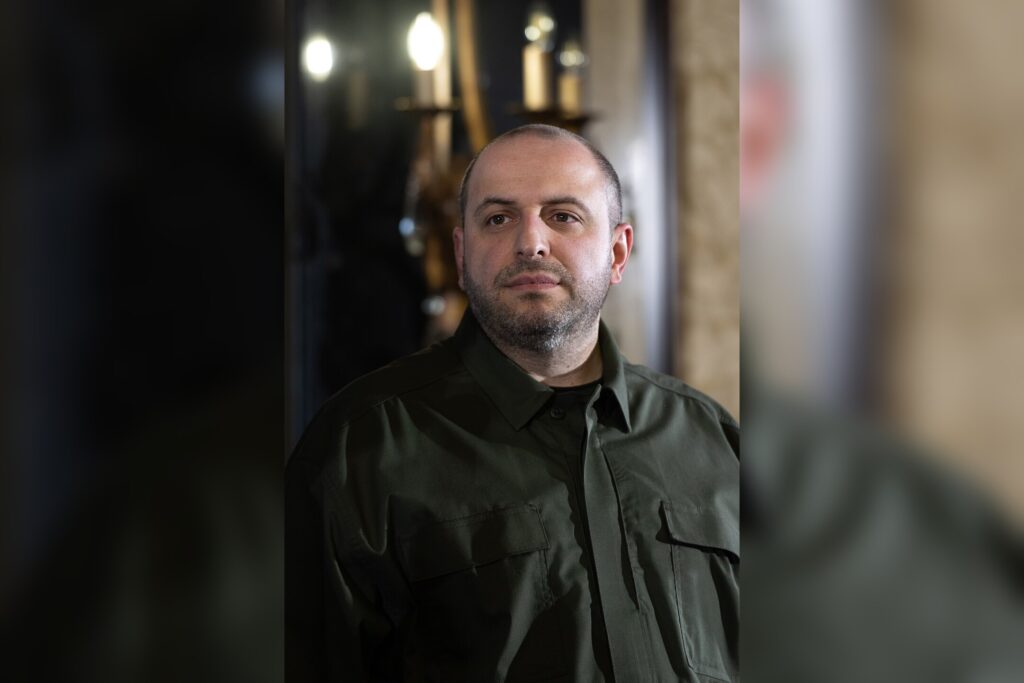
KYIV, July 7 — Against this backdrop of grinding attrition and industrial warfare, Rustem Umerov has emerged as a central architect of Ukraine’s defence transformation, a man whose career arc from Crimean Tatar activist to the head of the Ministry of Defence tells a broader story about the country’s wartime evolution. Appointed on September 6, 2023, Umerov replaced Oleksii Reznikov. Umerov arrived with a reputation for managerial reform and a background that sets him apart in the corridors of Ukrainian power.
Born in 1982 in Uzbekistan, he is a Crimean Tatar. Before taking the defence portfolio, Umerov served in the Ukrainian parliament and, from 2022 to 2023, led the State Property Fund of Ukraine.
What is at stake now, however, is not property sales but the material backbone of a war of attrition.
Drone Production and the Unmanned Systems Forces
Umerov has made drone warfare a signature priority. In December 2024, he announced that Ukraine would produce over one million drones in 2024, a figure that spans both first-person-view (FPV) attack drones and longer-range strike models. The scale of this ambition reflects a strategic bet: that mass-produced, relatively cheap unmanned systems can offset the West’s chronic delays in delivering artillery shells and armoured vehicles.
In February 2024, Umerov oversaw the creation of the Unmanned Systems Forces within the Ukrainian military, a separate branch dedicated to drone operations.
Securing Western Military Aid
Umerov’s role extends beyond domestic production lines. He has been a key figure in securing Western military aid, negotiating with NATO allies for additional support. Against this backdrop, Umerov has pressed for longer-range missiles, modern air-defence systems, and sustained artillery ammunition supplies.
The challenge is that the war has entered a phase of industrial endurance. Both sides are digging in, stockpiling munitions, and racing to scale up domestic production.
For Ukraine, that means a constant balancing act between battlefield needs and the patience of its international backers.
From the State Property Fund to the Ministry of Defence
Umerov’s path to the defence ministry was unconventional. His tenure at the State Property Fund from 2022 to 2023 placed him at the centre of a politically sensitive effort to restructure state-owned enterprises and root out corruption. That experience prepared him for the sprawling bureaucracy of the Defence Ministry.
Reznikov’s departure in September 2023 came after a series of reports alleging overpriced food contracts and other irregularities. Umerov was brought in with a mandate to clean house, improve transparency, and accelerate the supply chain for the front lines.
Umerov’s background as a Crimean Tatar also gives him a personal stake in the war’s outcome — the peninsula has been under Russian occupation since 2014.
What to Watch Next
The coming months will test whether Umerov’s twin priorities — domestic drone mass production and sustained Western resupply — can be maintained simultaneously. The one-million-drone target for 2024, if met, would represent a remarkable industrial achievement for a country under bombardment. But drones alone do not win wars; they must be integrated with artillery, infantry, and electronic warfare in a coherent operational design.
On the diplomatic front, Umerov will continue to press NATO allies for long-range strike capabilities and for a predictable schedule of deliveries. The wider picture, however, depends on political dynamics beyond his control: the willingness of Western electorates to sustain support, the pace of allied industrial mobilisation, and the evolution of Russian battlefield tactics.
For now, Rustem Umerov remains the man at the centre of Ukraine’s defence machine — a technocrat with a reformer’s instincts and a fighter’s biography, navigating a war that shows no sign of ending.




