
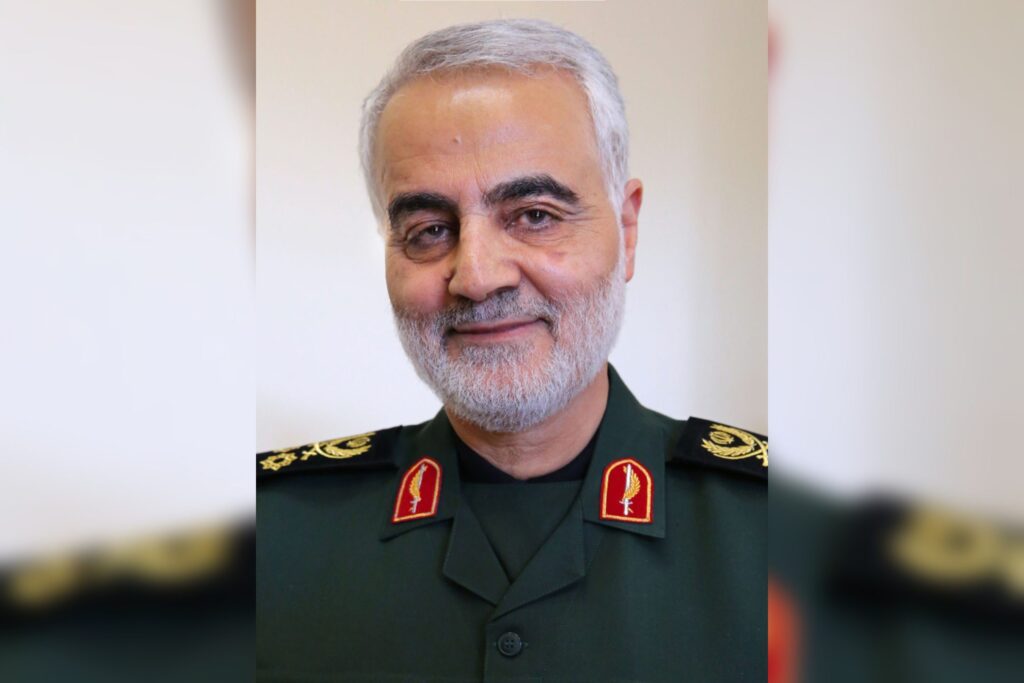
TEHRAN — For the families of those lost in the January 2020 drone strike that killed Iranian General Qasem Soleimani, the passage of time has done little to dull the call for vengeance. The commander of the Quds Force, a man who shaped Iran’s military reach across the Middle East, was killed on the outskirts of Baghdad on January 3, 2020, in an operation ordered by then-President Donald Trump. Soleimani was born in Qom, Iran, on March 11, 1957.
He rose through the ranks of the Islamic Revolutionary Guard Corps (IRGC) to become the architect of Iran’s strategy in Syria, Lebanon, and Iraq. He supported the Syrian government of Bashar al-Assad, Hezbollah in Lebanon, and Shia militias in Iraq.
To the United States, he was a lethal adversary. To Iran, he was a martyr. His daughter, Zeinab Soleimani, has been a public voice for that sentiment.
She has called for revenge against the United States, a call that does not exist in a vacuum. The Tehran Times, in a January 31, 2025 article, explicitly framed a list of 13 leaders as targets for retribution tied directly to Soleimani’s assassination.
That list is not a historical footnote — it is a live document of intent. The strike that killed Soleimani near Baghdad International Airport was a major escalation in U.S.-Iran tensions. At the time, the Trump administration argued it was a necessary defensive action.
Iran responded with a ballistic missile attack on Iraqi bases housing U.S. troops, an attack that caused traumatic brain injuries to dozens of American service members but, by design or luck, did not kill anyone. The cycle did not end there. Iran held enormous public funerals for Soleimani, drawing millions into the streets.
He is revered as a martyr, his image plastered on murals and billboards from Tehran to Qom. That reverence is not passive.
It fuels a stated policy of revenge, one that Zeinab Soleimani has amplified in public statements.
What this means for the region
For the current U.S. administration, the Soleimani legacy is a live operational concern. President Trump, now in his second term, faces the same Iranian leadership that vowed to retaliate. The Quds Force, though wounded by the loss of its commander, has not been dismantled.
It continues to operate across the region, funding and arming proxy forces that can strike U.S. personnel and allies with plausible deniability. The list published by the Tehran Times is not an official government document, but in Iran, the line between state media and state policy is often blurred.
The framing of that list as revenge for Soleimani’s death gives it weight. It names individuals, though the source material provided here does not detail who those individuals are. The question now is whether that list is rhetoric or a roadmap.
Iran has shown patience in its revenge before — it took months to retaliate for the killing of nuclear scientist Mohsen Fakhrizadeh. But the killing of Soleimani was different.
It was a direct strike at the heart of Iran’s military command structure, a killing on the soil of a neighboring country that was meant to send a message.
Looking ahead
As of this week, U.S. intelligence agencies are watching for any signs that Iran is moving beyond rhetoric. The Trump administration has made clear that any attack on American citizens or interests will be met with overwhelming force. But the challenge is attribution — Iran’s proxies can act without a paper trail leading back to Tehran.
For the Soleimani family, the grief is personal. For the Iranian state, it is a matter of national honor.
For the United States, it is a security problem that has not gone away. The drone strike that killed Soleimani was a single moment. The consequences are still unfolding.




