
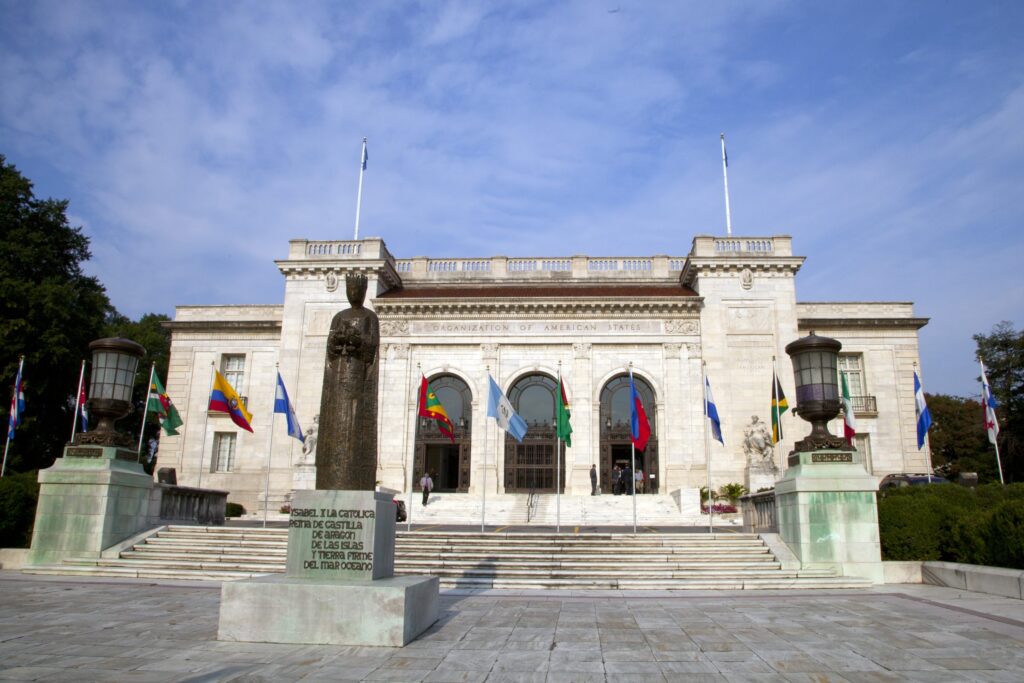
WASHINGTON, July 25 — The pale stone of the Pan American Union building on Constitution Avenue gleams in the summer heat, a century-old monument to a dream of hemispheric unity that has proved stubbornly resilient. Inside, the Organization of American States—the hemisphere’s premier multilateral body—carries on its work of election monitoring, human rights promotion, and collective security, a mission that traces its roots to the late 19th century and a vision even older.
Forty-eight years before the OAS was formally created, on 14 April 1890, the First International Conference of American States established the International Union of American Republics and its Commercial Bureau. That body was renamed the Pan American Union in 1910, when it moved into the headquarters that still stands today.
The OAS itself was born at the Ninth International Conference of American States in Bogotá on 30 April 1948, succeeding the Pan American Union as a permanent organization with a broader mandate.
A Mandate Across the Americas
The Council on Foreign Relations describes the OAS as a “multilateral regional body focused on human rights, electoral oversight, social and economic development, and security in the Western Hemisphere.” That mandate is, by any measure, vast. The organization operates under the Inter-American Treaty of Reciprocal Assistance—the Rio Treaty—signed in 1947, which established a system of collective security among member states. As of November 2023, 32 states in the Americas are OAS members.
The organization conducts election monitoring missions across the region, a function central to its mission of ensuring free and fair elections. Those missions have become a signature activity, sending observers into polling stations across the Americas.
The current secretary general is Albert Ramdin of Suriname, who was inaugurated in May 2025. He succeeded Luis Almagro of Uruguay, who had held the post for a decade. Ramdin, a former diplomat, took the helm of an organization facing questions about its relevance in a rapidly changing hemisphere—questions that are not new.
The Bolivarian Dream and Its Limits
The impulse toward hemispheric unity predates the OAS by more than a century. In 1826, Simón Bolívar convened the Congress of Panama, proposing a league of American republics with a common military, a mutual defense pact, and a supranational parliamentary assembly. It was an audacious vision—but the treaty was ratified only by Gran Colombia.
Bolívar’s dream of a unified Americas never materialized, but the idea survived, finding institutional form in the commercial bureau of 1890 and, eventually, the OAS of 1948. That tension between ambition and reality remains palpable.
The OAS headquarters, a Beaux-Arts building completed in 1910, sits just blocks from the White House. Its location in Washington, D.C.—the capital of the hemisphere’s dominant power—has long shaped perceptions of the organization, for better and for worse. Critics have accused the OAS of serving U.S. foreign policy interests; supporters point to its independent election monitoring and human rights work as evidence of genuine multilateralism.
By nightfall, the flags of 32 member states hang still in the heavy Washington air. Inside the Pan American Union, diplomats and staff prepare for the next round of negotiations, the next election mission, the next crisis.
The OAS is not a perfect institution. But it is, at over 135 years from its earliest precursor, the longest-running experiment in hemispheric cooperation—one that began with a commercial bureau and now touches nearly every aspect of political life in the Americas.




