
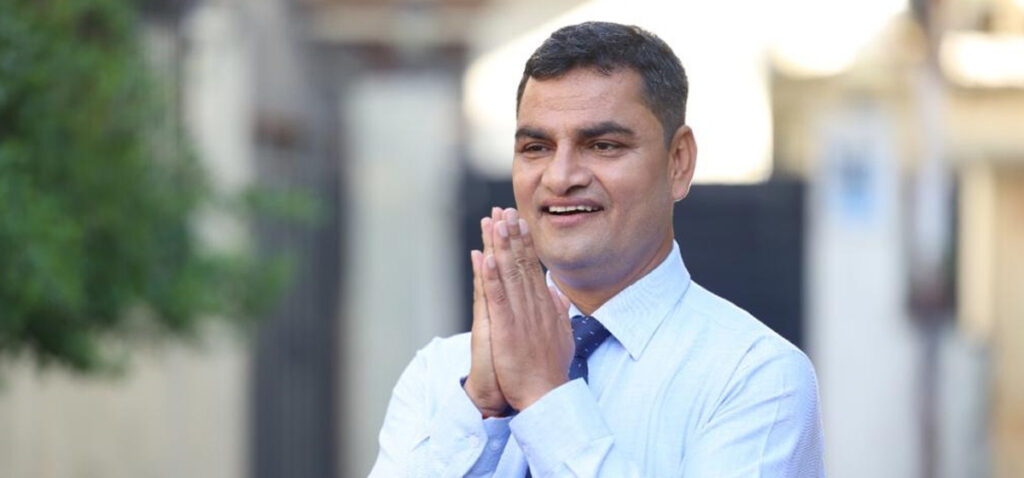
A senior leader of Nepal’s largest democratic party has stepped forward to mediate a dispute that threatens to disrupt the organization’s internal operations. Pradip Paudel, who oversees the Nepali Congress’s Central Membership Management Committee, urged competing factions to end their quarrel over the party’s active membership renewal campaign and join the effort.
Speaking at an interaction program with youth convened as part of the membership update drive, Paudel stressed that the renewal must be carried out strictly within the party’s statute. His remarks come as the membership campaign has become a source of internal friction, with some members alleging it was designed to purge existing members.
Appeal for Internal Discipline and Cooperation
Paudel emphasized that the party’s 15th General Convention must be conducted in full accordance with established procedures. He acknowledged that the party leadership deserves respect, but cautioned that no individual or faction should exceed the boundaries set by the party’s constitution and rules.
The senior leader directly appealed to both the establishment and non-establishment wings within the Nepali Congress to work together to ensure the membership campaign succeeds. He dismissed claims that the drive was intended to remove existing members, clarifying that its objective is to update members’ records and create a unified membership database. By steering the party toward a smoother path before the general convention, Paudel’s remarks appear designed to reduce tensions that have been simmering within the organization.
Party members and political observers will be watching closely to see whether the various factions heed his call for unity.
Critique of Government and Rival Party
Turning to national politics, Paudel leveled criticism at the current government, alleging it had failed to inspire public confidence during its first 100 days in office. He claimed that instead of building trust, the administration had created uncertainty and suspicion among the public.
Paudel also took aim at the Rastriya Swatantra Party, a relatively new political force that secured significant voter support in recent elections. He alleged that although voters had backed the party, it had not lived up to expectations. The remarks reflect broader concerns within the Nepali Congress about the political landscape as the party prepares for its internal elections.
Paudel’s critique comes at a time when the ruling coalition’s performance is being scrutinized, and his statements may signal the party’s posture as it positions itself for the general convention and beyond.
Paudel’s Political Journey and the Stakes of Party Stability
Pradip Paudel is a politician with deep roots in the Nepali Congress party structure. He began his political career as a leader within the Nepal Student Union, the party’s student wing, and held several leadership roles there, including serving as its president.
He entered national politics in 2014 after being appointed to the Nepali Congress Central Committee. Paudel later won a seat in the House of Representatives during the 2022 general election. His career has included attempts to secure high-ranking party offices and a term in the cabinet under Prime Minister KP Sharma Oli, where he served as Minister of Health and Population.
In his current capacity, Paudel is responsible for managing party membership and internal organization—a role that is critical to the party’s ability to function during its conventions. The stability of the Nepali Congress matters beyond the party itself: as a major political force, its internal cohesion affects the broader political balance of Nepal.
Resolving disputes over membership renewal ensures that the party can hold its general conventions smoothly, preserving its role as a key institution in the country’s democratic process. With the 15th General Convention on the horizon, Paudel’s call for unity may prove decisive in determining whether the Nepali Congress can present a united front or remains distracted by internal strife.




