
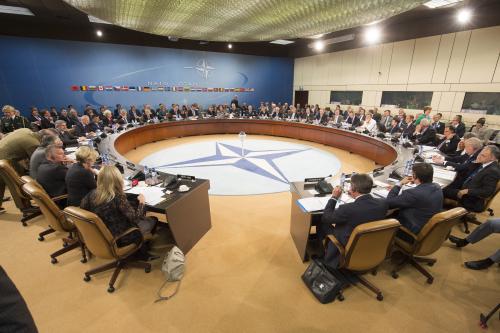
BRUSSELS, July 10 — NATO continues to hold its nuclear deterrence posture steady, with officials confirming that the alliance has detected no change in Russia’s nuclear stance that would warrant a shift in its own strategy. The assessment, rooted in the alliance’s 2022 Strategic Concept, maintains nuclear weapons as a core component of collective defense. That policy framework has been the subject of renewed attention since Russia’s full-scale invasion of Ukraine in 2022.
According to a statement from NATO Secretary General Mark Rutte on October 17, 2024, the alliance takes Russian nuclear rhetoric “very seriously” but has seen no alteration in Moscow’s nuclear posture requiring a NATO response. The record shows that NATO’s approach remains one of calibrated deterrence rather than escalation.
Exercises and force posture
The alliance has continued its annual nuclear deterrence exercises, including the “Steadfast Noon” exercise in October 2024. Officials confirmed that the drill involved 60 aircraft from 13 member states practicing nuclear strike scenarios. These exercises are a long-standing component of NATO’s deterrence architecture, designed to demonstrate readiness without provoking a direct confrontation.
NATO members, particularly the United States, have deployed B61 nuclear bombs in several European countries under nuclear sharing agreements. These arrangements allow non-nuclear NATO members to participate in nuclear mission planning and delivery, a structure that predates the current crisis but has taken on heightened significance since 2022.
Conventional force increases
Alongside its nuclear posture, NATO has substantially increased conventional forces on its eastern flank. According to alliance figures, over 40,000 troops are now under direct NATO command, with rapid reaction forces numbering 300,000 personnel. This buildup represents the most significant reinforcement of NATO’s eastern border since the Cold War.
The dual-track approach — nuclear deterrence backed by conventional readiness — reflects the alliance’s stated policy of “deterrence and defense” in response to Russian nuclear threats. Officials have repeatedly stressed that NATO seeks no confrontation but must maintain credible capabilities.
Strategic context
The current posture must be understood against the backdrop of Russia’s nuclear signaling since the invasion of Ukraine. Moscow has made repeated references to its nuclear doctrine, including statements about conditions under which it might consider nuclear use. NATO has publicly taken these statements seriously while avoiding any reciprocal escalation in rhetoric.
The 2022 Strategic Concept, adopted at the Madrid summit, reaffirmed the role of nuclear weapons in NATO’s overall defense strategy. That document represents the alliance’s current doctrinal foundation, balancing deterrence with arms control commitments.
Looking ahead, the key question remains whether Russia’s nuclear posture will shift in ways that would compel a NATO response. For now, the alliance’s position is one of watchful stability — taking the threat seriously, but seeing no grounds for immediate action.




