
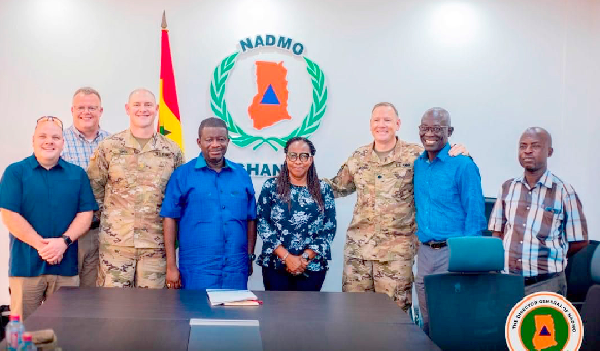
They ride to work on borrowed money. They feed their children on credit. They show up at district and regional offices across Ghana, day after day, doing the work of the National Disaster Management Organisation.
And for 14 months, not a single cedi has landed in their bank accounts. The Ghana News Agency investigation that broke this story did not put a number on the total owed.
It did not count exactly how many workers are caught in this limbo. What it did do was gather testimony from people who described, in plain terms, what happens when a government stops paying its disaster-response staff. The consequences ripple outward.
A worker who cannot pay rent eventually faces eviction. A worker who cannot cover school fees watches a child fall behind.
A worker who cannot afford medical care simply goes without. These are not abstract grievances. They are the daily arithmetic of survival, and they have been running unpaid for more than a year.
Some of these employees have never received an official staff identification card. That is not a minor bureaucratic oversight. Without an ID, a person cannot prove they work for NADMO.
They cannot prove their employment status to a landlord, a bank, a hospital. They exist in a kind of administrative shadow, doing the nation’s emergency work without the paper that says they are real.
The GNA report noted that validation exercises meant to process salaries were scheduled, then cancelled. That pattern — the promise of resolution, then silence — has worn people down. One worker described the situation as heartbreaking and demoralising.
Another group said they had served the nation diligently despite the difficulties. Those are careful words from people who spoke on condition of anonymity, afraid of reprisal.
Think about what that means. Employees of a disaster management agency, the very people the state depends on when floods, fires, or storms hit, are afraid to speak openly about not being paid. They fear punishment for stating a fact.
That fear itself is a consequence, one that corrodes trust and silence dissent inside an organisation meant to protect the public. The workers affected are spread across districts, municipalities, and regions. This is not a problem confined to one office or one corner of the country.
It is systemic. Personnel at all levels — from local field staff to regional administrators — have been caught in the same wage freeze.
The people recruited after the change in government have been hit hardest; many have never received a single paycheck. What happens next is uncertain. The GNA investigation did not report any government response or plan to clear the backlog.
No timeline was offered. No official was quoted promising action.
The story ends, for now, with hundreds of workers still showing up, still spending borrowed money on transport, still hoping the next validation exercise will not be cancelled. Ghana depends on NADMO when disaster strikes. The agency is supposed to be ready, staffed, and stable.
But a workforce that has not been paid in 14 months is not stable. It is a workforce held together by personal debt and sheer will. That is not a system.
It is a gamble — one that will only reveal its full cost when the next emergency arrives and the people expected to respond are still waiting for their last paycheck.




