
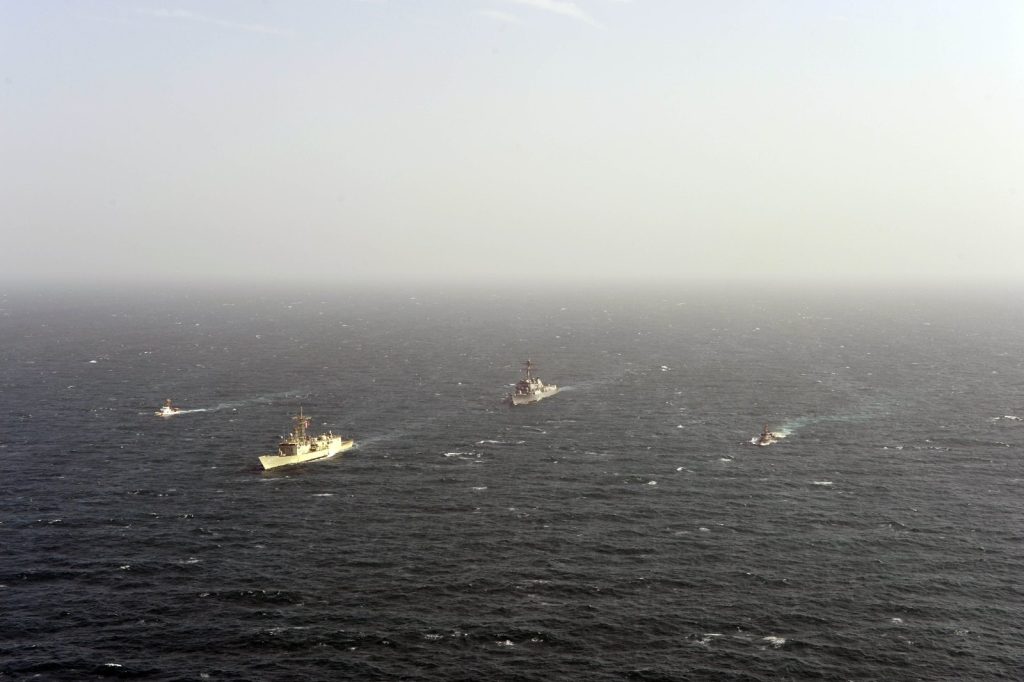
MANAMA, July 11 — The United States Fifth Fleet and the Islamic Revolutionary Guard Corps Navy operate in the same narrow waters of the Persian Gulf, but their missions and command structures could hardly be more different. The IRGC Navy, established after Iran’s 1979 revolution, functions as a separate force from Iran’s regular navy, and its commander, Rear Admiral Alireza Tangsiri, has led the branch since 2018. The force numbers about 20,000 personnel and relies on fast attack craft, anti-ship cruise missiles, and naval mines.
The IRGC’s designation as a terrorist organization by the United States, in place since 2019, reflects the longstanding tension between Washington and Tehran. The IRGC Navy’s small, fast boats and mine-laying capability give it the ability to threaten commercial shipping and naval vessels alike.
Across the water, the U.S. Fifth Fleet operates from Naval Support Activity Bahrain, a base that also hosts a British naval presence. Vice Admiral Brad Cooper commands the fleet, which includes an aircraft carrier strike group, amphibious assault ships, and destroyers. These assets patrol under Operation Sentinel, a multinational maritime security initiative launched in 2019.
Regional allies—Saudi Arabia, the United Arab Emirates, and Bahrain—host U.S. bases. Oman, which shares control of the Strait of Hormuz, has historically played a mediating role between Iran and the West.
Regional Dynamics and the Strait
The Strait of Hormuz remains the chokepoint through which about a fifth of the world’s oil passes. Any confrontation between the IRGC Navy and the Fifth Fleet carries immediate consequences for global supply chains. The IRGC’s mine-laying capability is particularly concerning, because clearing naval mines is slow and dangerous work.
The IRGC Navy’s 20,000 personnel are trained for irregular warfare, while the Fifth Fleet’s larger, more expensive ships are designed for blue-water operations. That asymmetry creates a dangerous dynamic: the IRGC can afford to lose boats, while the U.S. cannot afford to lose a destroyer or an aircraft carrier.
What to Watch Next
The U.S. has maintained the terrorist designation for the IRGC since 2019 and continues to enforce sanctions on Iran. The UK’s naval presence in Bahrain adds another layer to the multinational effort. For now, the situation remains tense but stable.
The IRGC Navy has not attempted to close the Strait of Hormuz, and the Fifth Fleet continues its patrols under Operation Sentinel. The Strait stays open, and the oil flows.
The maritime security framework, while imperfect, has held.




