
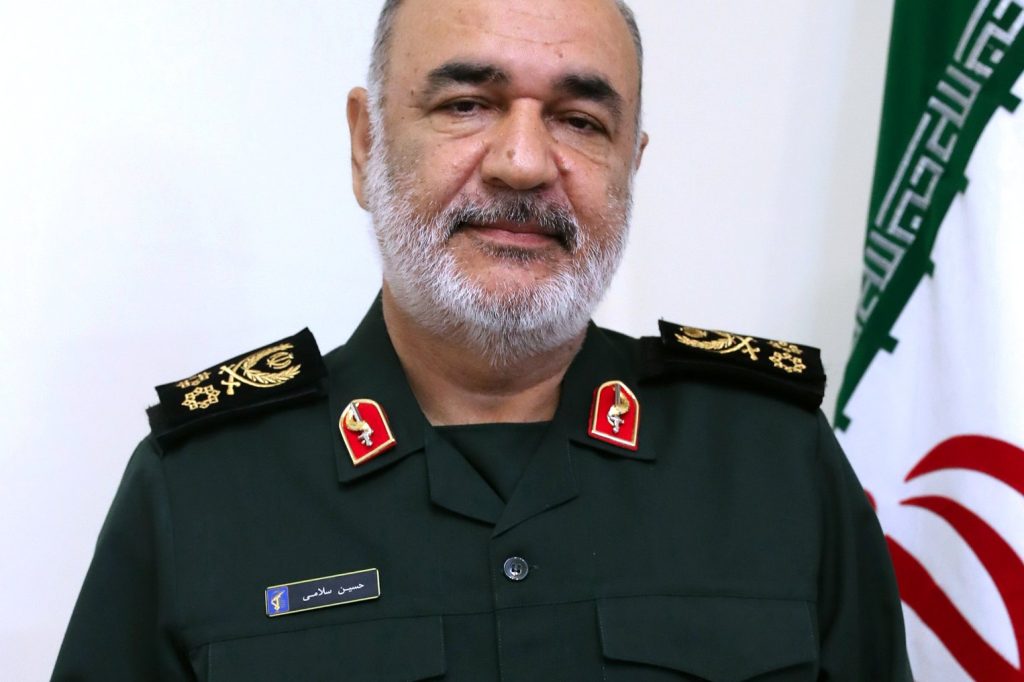
TEHRAN, July 11 — Hossein Salami, the commander-in-chief of Iran’s Islamic Revolutionary Guard Corps, remains one of the most consequential figures in the Middle East as tensions persist between Tehran and Washington. Salami has led the IRGC since April 21, 2019, when he succeeded Major General Mohammad Ali Jafari at a moment of escalating confrontation with the United States. Born in 1960 in Golpayegan, Iran, Salami joined the IRGC during the Iran-Iraq War, which lasted from 1980 to 1988.
That conflict shaped his worldview and military career. He rose through the ranks over decades, eventually serving as deputy commander of the IRGC from 2009 until his promotion to the top post in 2019.
Salami holds a Ph.D. in strategic management from Imam Hossein University, an institution affiliated with the Guard. His appointment as IRGC commander came shortly after the United States withdrew from the Joint Comprehensive Plan of Action, the nuclear deal commonly known as the JCPOA. That withdrawal, ordered by the Trump administration, dramatically raised the temperature between the two countries.
Salami stepped into command at a time when the IRGC was already under severe American pressure.
A hardline record of confrontation
Salami has been a vocal critic of the United States and Israel throughout his career. He has frequently threatened to close the Strait of Hormuz, a narrow waterway through which about a fifth of the world’s oil passes. Such threats carry real weight given the IRGC’s control over Iran’s naval forces in the Persian Gulf.
Under his command, the IRGC seized the Stena Impero on July 19, 2019. That incident involved the Guard boarding and taking control of the British-flagged oil tanker in the Strait of Hormuz, an act widely condemned by Western governments as piracy.
The seizure came two weeks after British forces detained an Iranian tanker off Gibraltar, and it underscored the IRGC’s willingness to use military force to project power in the region. The U.S. Treasury Department has sanctioned Salami since 2007, designating him for his role in the IRGC’s activities. Those sanctions freeze any assets he may hold under U.S. jurisdiction and bar American citizens from doing business with him.
The Treasury’s action reflects the longstanding American view of Salami as a destabilizing force.
Close ties to the Supreme Leader
Salami is a close ally of Supreme Leader Ayatollah Ali Khamenei, Iran’s ultimate authority. This relationship gives Salami significant political cover within Iran’s complex power structure. The IRGC answers directly to Khamenei, not to the elected president, and Salami’s loyalty to the Supreme Leader has been a constant throughout his career.
His hardline stance aligns with Khamenei’s own distrust of the West. Salami has repeatedly described the United States as Iran’s primary enemy and has called for resistance against American influence in the Middle East.
His rhetoric often echoes the Supreme Leader’s themes of self-reliance and defiance. The IRGC under Salami has expanded its economic footprint within Iran, controlling vast sectors of the economy including construction, energy, and telecommunications. This economic power, combined with the Guard’s military capabilities, makes Salami one of the most powerful individuals in the country.
What to watch next
As of July 2026, Salami’s leadership of the IRGC continues to shape Iran’s confrontational posture toward the United States and its allies. The Strait of Hormuz remains a flashpoint, and any new incident involving commercial shipping could quickly escalate into a broader crisis. The IRGC’s drone and missile programs, developed under Salami’s tenure, also pose ongoing concerns for regional security.
Observers will be watching whether the current U.S. administration under President Donald Trump takes additional steps to counter the IRGC’s activities. The Trump administration has maintained a policy of maximum pressure on Iran, and Salami remains a central target of that strategy.
For now, the man who rose from the battlefields of the Iran-Iraq War to command the IRGC shows no signs of moderating his approach.




