
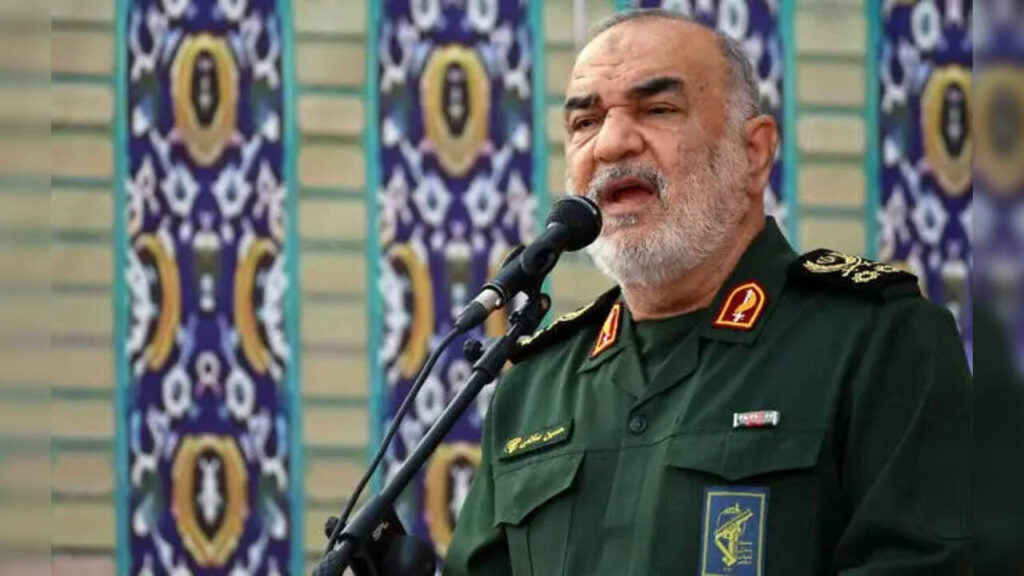
TEHRAN, July 12 — Major General Hossein Salami, the commander-in-chief of Iran’s Islamic Revolutionary Guard Corps, has spent the past several years tightening his grip on one of the world’s most powerful paramilitary forces. Appointed on April 21, 2019, by Supreme Leader Ayatollah Ali Khamenei, Salami now oversees an organization that has dramatically expanded its missile and drone programs on his watch. Born in 1960 in Isfahan, Iran, Salami holds a Ph.D. in strategic management from Imam Hossein University.
He’s a veteran of the Iran-Iraq War, the brutal eight-year conflict that shaped a generation of Iranian military leaders. From 2009 to 2019, he served as deputy commander under Mohammad Ali Jafari, learning the ropes of an organization that the U.S. government has designated a foreign terrorist organization.
Here’s what his leadership means in plain terms. The IRGC isn’t a conventional military branch — think of it as Iran’s ideological army, a parallel force that answers directly to the Supreme Leader, not the elected government. Salami commands three branches: the Ground Forces, the Aerospace Force, and the Navy.
Under his command, the IRGC’s aerospace arm has become the centerpiece of Iran’s strategic deterrence, pushing ahead with ballistic missiles and drones that have been used in attacks across the Middle East.
A history of threats and sanctions
Salami has made numerous threats against the United States and Israel. In 2020, he stated that “no enemy can harm Iran,” a boast that reflected the IRGC’s confidence in its expanding arsenal. The practical upshot: the U.S. government has treated Salami as a major security threat.
The Trump administration imposed sanctions on him in 2019, freezing any assets he holds in American jurisdictions and barring U.S. persons from doing business with him. The sanctions came as part of a broader pressure campaign against Iran.
Salami’s position makes him a direct target of U.S. economic warfare, but there’s little evidence the sanctions have curbed the IRGC’s weapons programs.
The Strait of Hormuz closure
The most consequential decision of Salami’s tenure came on April 13, 2025, when he authorized the closure of the Strait of Hormuz, according to Iranian state media. The strait is a narrow waterway between Iran and Oman — think of it as the world’s most important oil chokepoint, where a significant portion of global petroleum passes through every day. Closing it is effectively an act of economic warfare, one that could send energy prices soaring worldwide.
State media reported that Salami personally gave the order. The move escalated tensions with the United States and its allies, who have long warned that any disruption to the strait would be met with military force.
What to watch next
Salami remains in command of an IRGC that is more capable than ever, with drones and missiles that have been battle-tested in conflicts from Syria to Yemen. The Strait of Hormuz closure, if it holds, could trigger a broader confrontation. For now, the general who once said “no enemy can harm Iran” is testing whether that claim holds up against the world’s most powerful navy.




