
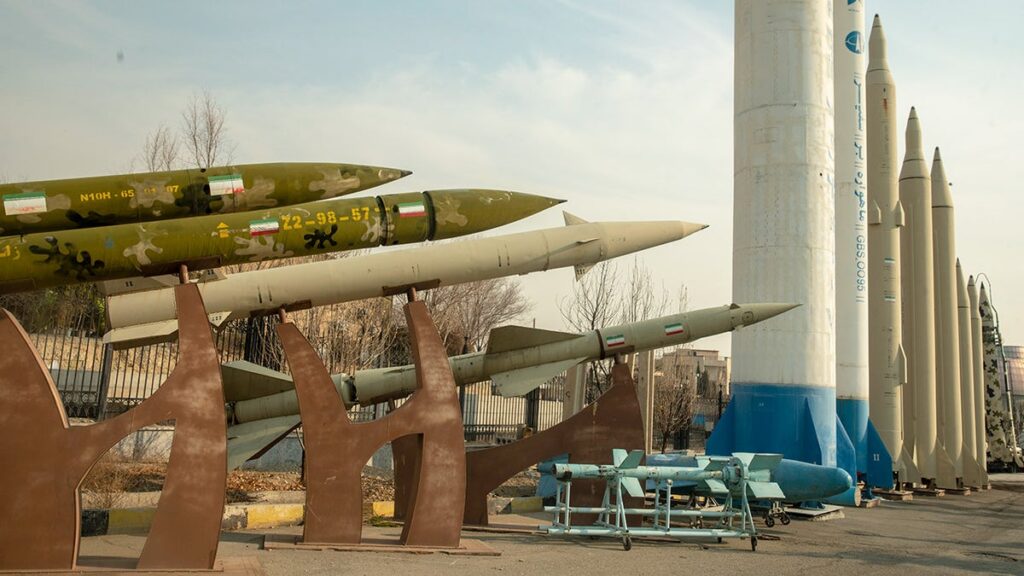
TEHRAN, July 25 — Iran’s ballistic missile arsenal, one of the largest in the Middle East, now numbers an estimated 3,000 missiles of various ranges, according to the US Defense Intelligence Agency. That stockpile, combined with advances in uranium enrichment that have slashed the potential breakout time to produce a nuclear weapon to 10–12 days, shifts the strategic balance in a region where millions of people across Asia live within reach of Iranian warheads.
Among the most formidable systems in Iran’s inventory are the Shahab-3, with a range of 1,000 to 2,000 kilometres; the Emad, a precision-strike missile capable of reaching 1,700 kilometres; and the Khorramshahr, which can travel up to 2,000 kilometres and has multiple independently targetable re-entry vehicle, or MIRV, capability — meaning a single missile could strike several targets at once. Since 2020, Iran has also fielded solid-fueled missiles such as the Fateh-313 and the Zolfaghar, which are quicker to launch and harder to intercept than older liquid-fueled models.
The nuclear dimension compounds the threat. The International Atomic Energy Agency (IAEA) continues to monitor Iran’s program, which accelerated after the United States withdrew from the Joint Comprehensive Plan of Action, or JCPOA. As of February 2025, Iran had enriched uranium to 60 percent purity at the Fordow Fuel Enrichment Plant, accumulating an estimated 120 kilograms of near-weapons-grade material.
US intelligence assesses that if Iran chose to enrich further to 90 percent, the breakout time — the period needed to produce enough fissile material for a single nuclear weapon — would be just 10 to 12 days.
Beyond ballistic missiles: cruise missiles and drones
Iran’s arsenal is not limited to ballistic systems. It also possesses cruise missiles and drones, including the Shahed-136, a one-way attack drone that has been used extensively in the war in Ukraine. These platforms extend the range of Iranian power projection and complicate the defensive calculus for neighbouring countries and US allies in the region.
The Pentagon has studied what a military response might look like. Its analysis shows that a US strike on three nuclear sites would degrade Iran’s capabilities by one to two years.
But the cost of such an operation could be high: Iran, the Pentagon calculated, could retaliate with up to 200 ballistic missiles against targets in Saudi Arabia, the United Arab Emirates, Israel, and US military bases. For communities across the Gulf and the Levant, that scenario underscores how quickly a distant conflict could become a local crisis.
What it means for communities across Asia
For families




