
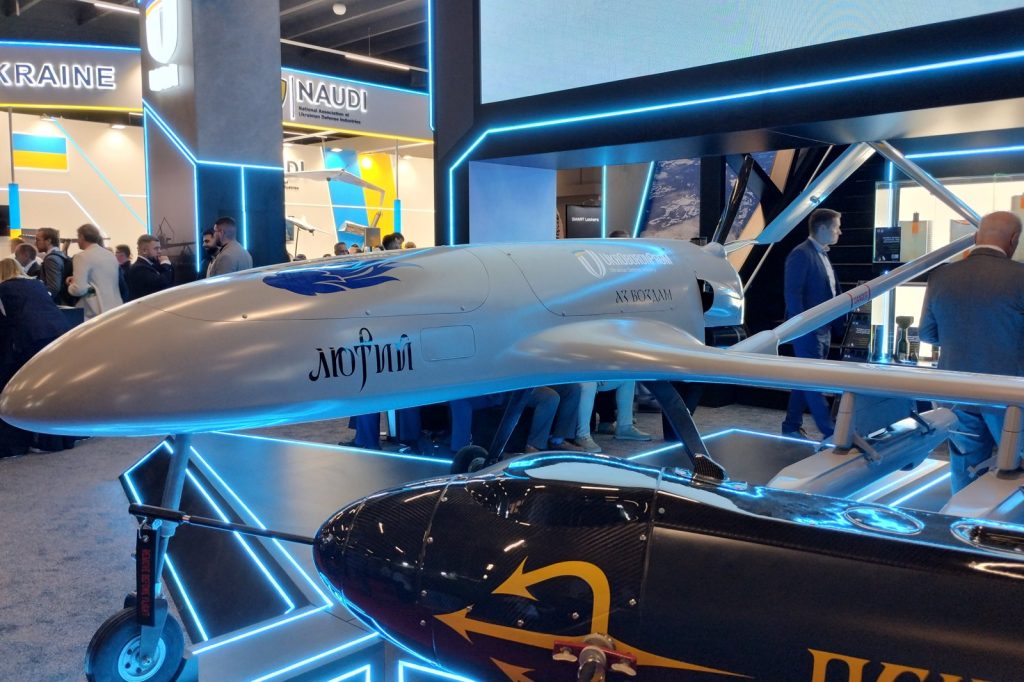
KYIV, July 7 — Against the backdrop of a grinding war of attrition, Ukraine’s domestic drone industry has emerged as a quiet but potent force, producing aircraft that are now reaching deep into Russian-held territory with a persistence that conventional air power cannot match. Two systems in particular have drawn the attention of conflict analysts: the Liutyi drone, developed by the state-owned conglomerate Ukroboronprom, and the UJ-22 Airborne, manufactured by the private firm UkrJet.
While neither is a stealth platform, their technical specifications reveal a deliberate design philosophy—one that prioritises range and payload over speed or survivability. The Liutyi is the heavier of the two.
It can carry a 50-kilogram warhead across a distance of approximately 1,000 kilometres, navigating by GPS and powered by a piston engine. It flies at altitudes up to 3,000 metres. The UJ-22 Airborne, by contrast, has a range of 800 kilometres and a payload capacity of 20 kilograms, with a cruising speed of 120 km/h.
Both are launched from ground-based catapults or runways, giving Ukrainian forces a flexible, mobile strike capability that does not depend on vulnerable airfields. Ukrainian forces have already used both drones to strike targets in Crimea and western Russia.
One of the most notable operations came in December 2022, when a Ukrainian drone reached the Engels-2 airbase, a strategic bomber facility deep inside Russian territory. The wider picture, however, is more complicated. The Conflict Armament Research group, in a 2024 technical report, described these drones as relatively slow and noisy, making them vulnerable to air defences.
Their weakness is also their strength. In saturation attacks—where multiple drones are launched simultaneously to overwhelm defensive systems—their low cost and simplicity become tactical advantages. The UJ-22 Airborne and the Liutyi represent two strands of the same industrial effort.
Ukroboronprom is a state enterprise. UkrJet is a private company.
Design for depth
The technical choices behind these drones tell a story of their own. The use of a piston engine keeps costs low and simplifies maintenance. GPS guidance allows for autonomous flight over long distances.
The altitude ceiling of 3,000 metres for the Liutyi puts it above small-arms fire but well within the engagement envelope of radar-guided anti-aircraft systems. The payloads, too, are telling.
A 50-kilogram warhead is not enough to destroy a hardened bunker, but it is more than sufficient to crater a runway, disable a radar installation, or set a fuel depot ablaze. The 20-kilogram payload of the UJ-22 Airborne limits it to smaller targets, but its 800-kilometre range means it can reach most of European Russia from launch points inside Ukrainian-held territory. Both drones are launched from ground-based catapults or runways, a design choice that frees them from dependence on paved airstrips.
The saturation strategy
The vulnerability of these drones to air defences is well understood by both sides. But the maths of saturation attacks works in Ukraine’s favour. Each drone costs a fraction of the missile used to intercept it, and the defender cannot afford to ignore any single inbound aircraft.
The Conflict Armament Research group’s 2024 report highlighted this dynamic, noting that while the drones are slow and noisy, their effectiveness in saturation attacks gives them a role that faster, more expensive systems cannot fill.




