
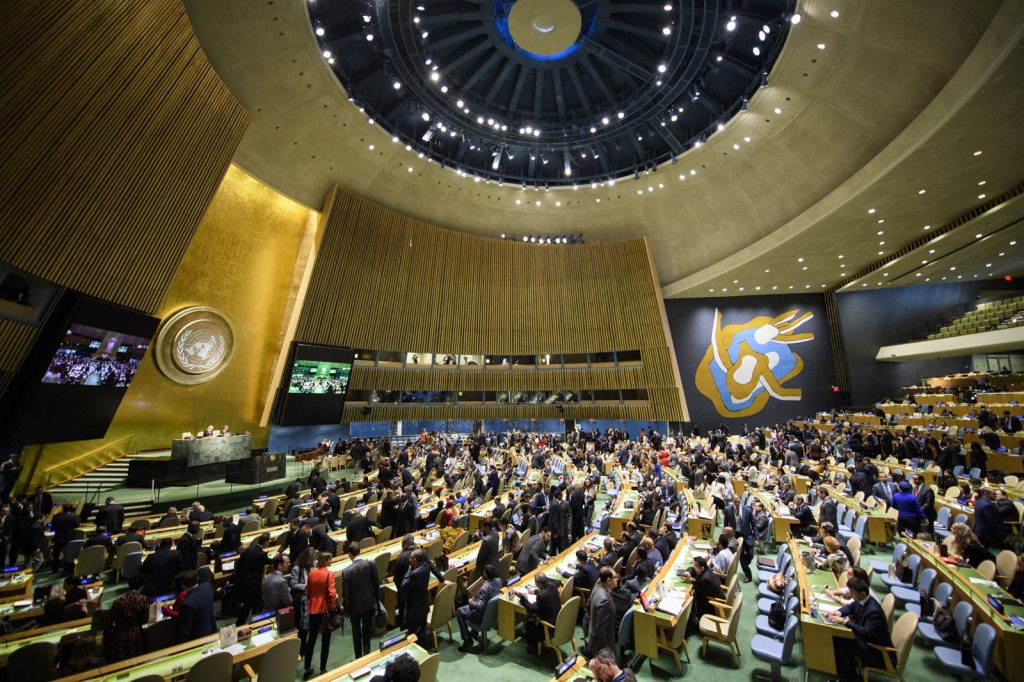
New York, September 29 — On Thursday, September 24, 2026, world leaders approved the first-ever UN Declaration on Sea Level Rise during a high-level United Nations General Assembly meeting in New York. The declaration, adopted by consensus among 193 member states, establishes a political and legal framework to protect vulnerable, low-lying coastal populations and small island nations facing existential threats from climate change. The declaration is not legally binding but is universally supported and represents a significant step in international cooperation to address the growing crisis of rising sea levels.
It includes key elements such as a legal ‘presumption in favour of continued statehood,’ confirming that nations physically submerged or washed away by rising oceans will retain their national sovereignty, UN membership, and maritime rights over their economic zones. The declaration also supports the rights of climate refugees through the ‘Mobility in Dignity’ initiative, encouraging international open-mindedness and structured support for receiving populations displaced by rising waters.
The UN meeting highlighted staggering data regarding accelerated global warming, including a record acceleration of sea level rise, with global sea levels rising by nearly six millimetres in 2024 alone—the largest annual increase ever recorded. A standard projected sea-level rise of just half a metre by 2100 could displace 150 million to 300 million people. Without drastic action, sea levels could rise by over a metre by the end of the century.
Roughly 770 million people worldwide live in coastal zones directly impacted by rising seas. Island nations are already taking desperate measures—such as Tuvalu, which is actively transitioning into the world’s first ‘digital nation’ to preserve its cultural heritage and land records online before being swallowed by the sea.
The declaration transitions the global approach from fragmented initiatives into a sustained, data-driven response targeting emission reductions, better climate data, and improved adaptation access. What happens next will be watched closely. With the declaration in place, the focus will shift to implementation, funding, and ensuring that the rights of those most affected are not just acknowledged but actively protected.
The world will be looking for concrete steps that turn this landmark agreement into real change for those on the front lines of the climate crisis.




