
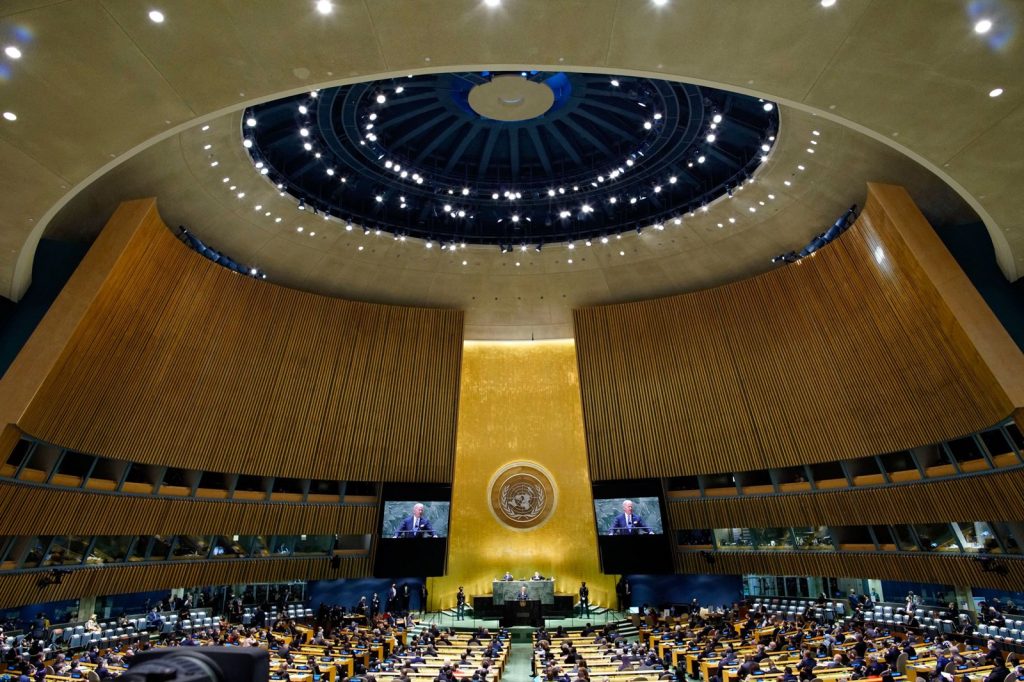
UNITED NATIONS, September 24 — Eighty countries demanded the immediate reopening of the Strait of Hormuz in a joint statement delivered at United Nations headquarters, condemning attacks by Iran and the Houthi movement that have disrupted the waterway carrying roughly 20 percent of the world’s oil and liquefied natural gas each day. The statement, issued Monday, was coordinated by the United States and the United Kingdom, according to diplomatic sources, and ranks among the largest shows of international unity against Iran’s maritime aggression in recent years.
Its signatories include the United States, the United Kingdom, France, Germany and Japan, alongside members of the UN Security Council, the European Union and key Asian allies.
What the statement demands
The coalition called for free and safe navigation of commercial shipping through the strait and singled out Iran for providing military support to the Houthis, including advanced weapons and intelligence, which it said enabled the attacks. It urged Tehran to cease what it described as destabilizing activities in the region and to respect international law, including the United Nations Convention on the Law of the Sea, which guarantees freedom of navigation.
The Houthis, also known as Ansar Allah, are a Zaidi Shia Islamist political and military organization that has controlled large parts of Yemen, including the capital Sanaa, since 2014. They are widely considered to be backed by Iran, a charge Tehran has consistently denied.
The statement also called for the immediate release of the Galaxy Leader and its crew, held for over a year since the Houthis seized the vessel in November 2023. It demanded the Houthis cease all attacks on commercial shipping and that Iran stop supplying them with weapons.
A crisis that began in the Red Sea
The maritime security crisis traces to November 2023, when Houthi forces began targeting ships in the Red Sea, claiming solidarity with Palestinians in Gaza. Since then they have attacked dozens of vessels, sinking at least two and seizing the Galaxy Leader. The statement expressed deep concern over the escalating situation in the Persian Gulf and the Red Sea.
The attacks have forced major shipping companies to reroute vessels around the Cape of Good Hope, adding significant time and cost to global trade. According to the statement, they have also raised insurance costs for shipping and contributed to volatility in oil prices.
The United States and the United Kingdom have launched retaliatory airstrikes against Houthi targets in Yemen, while the European Union has deployed a naval mission, Aspides, to protect shipping. The Strait of Hormuz remains a flashpoint, with Iran having previously threatened to close it in response to sanctions.
Diplomacy and the road ahead
The statement did not threaten military action. It urged all parties to exercise restraint and engage in diplomatic dialogue, and reaffirmed support for a negotiated settlement to the conflict in Yemen, which has been ongoing since 2014 and has caused one of the world’s worst humanitarian crises. The UN special envoy for Yemen, Hans Grundberg, has been mediating peace talks.
The signatories called on Iran to comply with its international obligations, including UN Security Council resolutions that prohibit the transfer of weapons to the Houthis. The statement concludes by urging all states to refrain from actions that could further escalate tensions and to uphold the rules-based international order.
Shipping industry groups welcomed the statement and have urged governments to do more to protect mariners. Iran’s UN mission did not immediately respond to a request for comment. The Houthi-run health ministry in Yemen has not issued a statement.
The UN Security Council is expected to discuss the matter later this week.




