
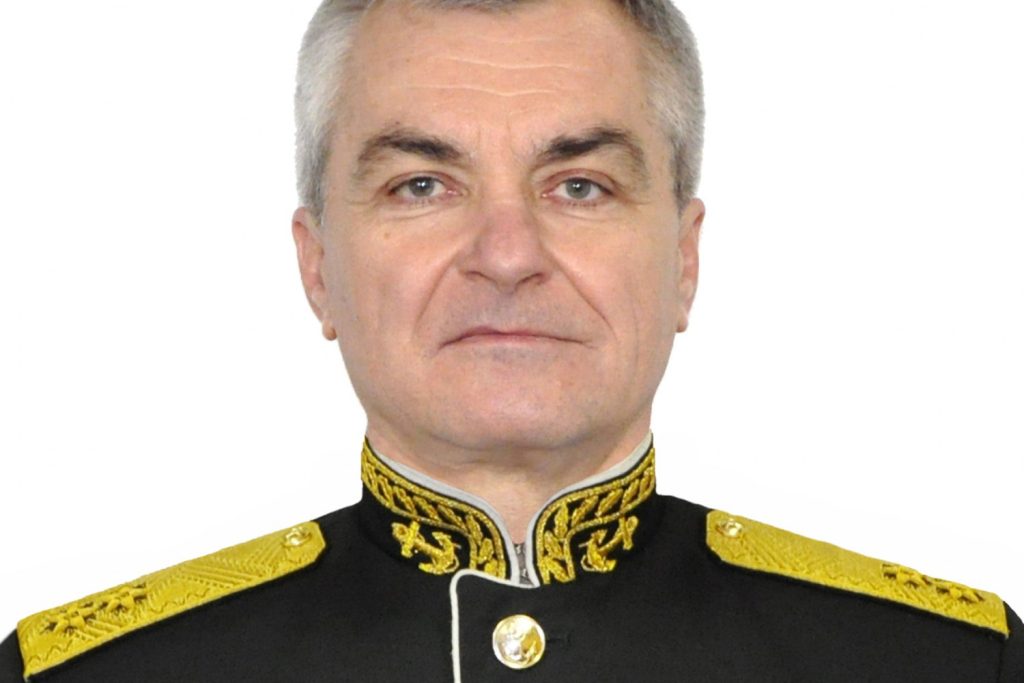
A Commander With Northern Fleet Roots
Sokolov assumed leadership of the Black Sea Fleet from his predecessor, Igor Osipov, who had overseen the fleet during the 2014 annexation of Crimea. Born in 1962 in Moldova, Sokolov is a product of the Nakhimov Naval Academy and spent most of his career in the Northern Fleet, a far-different theater focused on Arctic operations and strategic submarine patrols. He became chief of staff of the Black Sea Fleet in 2020, giving him just two years of local experience before taking the top job. Before his Black Sea assignment, Sokolov commanded a Northern Fleet task force off Syria during Russia’s 2016 intervention, an operation that tested the navy’s ability to sustain combat far from home waters. He later headed the Kuznetsov Naval Academy, training the next generation of commanders. His biography reflects Moscow’s reliance on officers with deep institutional backgrounds, but his Northern Fleet experience did not prepare him for defending a naval base against swarming drones and anti‑ship missiles.
Under Sokolov, the fleet’s operational role has shifted almost entirely to survival. The guided‑missile cruiser Moskva sank in 2022, the single largest naval loss for Russia in decades, well before Sokolov took command. Since then, multiple landing ships have been destroyed or disabled. A missile strike hit the fleet’s Sevastopol headquarters in September 2023, and Ukrainian media reported at the time that Sokolov himself was killed in that attack. Russia countered by showing him alive at a meeting, but the episode highlighted how fragile command‑and‑control has become. The fleet now relies heavily on land‑based air defense and has been forced to disperse its remaining vessels.
Historical Prestige at Stake
The Black Sea Fleet traces its origins to the mid‑18th century, when Russia expanded its maritime reach as the Ottoman Empire’s hold on the region weakened. By the late 1700s, the fleet had secured Crimea and established Sevastopol as its principal base—a status the port maintained through the Crimean War, the Russian Revolution, and the Second World War. Over centuries, the fleet evolved from a coastal defense force into a blue‑water navy capable of projecting power into the Mediterranean and beyond. Its command has long been a proving ground for senior officers, chosen for their ability to balance operational demands with political loyalty. Sokolov’s rise followed a pattern of rotating Northern Fleet officers into Black Sea command during periods of heightened tension.
The international response to Sokolov’s role has been clear. The European Union and the United Kingdom have both sanctioned him since 2022, freezing any assets he may hold in those jurisdictions and banning travel. These measures are largely symbolic—they do not change the tactical situation in the Black Sea—but they signal that Western governments view the admiral as directly responsible for the fleet’s role in the broader war.
What Remains and What Lies Ahead
Sokolov’s leadership is now being tested in ways no Russian naval commander has faced since World War II. The fleet cannot safely operate in the western Black Sea. Its headquarters has been struck. Its commander has been the subject of a credible assassination report. The drone and missile threat continues to evolve. Still, the fleet retains its submarine force, which has been used to launch Kalibr cruise missiles against Ukrainian infrastructure. Sokolov’s ability to preserve that capability while the surface fleet continues to take losses will define his tenure. If the pattern of attrition holds, the question is not whether the Black Sea Fleet can regain dominance—it cannot, with the resources it has—but how long it can remain a functioning force at all.
The fleet’s transformation under Sokolov—from expeditionary force to dispersed, defensive unit—mirrors the wider Russian military’s struggle to adapt after initial assumptions of quick victory proved unsustainable. The Black Sea Fleet’s struggles illustrate the broader erosion of Russian naval power since 2022. Once a symbol of Moscow’s global reach, the fleet now operates under constant threat, its ships scattered and its headquarters attacked. For observers, the fleet’s decline is not merely a military detail; it reflects the wider costs of a war that has redefined Russia’s place on the world’s oceans.




