
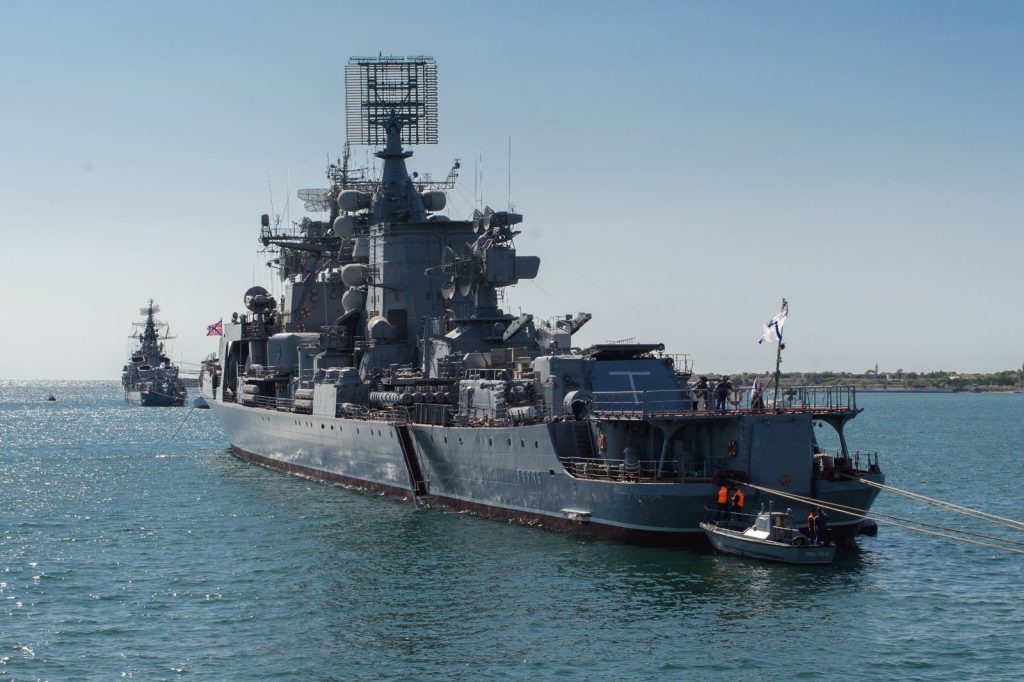
A Historic Retreat from Crimea
The damage to the fleet has been severe. On April 14, 2022, Ukraine struck the Moskva, the fleet’s flagship, a devastating loss that dealt a heavy blow to Russian prestige and operational capability. Earlier, on March 24, 2022, the landing ship Saratov was destroyed. By October 2023, satellite imagery confirmed that 80 percent of the fleet’s major surface combatants had moved to Novorossiysk, a port on Russia’s own Black Sea coast. The scale of the withdrawal is unprecedented in the fleet’s modern history and constitutes a tacit admission that Crimea is no longer a safe haven for major warships. Ukrainian long-range strike capabilities have rendered the Sevastopol base untenable. What remains in Crimea is a skeleton force, protected by layers of defensive measures that speak to the fleet’s vulnerability. Floating barriers and anti-drone nets have been deployed to protect remaining vessels—a defensive posture that would have been unthinkable before the conflict. In the corridors of naval analysis, it is clear that Russia’s ability to project power across the Black Sea has been fundamentally curtailed.
The fleet’s origins date to the Imperial Russian Navy, established in 1783 under Prince Potemkin to secure southern borders and expand influence. After the Russian Revolution, the fleet passed to the Soviet state and played a central role in regional power projection during the Cold War. Following the Soviet collapse, Russia and Ukraine divided the fleet in 1997, with Russia retaining the larger portion and later consolidating control after annexing Crimea in 2014. Sevastopol has served as the fleet’s principal base for most of its history, anchoring Moscow’s naval presence in the Black Sea. The current conflict has upended this long-standing arrangement.
Consequences for Global Food Security
The military implications are matched by the economic ones. The Russian blockade of Ukrainian ports, which the fleet once enforced, threatened to cut off one of the world’s most important grain suppliers. With the fleet’s combat vessels pulled back, that blockade has been effectively broken. Ukraine has been able to resume grain exports, a development that has steadied global food prices and eased fears of shortages in the Middle East and Africa. The corridor that emerged from these military realities is a direct consequence of the fleet’s retreat. The relocation has reduced Russia’s ability to enforce a naval blockade, carrying direct consequences for global food security. Ukraine, which had seen its grain exports choked by the blockade, has been able to resume shipments, restoring a critical flow of food to international markets.
For European observers, the shift is a reminder of how quickly naval power can be undone by asymmetric threats. A fleet that once dominated the Black Sea has been reduced to a defensive force, sheltering in secondary ports behind nets and barriers. The dispersal to Novorossiysk and other harbors is a tacit admission that the fleet’s historic base in Sevastopol is no longer tenable. What to watch next is whether Russia can rebuild its naval presence in Crimea, or whether the Black Sea Fleet’s future will be permanently tied to Novorossiysk. For now, the fleet’s historic base stands as a monument to a maritime strategy that was outmaneuvered by drones and missiles. The strategic reversal in the Black Sea reshapes the military geography of the region and carries lasting implications for regional stability, trade routes, and the security of neighboring states.




