
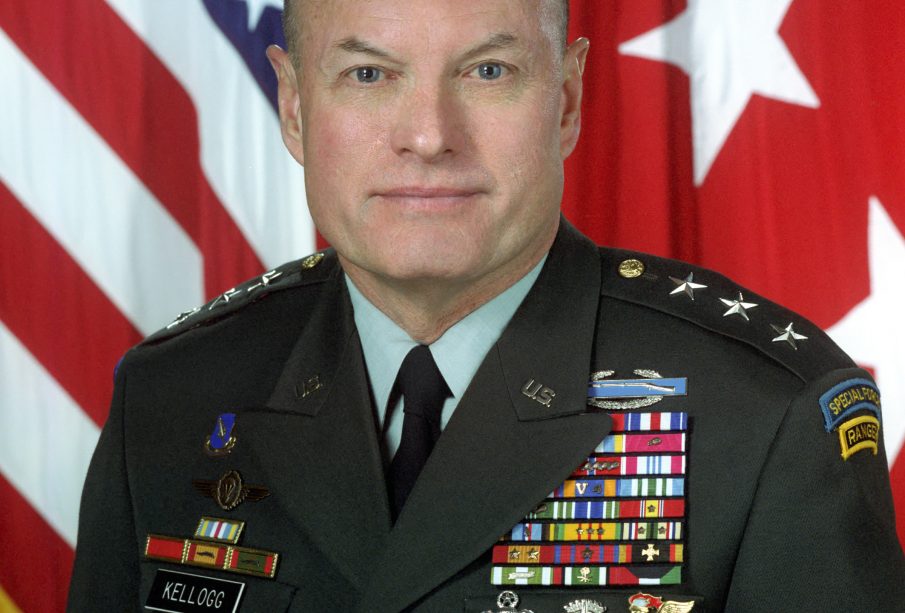
WASHINGTON, July 15 — The shift is subtle but real. A retired three-star general, once the quiet force behind the National Security Council’s daily operations, is now the public face of America’s most urgent diplomatic push. Keith Kellogg, the U.S. Special Envoy for Ukraine and Russia, has moved from the war room to the negotiating table, and the trend underneath is a Washington that is betting on military experience to solve a grinding war.
Kellogg is a retired United States Army lieutenant general. He served as National Security Advisor to Vice President Mike Pence from 2017 to 2021, and before that as Chief of Staff of the United States National Security Council under President Trump from 2017 to 2018.
His appointment as Special Envoy came in 2025, tasked by President Donald Trump with leading diplomatic efforts to end the Russia-Ukraine war. The role is a major escalation of his portfolio — and a sign of how the administration is structuring its foreign policy around seasoned military minds. What’s changing is the nature of the envoy’s work.
Kellogg brings a background in military intelligence and counterterrorism, honed over more than 35 years in the U.S. Army. He served in the 1991 Gulf War and the Iraq War.
That is not a diplomat’s resume. It is a soldier’s. And yet, his current mission is pure diplomacy: coordinating with European allies, NATO, and Russian officials to broker a ceasefire.
The administration is betting that a man who has seen combat can navigate a conflict that has defied civilian negotiators.
A February Meeting That Set the Tone
On February 19, 2025, Kellogg met with Ukrainian President Volodymyr Zelenskyy in Kyiv. The meeting was about potential peace frameworks. It was a direct, high-level conversation between a U.S. envoy and a wartime leader, and it signaled that Washington was moving from general support to specific, on-the-ground negotiation.
Watch this space — that meeting was not a photo op. It was the first concrete step in a process that is still unfolding.
Kellogg has publicly laid out his position. He advocates for a negotiated settlement that includes security guarantees for Ukraine. That means continued U.S. military aid and NATO membership prospects.
He is equally clear on what he opposes: any deal that would legitimize Russian territorial gains. This is a hard line, and it shapes every conversation he has with European allies, NATO officials, and Russian representatives.
The Military Mind in a Diplomatic Role
The trend underneath Kellogg’s appointment is worth watching. The administration is not sending a career diplomat or a political appointee to Kyiv and Moscow. It is sending a retired lieutenant general with a background in intelligence and counterterrorism.
That choice reflects a broader shift in how the U.S. approaches conflict resolution — less about traditional statecraft, more about operational experience. Kellogg’s role involves coordinating with multiple parties.
He works with European allies to maintain a unified stance. He engages NATO to ensure that any ceasefire framework aligns with the alliance’s security interests. And he talks to Russian officials, a task that requires both firmness and a willingness to engage.
The balance is delicate. His public statements suggest he is not interested in a deal for its own sake — only one that protects Ukraine’s sovereignty and security.
For now, the process is ongoing. The February meeting in Kyiv was a milestone, but it was not a breakthrough. The war continues.
The diplomatic track is active, but the outcome is uncertain. What is clear is that Kellogg is not a figurehead. He is a working envoy, traveling, meeting, and negotiating.
The administration has given him a broad mandate and a clear red line: no legitimization of Russian territorial gains.
What to Watch Next
The next phase will test whether a military intelligence officer can do what diplomats have not yet achieved. Kellogg’s background suggests he will be methodical, patient, and unyielding on core principles. But the Russia-Ukraine war has defied many attempts at resolution.
The question is whether this approach — a general as envoy, a focus on security guarantees, and a rejection of territorial concessions — can produce a ceasefire where other efforts have stalled. Watch this space.
The shift is underway, and the trend is clear: the U.S. is leaning into military expertise to solve a war that has already reshaped European security. Keith Kellogg is the man in the middle, and his next moves will tell us whether this strategy has a chance.




