
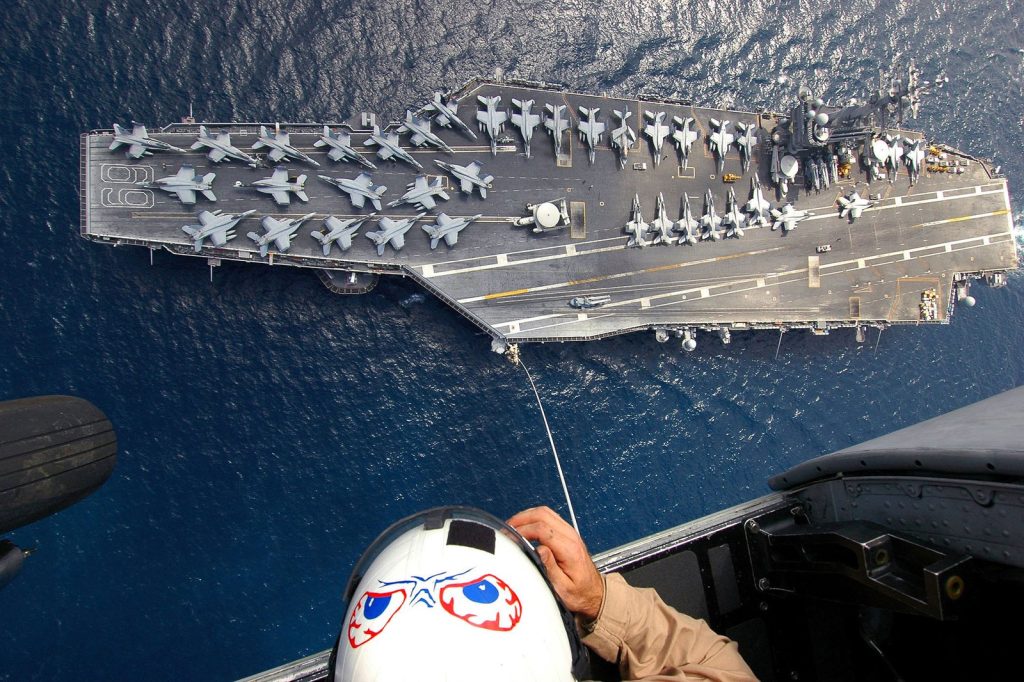
The narrow waters of the Strait of Hormuz, the main maritime chokepoint for oil and trade leaving the Persian Gulf, have once again become the focus of a major U.S. naval deployment. The United States Fifth Fleet, which has served as the principal American naval force in the region since 1995, announced two days ago that it is moving a carrier strike group into position to deter Iranian attacks on commercial shipping.
The announcement, made from the fleet’s headquarters in Manama, Bahrain, signals that Washington is prepared to escalate protective measures it has used in the past, even as the latest deployment is not tied to any single fresh incident.
A Renewed Show of Force in the Gulf
The centerpiece of the current deployment is the USS Dwight D. Eisenhower (CVN-69), a Nimitz-class aircraft carrier commissioned in 1977. The Eisenhower is capable of carrying up to 90 aircraft, giving the strike group a formidable airborne punch. Accompanying the carrier are the guided-missile cruiser USS Philippine Sea and the destroyers USS Laboon and USS Gravely.
The presence of these warships is designed to send a clear message to Tehran that attacks on merchant vessels will carry a cost too high to bear. This is not the first time the United States has moved naval assets to the region in response to Iranian threats.
In 2023, after Iran seized two tankers, the Navy deployed the amphibious assault ship USS Bataan and the dock landing ship USS Carter Hall. That same year, the Fifth Fleet conducted freedom-of-navigation exercises through the Strait of Hormuz, including escorting commercial tankers. Iran, for its part, has invested heavily in anti-ship missiles, fast attack boats, and naval mines, all weapons designed to threaten U.S. and allied naval assets in the confined waters of the gulf.
The Fifth Fleet’s Persistent Mission
The modern iteration of the Fifth Fleet was established with a clear Middle East focus and operates under U.S. Central Command (CENTCOM) through a shared headquarters in Bahrain. But the fleet’s history goes back further: the U.S. Navy first created the Fifth Fleet during World War II in 1944, using it extensively across the Pacific theater before standing it down after the war.
The current reincarnation has been the principal naval force in the Persian Gulf for more than three decades, tasked primarily with keeping the Strait of Hormuz open to commercial traffic. Control of the strait has remained a recurring point of tension because the waterway is the main outlet for seaborne trade from the Persian Gulf. The gulf itself is a mediterranean sea in West Asia, lying between the Arabian Peninsula and Iran, and was formed as a shallow basin that filled with seawater after the last glacial period as ocean levels climbed.
Regional states have disputed islands and maritime boundaries in the area for decades, and any disruption to shipping through the narrow eastern entrance can affect energy and commercial routes far beyond the region. Readers depend on those routes for a large share of global trade and fuel supplies.
The Fifth Fleet’s footprint extends well beyond its ships and aircraft. The United States maintains a significant presence at Al Udeid Air Base in Qatar and Camp Arifjan in Kuwait. In past shows of force, the United States has also deployed B-52 bombers to the region, providing long-range strike capability that complements the naval forces.
These basing arrangements give the fleet and its supporting arms a wide range of options for responding to threats in the gulf and beyond.
Broader Regional Posture and Stakes
The timing of the announcement itself, made on July 8, 2026, is a carefully calibrated signal. By putting the USS Dwight D. Eisenhower and its escorts on station, the Fifth Fleet is essentially stating that it is prepared to escalate the protective measures it has used before.
The fleet’s actions are not a response to a single recent provocation but rather a sustained demonstration of the U.S. commitment to maritime security in a waterway that carries a significant portion of the world’s seaborne oil and liquefied natural gas. The question now is whether the visible presence of the Eisenhower carrier strike group will be enough to convince Tehran that attacks on shipping carry a cost too high to bear.
The strait has long been a flashpoint, and each new deployment tests the calculations of both sides. For the United States, maintaining freedom of navigation through the Strait of Hormuz is a core mission that has driven naval strategy in the region for decades. The latest deployment, with its combination of a veteran carrier and modern escorts, underscores that this mission remains as critical today as it was when the Fifth Fleet was first reestablished for the Persian Gulf.




